What Is Lateral Thinking? 8 Techniques to Think Creatively
Introduction
When solving a problem, we tend to fall back on tried-and-tested methods, even when they stop giving us results. We keep adjusting the same ideas, hoping something will work. Our past experiences and cognitive biases can make certain approaches feel like the only logical options, leaving us stuck in a cycle of repetitive thinking.
Lateral thinking helps us move away from repeatedly trying the same problem-solving approaches. It's a creative problem-solving method that encourages us to question assumptions, explore unexpected connections, and find alternative solutions by looking at problems from different perspectives.
For designers, educators, business professionals, and innovators, learning to think laterally can open up new ways to approach challenges. It also helps teams make brainstorming sessions more productive by encouraging fresh ideas when discussions start becoming predictable.
In this guide, we'll explore how lateral thinking works, how it differs from vertical thinking, and how to apply its techniques to approach challenges more creatively.
What is lateral thinking and why is it important?
Lateral thinking is a creative problem-solving approach that helps us explore problems from unconventional perspectives rather than following familiar logical patterns. It encourages us to challenge assumptions, break habitual thinking patterns, and discover alternative solutions that conventional approaches might overlook.
Edward de Bono introduced the concept in his 1967 book The Use of Lateral Thinking. Unlike random guessing, lateral thinking uses deliberate methods to create unexpected connections and explore possibilities we might otherwise dismiss. It shares ideas with out-of-the-box thinking and divergent thinking, particularly the practice of generating multiple solutions before evaluating them.
Why is lateral thinking important?
Lateral thinking becomes especially valuable when familiar methods produce limited results or teams keep returning to similar ideas. The World Economic Forum's Future of Jobs Report 2025 ranked creative thinking as the fourth most important core workplace skill, showing the value employers place on exploring new approaches alongside analytical reasoning.
Its benefits include:
- Breaks habitual thinking patterns: Helps us recognize when we're repeating familiar approaches and consider directions we haven't explored.
- Encourages creative problem-solving: Expands our options when a challenge doesn't have an obvious solution.
- Challenges assumptions and cognitive biases: Encourages us to question the beliefs and mental shortcuts influencing our decisions.
- Promotes innovation: Helps us rethink how products work or discover entirely different ways to deliver value.
- Encourages different perspectives: Reveals possibilities by examining a problem through someone else's needs or experiences.
- Improves collaboration and idea generation: Encourages team members to share unconventional suggestions and develop ideas together.
- Supports informed decision-making: Gives us a wider range of possibilities to assess through logical reasoning before committing to a solution.
Consider a product team trying to improve customer engagement. Instead of continually refining existing features, they question whether users need a different experience altogether. The team explores new ways to help customers achieve their goals, showing how lateral thinking can uncover opportunities by rethinking the problem itself rather than improving an existing solution.
How does lateral thinking work?
Lateral thinking works by interrupting our usual thought patterns and deliberately exploring different ways to understand or solve a problem. Edward de Bono's principles provide a structured way to guide the process:
- Focus: Identify a specific problem or opportunity to explore. A clear focus keeps creative thinking directed toward something useful rather than generating unrelated ideas.
- Challenge: Question assumptions behind existing approaches to understand why we solve a problem in a particular way. Doing so helps uncover possibilities that accepted beliefs might be hiding.
- Alternatives: Deliberately explore different approaches before selecting a solution. Considering multiple directions prevents us from settling too quickly on the first reasonable answer.
- Random entry: Introduce an unrelated word, image, or concept to spark unexpected connections. The unfamiliar stimulus encourages us to make associations that conventional reasoning wouldn't naturally produce.
- Provocation: Use deliberately unusual or seemingly impractical ideas to challenge established thinking. Exploring what makes an extreme idea interesting can reveal useful possibilities hidden within it.
- Harvesting and treatment: Identify valuable insights from unconventional ideas and refine them into workable solutions. The aim is to turn creative exploration into something practical enough to evaluate or test.
For example, a customer support team wants to reduce waiting times and initially considers hiring more agents. By questioning whether customers need to wait for an agent at all, they explore self-service options and proactive assistance. Lateral thinking helps them shift their focus from speeding up support to reducing the need for it.
Related Read: Structured Brainstorming: How It Works, Benefits & Techniques
Lateral thinking vs. vertical thinking: What is the difference?
The main difference between lateral and vertical thinking lies in how we approach a problem. Lateral thinking explores unconventional possibilities by questioning existing assumptions, while vertical thinking follows a logical, step-by-step process to develop and validate solutions.
Vertical thinking relies on established information and sequential reasoning, where each step builds on the previous one. It's closely related to linear thinking, while lateral thinking, sometimes called horizontal thinking, allows us to move between different perspectives without following a fixed path.
Here's how the two approaches compare:
Aspect | Lateral thinking | Vertical thinking |
Approach | Non-linear and exploratory | Linear and sequential |
Objective | Discover alternative solutions | Develop logically supported solutions |
Assumptions | Questions existing assumptions | Works with established premises |
Idea generation | Encourages unconventional possibilities | Builds on logical connections |
Problem-solving | Explores multiple directions | Follows a structured progression |
Evaluation | Delays judgment during idea generation | Applies logical evaluation throughout |
Best suited for | Innovation and creative ideation | Analysis and solution validation |
Consider a product team trying to increase mobile app engagement.
- With vertical thinking, the team analyzes engagement metrics, identifies where users drop off, and improves existing features based on the findings.
- With lateral thinking, the team questions whether the current app experience meets users' needs and explores entirely different ways for users to interact with the product.
PMI's 2025 Pulse of the Profession report found that 83% of project professionals with high business acumen met their project business goals, compared with 78% of their peers. This makes business objectives an important consideration when evaluating unconventional ideas.
Both approaches have their place in effective problem-solving. Lateral thinking helps us discover possibilities we haven't considered, while vertical thinking helps us assess their feasibility and develop the most promising ideas into practical solutions.
8 lateral thinking techniques to generate creative ideas
Lateral thinking techniques provide structured ways to challenge assumptions and generate ideas when familiar problem-solving methods lead to predictable results. They help us explore new perspectives with greater intention and turn unconventional thinking into practical possibilities.
Some techniques come from Edward de Bono's original methodology, while others draw on complementary brainstorming frameworks. Let's explore eight techniques you can apply to develop more creative solutions.
1. Recognize thought patterns and challenge assumptions
We sometimes accept an initial idea as the best solution without exploring other possibilities. Anchoring bias reinforces this tendency by making us rely too heavily on the first information or suggestion we encounter, limiting our ability to consider alternatives.
Assumption challenging helps us identify beliefs we've accepted without questioning them. During brainstorming workshops, teams can use sticky notes on a MockFlow whiteboard to separate assumptions worth questioning from genuine constraints they need to work within.
To challenge your assumptions, ask:
- Why have we always approached the problem in a particular way?
- What are we assuming to be true?
- What if the opposite of our assumption were possible?
- What would change if an assumed constraint didn't exist?
For example, a team assumes improving employee productivity requires more monitoring tools. Questioning the assumption reveals opportunities to reduce unnecessary meetings and simplify processes instead. The exercise helps distinguish beliefs worth challenging from genuine limitations, such as a fixed budget, so creative exploration stays practical.
Keep in mind: Before developing an unconventional solution, validate the underlying problem with users. Ask them to describe the last time they encountered the issue and how they handled it, rather than whether they would use a proposed feature. Their responses can reveal needs that the original problem statement overlooks.
2. Explore alternatives and reframe problems
The way we frame a problem influences the solutions we explore. Problem reframing helps us reconsider what we're actually trying to solve, while alternative generation encourages us to explore several approaches before choosing one.
For example, a product team asking, "How can we make checkout faster?" will likely focus on improving existing steps. Reframing the question as "How can we make purchasing effortless?" encourages them to explore saved preferences or simpler checkout experiences that reduce the effort required from customers.
To explore alternatives, try examining the same problem from different perspectives:
- Customer: What outcome is the customer trying to achieve?
- Business: What are we ultimately trying to improve?
- Operations: Which steps are actually necessary?
- Design: How would we approach the experience from scratch?
If your team finds it difficult to come up with different angles, try using the MockFlow AI brainstorming prompt library. You can customize an innovation brainstorming prompt around your challenge to generate alternative problem statements and map out possible directions visually.
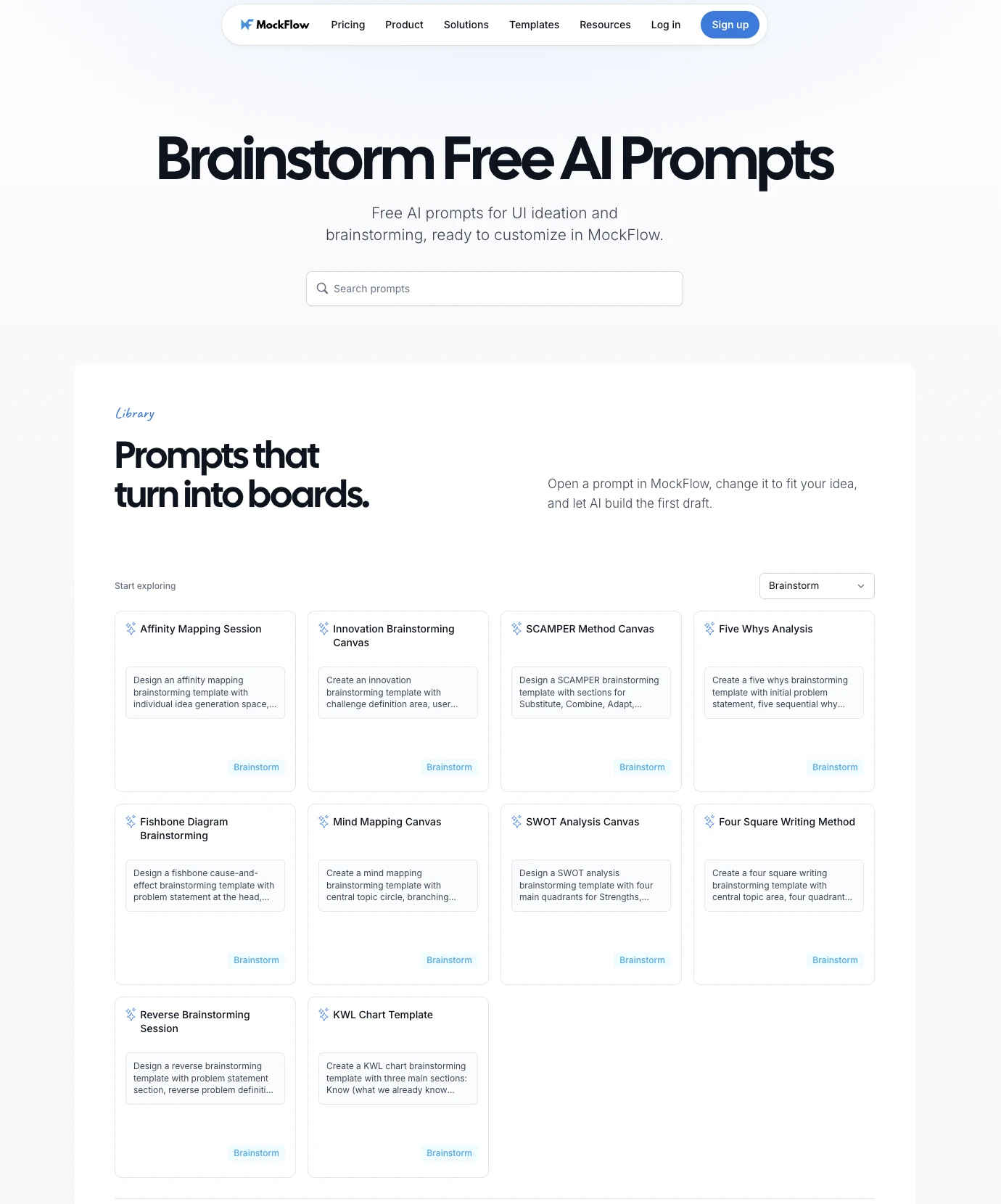
Pick your first prompt and get started with MockFlow AI Prompt Library
Tip: When using AI for creative problem-solving, try reviewing ideas from a specific user perspective. Give the AI a particular user persona, goal, or challenge instead of requesting general feedback. This can reveal overlooked assumptions and suggest alternative approaches that might not emerge from an open-ended prompt.
Having problem statement alternatives in one place makes it easier to compare perspectives and recognize opportunities that the original question might have overlooked.
Microsoft's 2025 Work Trend Index found that 46% of surveyed employees viewed AI as a thought partner for challenging their thinking, brainstorming, or generating creative ideas. Teams can use this approach to develop alternative problem statements before evaluating possible solutions.
3. Use mind mapping to discover unexpected connections
Mind mapping is a visual brainstorming technique that helps us explore a problem by branching out from a central idea. As we expand different branches, we begin to notice connections between concepts that might seem unrelated at first, leading to new possibilities.
If you're unsure where to start, try MockFlow's mind mapping tool to organize your ideas visually. You can build on your thoughts as they develop, making it easier to explore different directions and spot connections without losing track of the bigger picture.
Here's how to use mind mapping for lateral thinking:
- Start with a central problem: Place the challenge you want to explore at the center.
- Create related branches: Add different aspects of the problem or possible directions.
- Expand your ideas: Build on each branch with related concepts and suggestions.
- Find unexpected connections: Look for relationships between separate branches that could inspire new solutions.
For example, a team developing an educational platform starts with "student engagement" and explores branches such as personalization and collaboration. Connecting the two leads to an idea for group learning challenges that adapt to individual progress.
If creating the initial structure feels time-consuming, you can create a mind map with AI on MockFlow. Simply describe your problem or ideas in plain language, and it can generate an editable mind map that your team can expand and refine together. You can focus on exploring connections while the tool handles the initial visual structure.
4. Try random entry and external stimuli
Random Entry is a lateral thinking technique developed by Edward de Bono that uses an unrelated word, image, or object to spark unexpected ideas. By introducing something unfamiliar into a problem-solving session, we encourage our minds to make connections that conventional thinking might overlook.
To make the exercise more engaging during team workshops, you can try MockFlow's Decision Dice. Add two to six unrelated words or concepts to the dice and let participants roll to select a random stimulus. Everyone on the shared whiteboard sees the same result, giving the team a common starting point for exploring unexpected connections.
Here's how to practice Random Entry:
- Choose a random stimulus: Pick an unrelated word, image, or concept. You can also draw inspiration from another industry.
- Identify three characteristics: Explore what the stimulus represents or how it behaves.
- Connect it to your problem: Use each characteristic to generate a possible idea or direction worth exploring.
For example, a team designing a project management app randomly selects "garden." Exploring ideas associated with growth and seasons inspires visual progress indicators and project milestones that reflect different stages of development.
The value of Random Entry comes from using unexpected associations to discover possibilities that wouldn't naturally emerge from the original problem.
5. Use brainstorming and reversal techniques
Brainstorming helps us explore ideas freely before judging their practicality. Reversal techniques take creative thinking further by asking us to consider the opposite of our intended outcome, often revealing problems and opportunities we'd otherwise overlook.
Reverse brainstorming involves deliberately exploring how to cause or worsen a problem, then turning the negative ideas into constructive solutions. The worst possible idea exercise follows a similar approach, encouraging deliberately impractical suggestions to uncover hidden weaknesses and unexpected possibilities.
If you're running a team session, try the MockFlow reverse brainstorming template. It gives everyone a visual structure to capture negative ideas alongside potential solutions, making it easier to identify useful insights without losing track of how each idea developed.
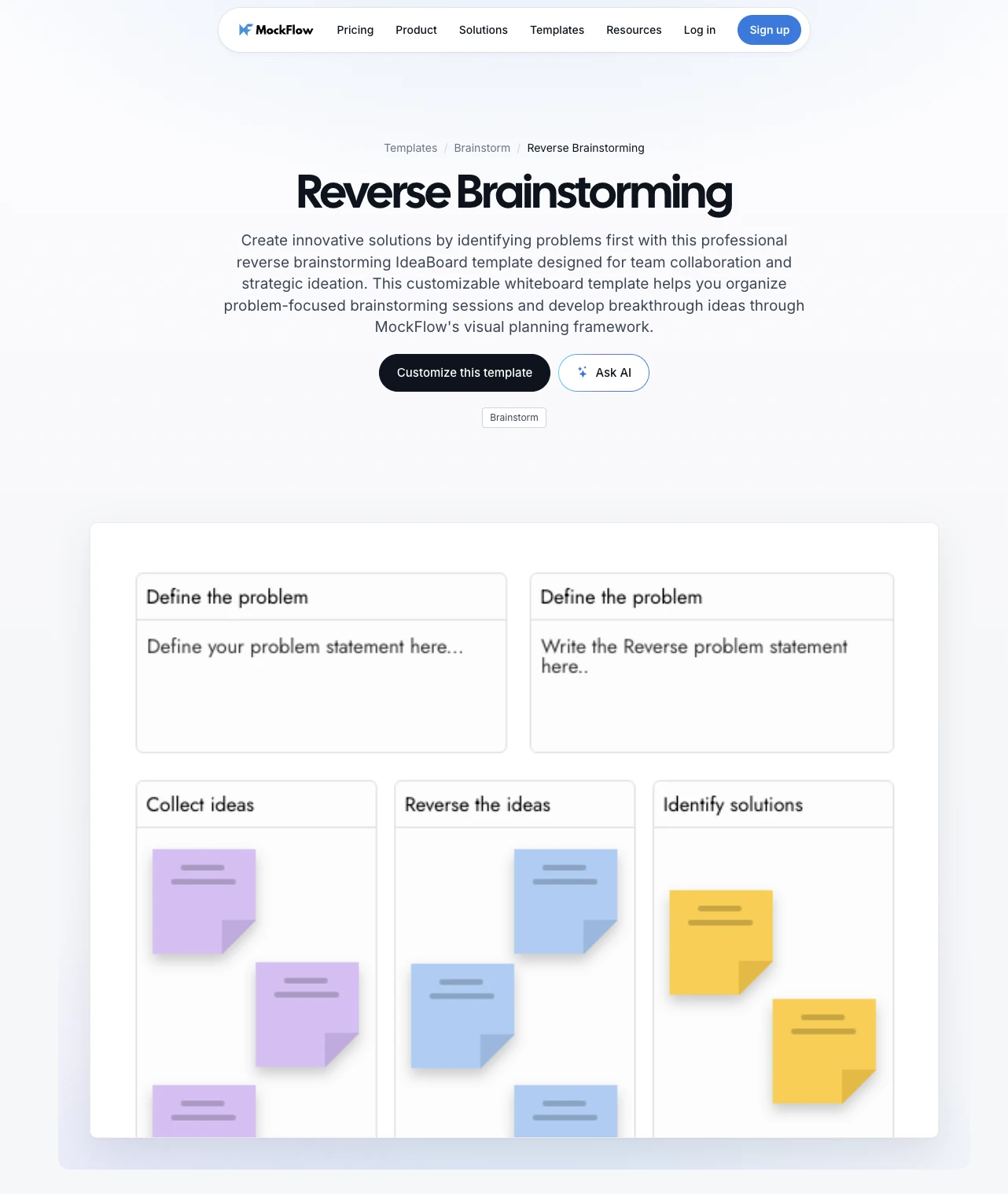
Click to customize this reverse brainstorming template
Here's how to practice reverse brainstorming:
- Reverse the original question: Turn "How can we improve customer retention?" into "What would make customers leave immediately?"
- Generate negative ideas: Explore possible causes, such as confusing onboarding or unclear pricing, without evaluating suggestions too early.
- Turn them into solutions: Use the negative ideas to identify improvements, such as simplifying onboarding or making pricing easier to understand.
To make the exercise easier to repeat across workshops, you can also use MockFlow's AI Prompt Box. Set up a reusable prompt that turns any problem participants enter into reversed questions or unconventional starting points. AI recipes can help make similar prompting activities reusable, so your team spends less time preparing exercises and more time developing ideas.
Microsoft's 2026 Work Trend Index found that 63% of Frontier Professionals brainstormed and refined business processes with their teams to identify AI opportunities, compared with 32% of other professionals. Structured exercises can give teams a practical starting point for such discussions.
6. Explore different perspectives with Six Thinking Hats
Developed by Edward de Bono, Six Thinking Hats is a structured brainstorming technique that helps teams examine a problem through six different perspectives. By focusing on one way of thinking at a time, we can explore ideas more thoroughly and prevent discussions from getting stuck on a single viewpoint.
If you're facilitating a group session, try the MockFlow 6 Thinking Hats template. It gives each perspective a dedicated space where participants can add their thoughts, making it easier to capture everyone's input and revisit ideas without repeatedly organizing the discussion.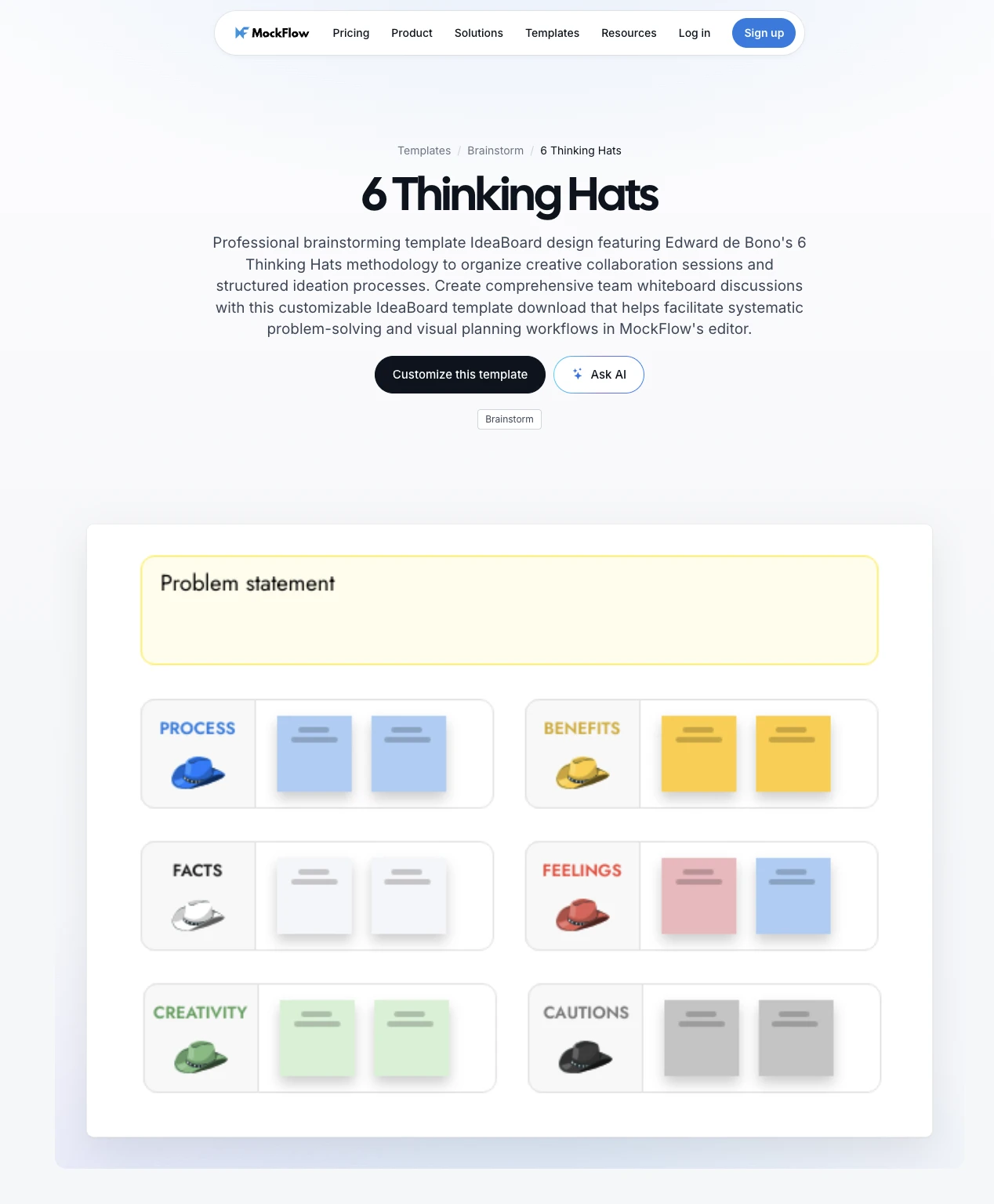
Customize this 6 thinking hats template
Each hat guides a different type of thinking:
Hat | Thinking perspective |
White | Examine facts and available information |
Red | Express emotions and intuition |
Black | Identify risks and potential concerns |
Yellow | Explore benefits and opportunities |
Green | Generate creative and unconventional ideas |
Blue | Organize and guide the thinking process |
The Green Hat encourages unconventional ideas without immediate judgment, while the other hats help evaluate them from different perspectives.
If you already use an MCP-compatible AI assistant, MockFlow's Six Thinking Hats skill offers another way to simplify preparation. Once you've connected MockFlow and installed the skill, you can enter your discussion topic and have the AI generate a visual breakdown through all six perspectives. That gives your team a structured starting point without manually building the framework.
7. Apply the SCAMPER technique
SCAMPER is a structured brainstorming technique that helps us rethink existing products and processes using seven creative prompts. Each prompt encourages a different kind of change, helping us discover improvements we might overlook when approaching a problem in the usual way.
If you're starting from scratch, try MockFlow's SCAMPER Method Canvas. You can use the AI prompt to generate a visual SCAMPER framework for your idea, giving you a structured starting point without having to set up all seven categories manually.
Here's what each SCAMPER prompt encourages us to explore:
SCAMPER element | Guiding question |
S - Substitute | What can we replace? |
C - Combine | What can we bring together? |
A - Adapt | What can we borrow or adjust? |
M - Modify | What can we change or amplify? |
P - Put to another use | Could something serve a different purpose? |
E - Eliminate | What can we remove? |
R - Reverse | What can we rearrange or invert? |
For example, a team improving a collaboration app uses Combine to explore bringing project planning and communication together. Eliminate helps them identify unnecessary setup steps, while Reverse encourages them to reconsider the onboarding sequence. Each prompt reveals a different opportunity to improve the user experience.
For collaborative workshops, the MockFlow SCAMPER template gives everyone a shared space to develop ideas under each prompt. The team can compare suggestions visually and build on promising concepts, making it easier to move from individual ideas toward solutions worth testing.
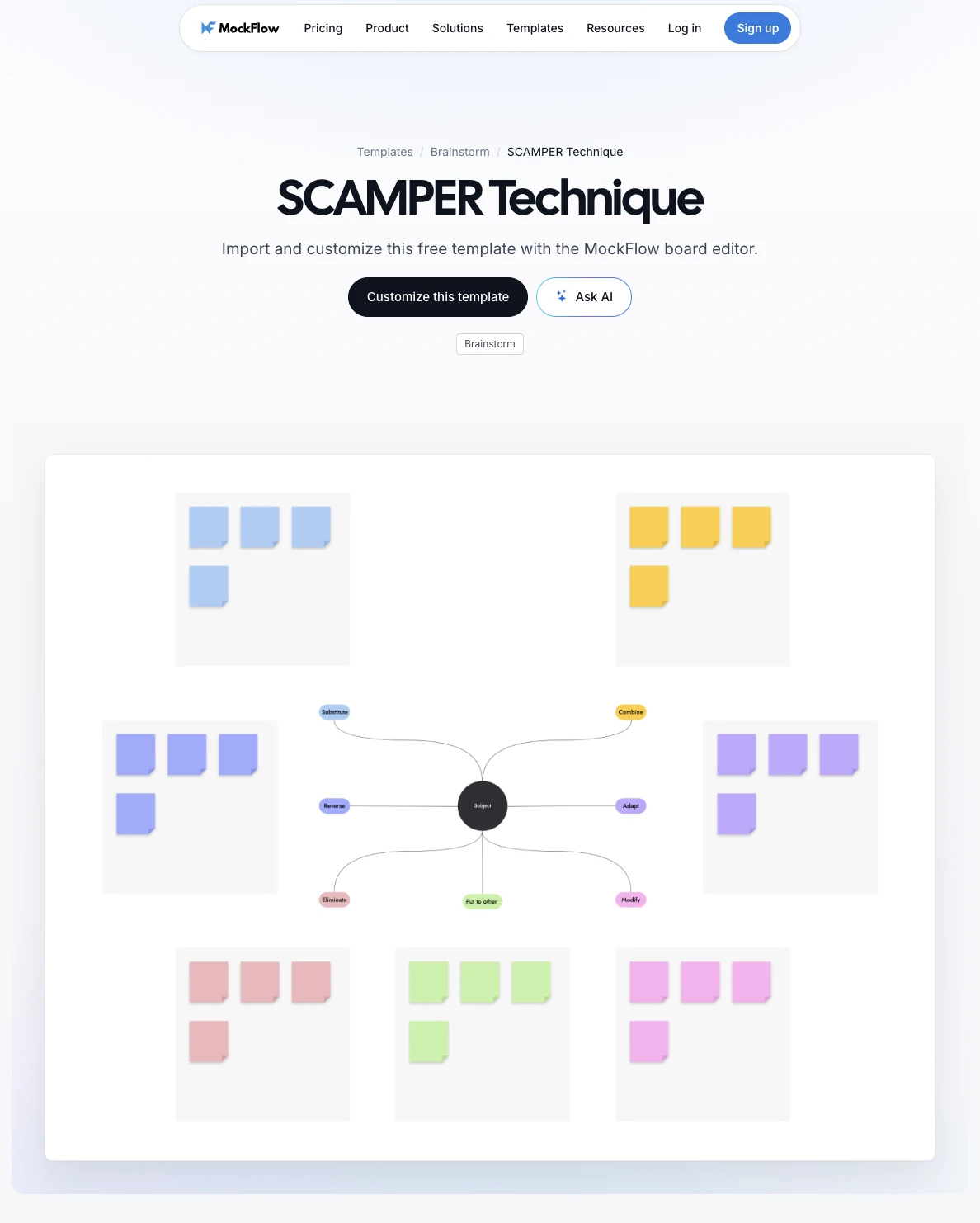
Customize this SCRAMPER technique template on MockFlow
8. Ask better questions with starbursting
Starbursting is a question-based brainstorming technique that helps us examine an idea from different perspectives before deciding how to develop it. By asking Who, What, When, Where, Why, and How, we can uncover missing information, challenge assumptions, and identify new directions for creative problem-solving.
If you're facilitating a brainstorming session, try the MockFlow starbursting brainstorming template. It gives you a ready-made visual structure with all six question categories, so your team can start exploring an idea immediately without spending time setting up the framework.
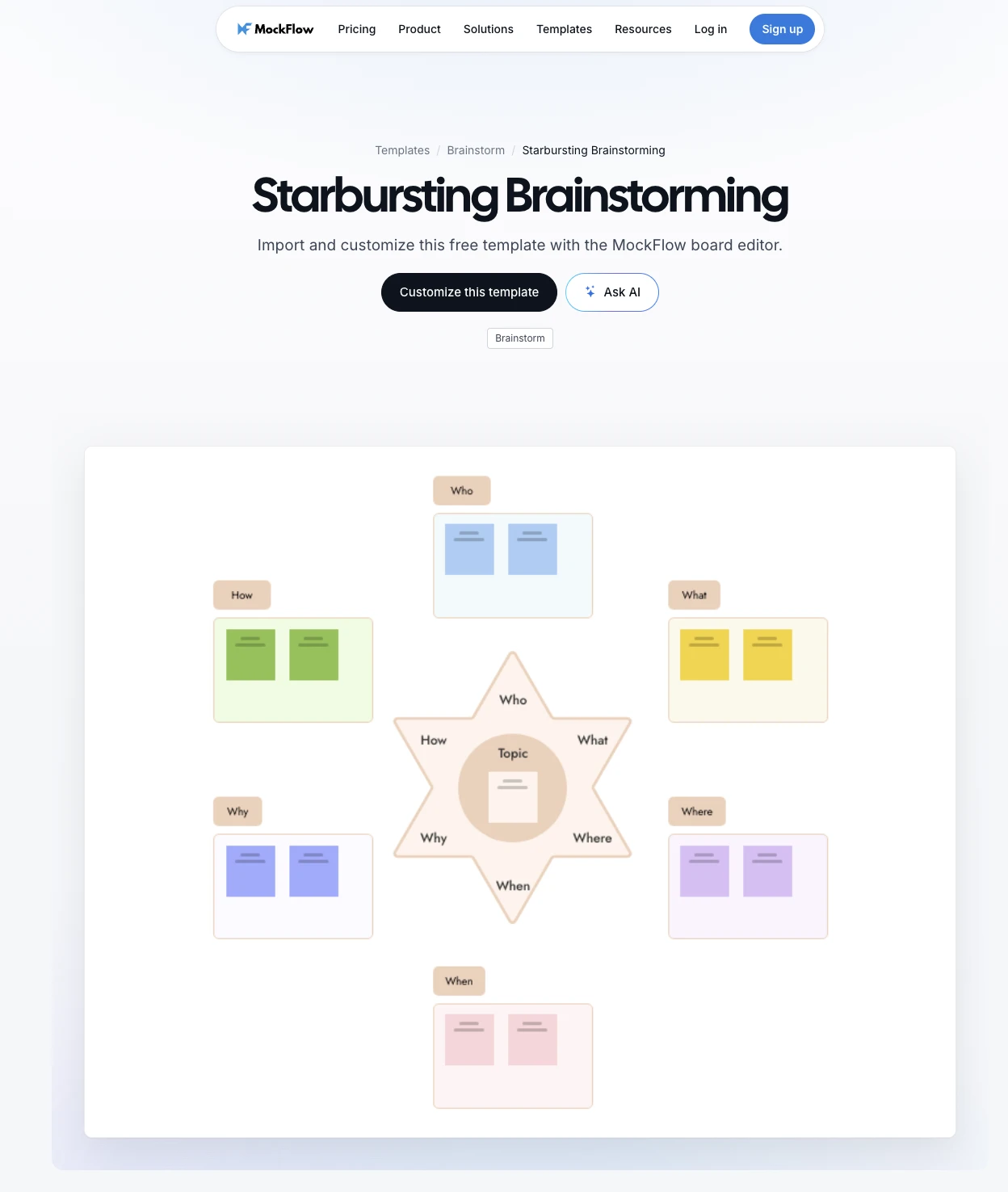
Customize this starbursting template on MockFlow
Here's how to question a problem using starbursting:
- Who: Who is affected by the problem or proposed solution?
- What: What needs are we trying to address?
- When: When does the problem occur or require attention?
- Where: Where do people experience the greatest difficulty?
- Why: Why do existing approaches fail to meet their needs?
- How: How else could we approach the challenge?
For example, a team developing a learning platform uses starbursting to understand where students struggle and why existing methods fall short. Asking how learning could be delivered differently helps them explore alternative experiences before committing to specific features.
Related Read: 25 Brainstorming Techniques: How Each One Works and When to Use It
How to develop lateral thinking skills: 7 methods to improve
You don't have to be naturally creative to become a better lateral thinker. Like any problem-solving skill, lateral thinking improves with practice. Regularly questioning assumptions and exploring unfamiliar approaches helps us recognize possibilities we might otherwise overlook.
Here are seven practical ways to develop lateral thinking skills:
- Practice lateral thinking questions and puzzles: Puzzles help us recognize hidden assumptions and explore different interpretations. For example, "A man pushes his car to a hotel and realizes he's bankrupt. Why?" He's playing Monopoly. We assume it's a real car, although the question never says so. To solve lateral thinking puzzles, separate the given facts from your assumptions. You can also use lateral thinking cards for quick, regular practice.
- Build creative flexibility through different perspectives: Look at a problem from a customer's or colleague's viewpoint. Role-playing and group discussions help reveal needs or possibilities that your own perspective might miss.
- Challenge everyday assumptions: Pick a familiar routine and ask why each step exists. Consider what would happen if you removed or changed one. The exercise helps you distinguish necessary requirements from habits that no longer serve a purpose.
- Practice generating multiple solutions: Set a five-minute timer and challenge yourself to produce eight different approaches to one problem. Save evaluation for afterward so your first reasonable idea doesn't limit further exploration.
- Use visual brainstorming to connect ideas: Mapping ideas visually helps reveal relationships that linear notes might miss. If you're brainstorming with a team, try MockFlow's brainstorming templates to organize ideas and explore connections without spending time creating the framework yourself.
- Apply lateral thinking to everyday problems: Practice on manageable challenges. For instance, a team struggling with repetitive status meetings questions whether every update needs a meeting. The discussion leads to asynchronous updates and shorter meetings focused on resolving blockers.
- Evaluate and refine creative ideas: Assess promising ideas for feasibility, potential impact, and available resources before implementation. If your team needs help generating alternatives, try MockFlow's Crazy 8s Wall, an interactive Artifact that encourages participants to develop eight ideas quickly. You can then review the concepts together and identify which deserve further testing.
The more regularly we practice generating and evaluating alternative approaches, the easier it becomes to apply lateral thinking when familiar solutions stop working.
Put lateral thinking into action with MockFlow
Lateral thinking helps us move past familiar solutions and discover new possibilities. Turning unconventional ideas into practical solutions becomes easier when we have a way to capture them, explore connections, and develop the most promising ones.
With MockFlow, you have a visual workspace to put creative thinking into practice. Start with a blank whiteboard to explore ideas freely, or use ready-made brainstorming templates for techniques like SCAMPER and reverse brainstorming. You can organize contributions visually, build on your team's suggestions, and refine promising ideas together.
If you're unsure where to begin, MockFlow AI can turn a simple description into an editable brainstorming structure, saving you the effort of building everything manually. Interactive components also help you involve your team in exploring different possibilities.
Sign up to start brainstorming with MockFlow and turn unconventional thinking into a more structured, collaborative creative process.
FAQs
1. What is lateral thinking with an example?
Lateral thinking is a creative problem-solving approach that helps us find alternative solutions by questioning familiar assumptions. For example, a restaurant struggling with long queues might introduce online pre-ordering instead of adding more seating. The team addresses the underlying problem by changing how customers place orders rather than expanding the restaurant.
2. Who is a famous lateral thinker?
Edward de Bono is the best-known figure associated with lateral thinking. He introduced the concept in his 1967 book The Use of Lateral Thinking and developed structured methods to encourage unconventional problem-solving. His contributions also include the Six Thinking Hats framework, which helps individuals and teams explore problems from different perspectives.
3. What is another word for lateral thinking?
Lateral thinking is often described as out-of-the-box thinking, unconventional thinking, or non-linear thinking. The expressions share an emphasis on exploring unfamiliar approaches. Divergent thinking is also closely related, but it specifically focuses on generating multiple ideas, while lateral thinking uses deliberate methods to challenge established thought patterns.
4. How do you know if you are a lateral thinker?
You demonstrate lateral thinking when you regularly question assumptions, explore different explanations, and make connections between seemingly unrelated ideas. You can strengthen these habits through regular brainstorming exercises. If you're practicing with a team, MockFlow's visual brainstorming templates can help you explore alternative perspectives and develop ideas together.
5. What is the difference between lateral thinking and critical thinking?
Lateral thinking focuses on generating alternative ideas by challenging conventional approaches. Critical thinking examines evidence and uses logical reasoning to determine whether an idea is valid or practical. The two work together during problem-solving. Lateral thinking expands the possibilities we consider, while critical thinking helps us evaluate and select promising solutions.
6. How do you solve lateral thinking puzzles?
To solve lateral thinking puzzles, start by identifying the facts explicitly provided in the question. Then examine any assumptions you've made and consider alternative interpretations. Test different explanations against the available clues before settling on an answer. Avoiding premature conclusions helps you recognize possibilities that an obvious first interpretation might hide.
Team Planning Process Guide: Steps & Best Practices in 2026
Team planning often starts when the team already feels the pressure. A new quarter is approaching. A major project is about to...

Design Thinking Process Steps: 5 Stages Explained with Examples
Introduction If you’ve ever worked on a product, feature, or even a simple redesign, you’ve probably hit that moment where...

What is Wireframe? - Definition, Types, and Best Practices for 2026
Every great digital product starts with a clear plan. Before colors, fonts, or visuals come into play, designers begin by...
