How to Run a Structured & Productive Brainstorming Session
Introduction
Ever been in a brainstorming session that felt busy but not useful? No strong ideas stood out. No decisions felt closer. It just blended into the rest of the day.
That usually isn’t because the team lacked creativity or experience. It’s because the session itself wasn’t designed to do any real work. When brainstorm meetings are treated like open conversations, they drift. A few voices take over, others hold back, and good thoughts disappear the moment the call ends.
A strong brainstorming session feels different. It has a clear reason for existing. Everyone knows what they are there to contribute. Ideas are captured in a way that lets the group see patterns, gaps, and priorities. And by the end, there’s a shared understanding of what comes next.
In this guide, we’ll walk through how to run a brainstorming session that creates that kind of clarity. You’ll learn how to lead a brainstorming session effectively and get access to repeatable templates that work across teams and situations.
What is a brainstorming session?
A brainstorming session is a structured, time-bound team activity used to generate, explore, and organize ideas collaboratively around a clear goal. It follows a defined agenda, involves relevant participants, and uses facilitation to maintain focus and balance input.
The session prioritizes idea generation before evaluation, supports open contribution, and relies on tools to capture and organize inputs. Effective brainstorming sessions end with grouped insights, prioritized themes, and clear next steps that guide decisions or follow-up actions.
Equally important is understanding what brainstorming is not. It is not an open-ended conversation, a debate, or a meeting where ideas are evaluated as they surface. Those formats tend to reward louder voices and narrow thinking too early, which limits the range of insights a team can uncover.
A well-run brainstorming session functions as a deliberate working session. It creates space for exploration without losing direction and ensures that ideas are captured, organized, and carried forward.
Benefits of brainstorming session
Brainstorming sessions matter because they change how teams think before decisions are made. Instead of reacting to problems as they surface, teams get a structured moment to slow down, explore options, and align early.
Research published in Harvard Business Review has shown that structured virtual brainstorming can outperform in-person sessions for idea generation and is better for innovations.
When run well, brainstorming sessions deliver clear benefits:
- Better decisions, not just more ideas: By laying out multiple approaches side by side, teams avoid defaulting to the safest or most familiar option. This leads to more considered choices, backed by broader input.
- Fewer blind spots and missed risks: Brainstorming brings different perspectives into the same room at the same time. That makes it easier to spot gaps, constraints, or second-order effects early.
- Stronger alignment before execution begins: When people help shape ideas, they understand the reasoning behind them. This reduces pushback later and speeds up execution.
- More balanced participation across the team: Structured sessions reduce the influence of hierarchy or louder voices, allowing quieter contributors to add value in a meaningful way.
- Clearer next steps instead of vague outcomes: Effective brainstorming sessions end with organized inputs, shared priorities, and a sense of direction, not just notes from a meeting.
In short, brainstorming sessions matter because they turn scattered thinking into shared clarity.
How to run a brainstorming session
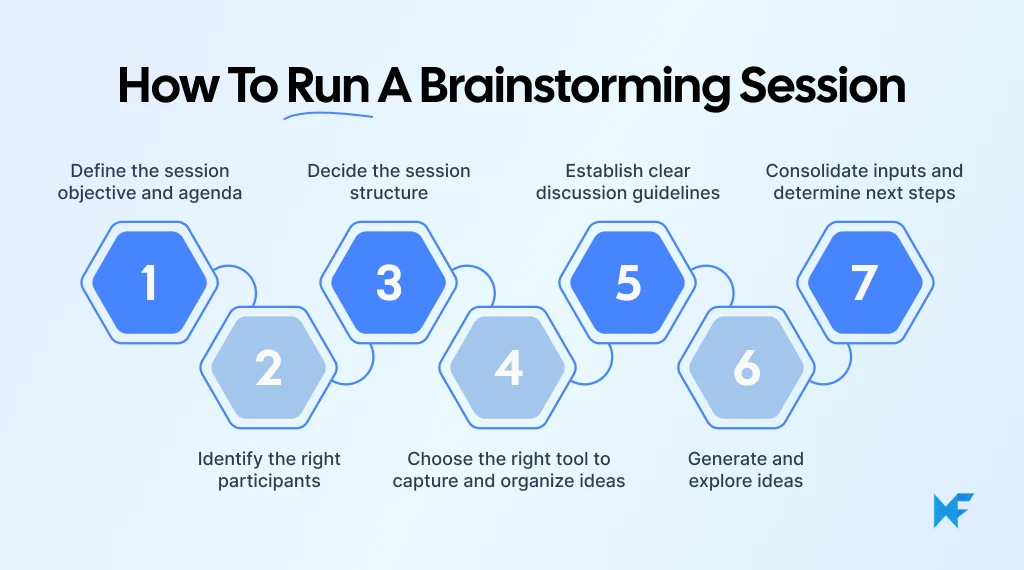
Running a brainstorming session well is about removing ambiguity before it shows up in the room. When people know why they are there, what they are expected to contribute, and how the session will flow, ideas come out more clearly and conversations stay productive.
The steps below are designed to help you set that foundation properly, so you know how to run a successful brainstorming session with confidence.
1. Define the session objective and agenda
A brainstorming session should always start with a clearly defined objective. This is not a theme or a broad problem statement, but a concrete outcome the session is meant to support. Without this clarity, participants will interpret the purpose differently and pull the discussion in competing directions.
A strong objective answers three things upfront:
- Why the session is being held now
- What type of thinking is expected (exploration, improvement, alternatives, prioritization)
- What a useful outcome looks like at the end
Once the objective is clear, outline a simple agenda that shows how the session will progress. This does not need to be rigid, but it should indicate:
- Time for individual thinking versus group discussion
- When ideas will be generated versus organized
- When the session will shift toward identifying next steps
An agenda signals that the brainstorming session is meant to produce movement, not just conversation.
2. Identify the right participants
The quality of a brainstorming session depends more on who is in the room than how many people attend. Inviting everyone rarely improves outcomes. It usually increases noise and reduces accountability.
When selecting participants, focus on:
- People with direct knowledge of the topic or problem
- Individuals who will use, implement, or be impacted by the outcome
- A small number of participants who bring different perspectives, not overlapping roles
An effective group is large enough to surface varied thinking, but small enough for everyone to contribute meaningfully. When too many people are involved, discussions slow down and ideas become watered down.
It also helps to be intentional about decision authority. Not everyone needs to decide, but participants should know whether the session is meant to inform a decision, shape options, or set direction. That clarity keeps contributions focused and relevant.
3. Decide the session structure
One common reason brainstorm meetings fail is that they get used to validate a direction that’s already decided. As Stein Greenberg notes, “a brainstorm is called when somebody really has an idea that they want to advance,” and the group is pulled into agreement instead of exploration.
The structure of a brainstorming session determines how ideas surface. When structure is missing, discussion tends to follow the loudest voice or the first idea mentioned. When structure is intentional, thinking becomes more deliberate and balanced.
A practical brainstorming session structure often includes:
- Individual ideation first, where participants write ideas privately. This reduces group bias and improves idea variety.
- Round-based sharing, where ideas are shared in sequence or grouped by theme instead of debated immediately.
- Clear time boxes, so the session progresses instead of drifting into extended discussion.
Structure should also reflect how the session is run:
- In in-person sessions, physical grouping of ideas helps teams see patterns quickly.
- In remote or hybrid sessions, written inputs and visual organization matter more than open conversation, since verbal discussion alone tends to exclude some voices.
The intent of structure is not control. It is to create space for thinking while keeping the session moving toward clarity.
4. Choose the right tool to capture and organize ideas
How ideas are captured during a brainstorming session often determines whether anything useful happens afterward. When ideas are scattered across chat messages, notebooks, or memory, they rarely turn into action.
A brainstorming tool should do more than record ideas. It should help teams see, organize, and revisit thinking over time.
A strong brainstorming tool should make it easy to:
- Capture ideas in one place so nothing gets lost across chats, docs, or memory
- Visually organize inputs to reveal patterns, overlaps, and gaps as they emerge
- Revisit and refine ideas later, not just during the session
- Collaborate without friction, whether the team is in the same room or fully remote
Visual tools are especially effective because they make relationships between ideas visible. For example, when a team clusters similar ideas together, gaps and overlaps become obvious without lengthy discussion.
Tools like MockFlow IdeaBoard work well for brainstorming because they mirror how teams actually think. The infinite canvas removes artificial boundaries, so ideas can start unstructured and then grow organically. Teams can spread thoughts out, cluster related inputs, and visually connect ideas as patterns emerge. This makes it easier to move from raw ideation to structured thinking without forcing premature organization.
IdeaBoard also reduces setup and follow-through effort. Ready-made brainstorming templates such as affinity mapping, lotus diagrams, and reverse brainstorming give teams structure when they need it, while the AI Toolbox and editable prompt library help generate structured boards quickly when time is limited.
Microsoft’s Work Trend Index describes that AI power users use generative AI several times a week and save more than 30 minutes a day, largely by reducing setup and friction during early thinking.
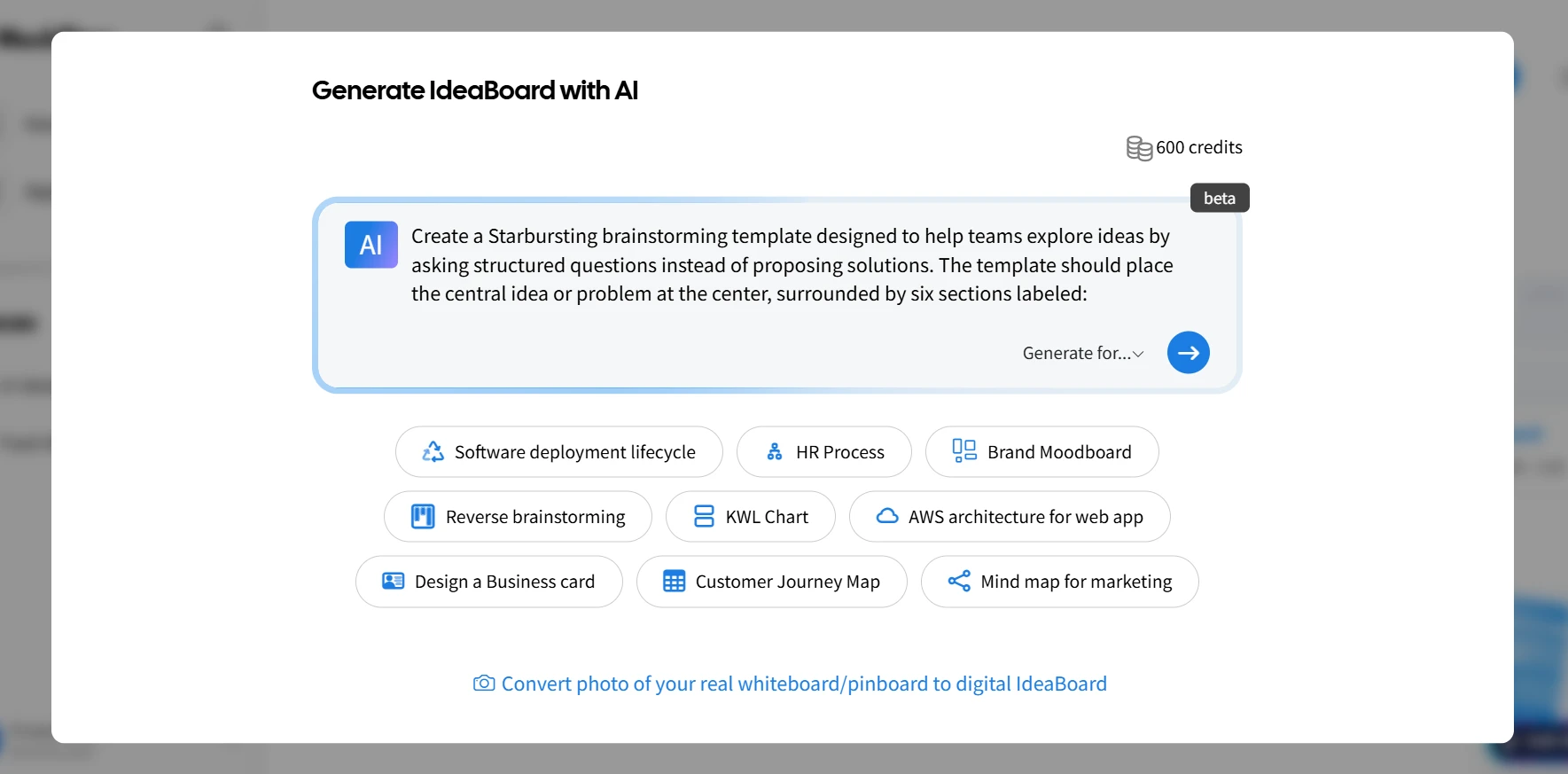
Real-time collaboration, including voice/video comments, supports hybrid and remote sessions without slowing participation, and offline mode allows teams to continue brainstorming even without connectivity.
Because boards can be revisited, exported, or shared after the session, ideas don’t disappear once the meeting ends. They stay usable for prioritization, planning, or follow-up discussions, turning brainstorming into a repeatable process instead of a one-off exercise.
5. Establish clear discussion guidelines
Discussion guidelines keep a brainstorming session focused and prevent it from turning into debate or open-ended conversation. They clarify how ideas should be shared, when discussion should happen, and what the session is optimizing for.
Well-defined guidelines typically include:
- Defer judgment early, so ideas are explored before they are critiqued
- Stay on topic, using the session objective as a reference point
- Build on ideas, instead of responding only with counterpoints
- Respect time limits, so no single thread dominates the session
It also helps to be explicit about participation. Let people know whether they are expected to contribute individually first, respond to others’ ideas, or add context asynchronously. These signals reduce confusion and keep attention on the work, not the process. When expectations are clear, the session runs smoother and produces more usable output.
This step also applies to how tools are used. A 2025 study published in Nature Human Behaviour found that ChatGPT-assisted brainstorming can reduce idea diversity, reinforcing why teams should avoid outsourcing divergence too early.
6. Generate and explore ideas
Start with individual ideation. Giving people a few quiet minutes to write down ideas prevents group bias and ensures broader input. Once ideas are captured, move into structured sharing so contributions are surfaced evenly rather than through open discussion.
To keep exploration productive:
- Encourage adding variations or extensions to existing ideas
- Allow ideas to be combined or reframed as patterns emerge
- Avoid evaluating feasibility or priority at this stage
Exploration works best when ideas are visible to everyone. Seeing inputs side by side helps teams build on each other’s thinking instead of repeating points. The aim is to expand the solution space while staying anchored to the session objective.
Using templates can significantly improve this stage. Templates provide just enough structure to guide thinking without constraining it, helping teams move faster and stay focused on idea generation.
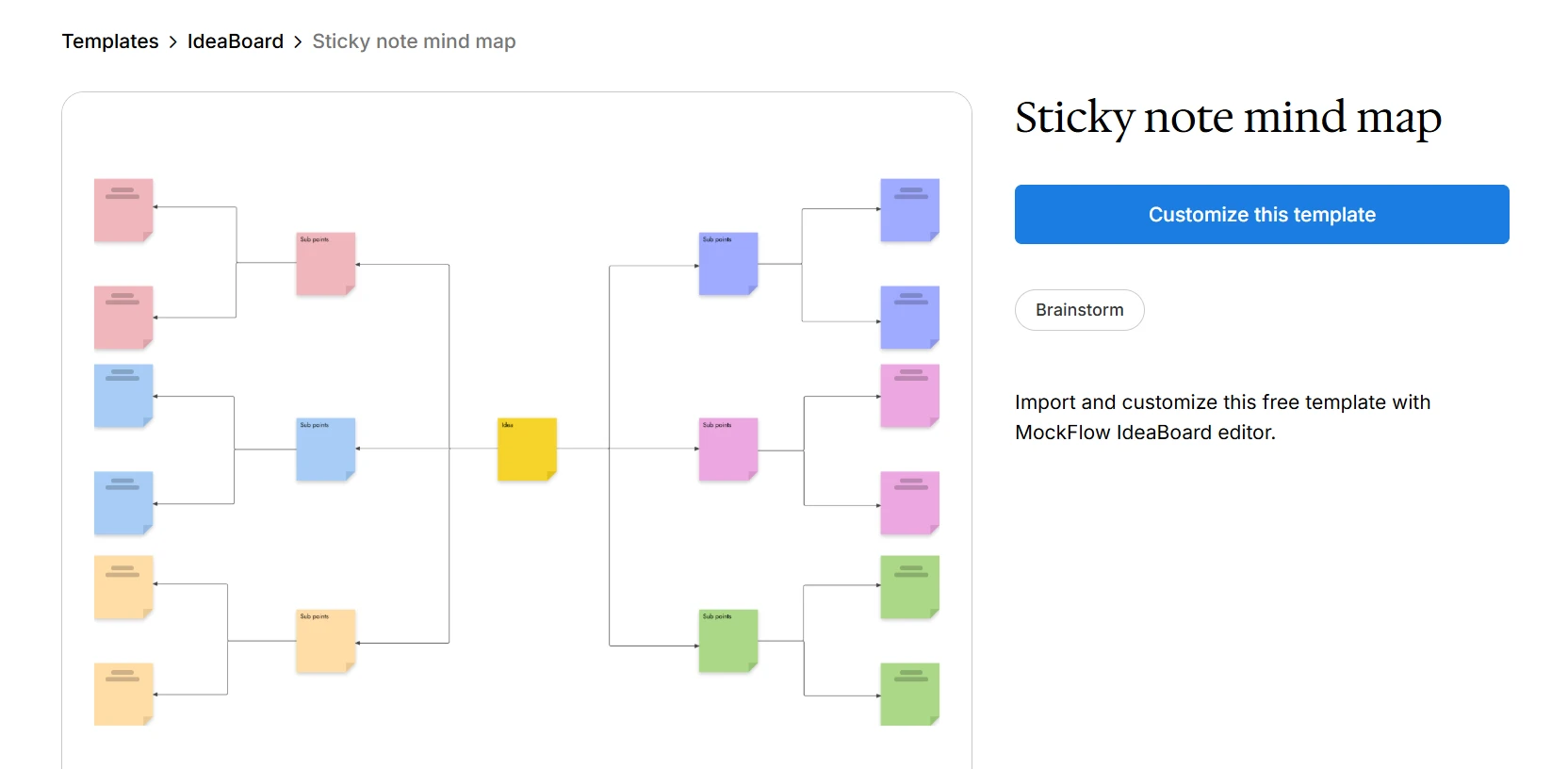
Tools like IdeaBoard offer a wide range of ready-to-use, editable brainstorming session templates that teams can apply immediately. Examples include:
- Sticky note mind map: Useful for open-ended idea generation where teams want to branch thoughts freely from a central topic.
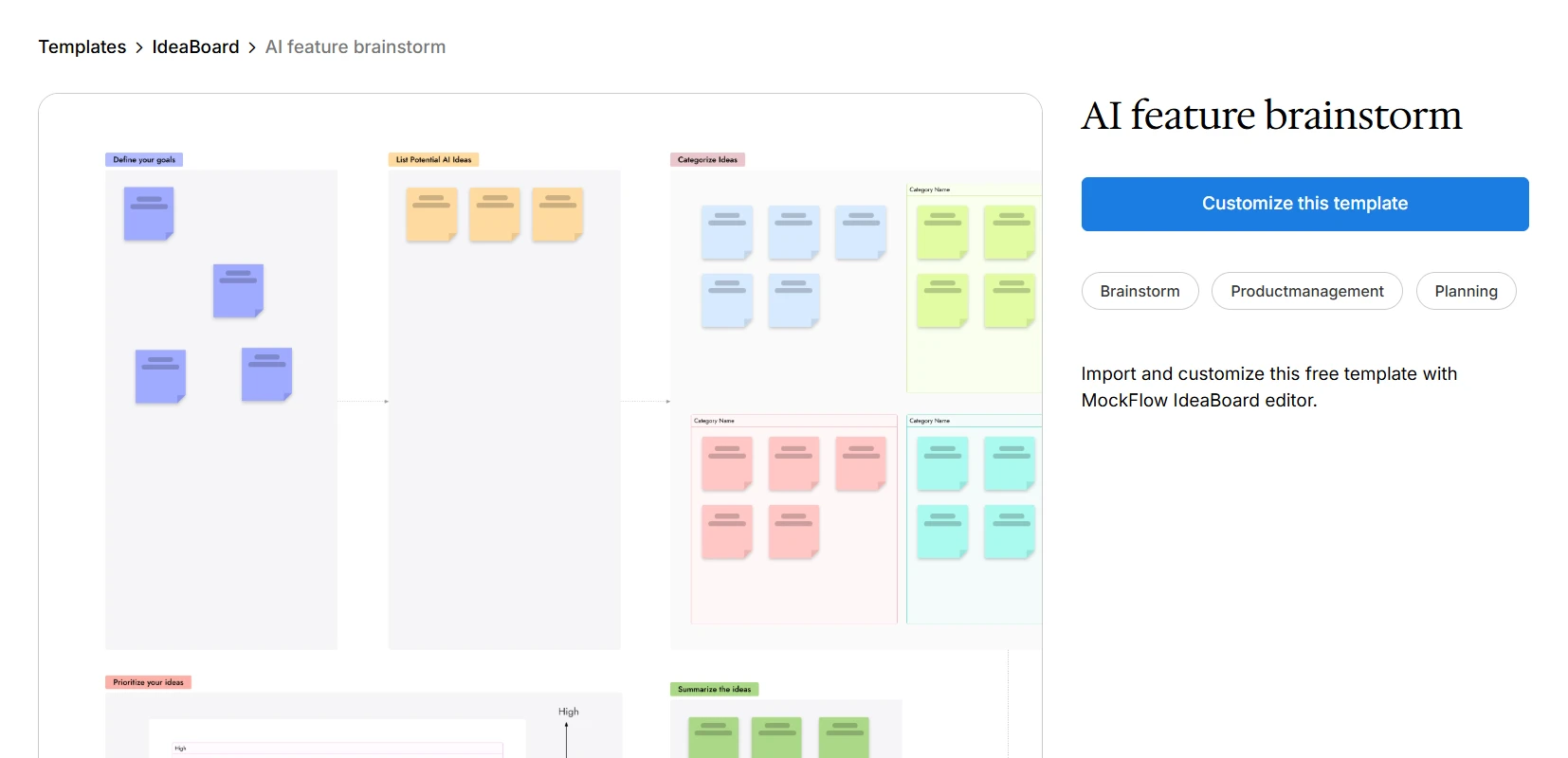
- AI feature brainstorm template: Designed for product or capability exploration, helping teams think through use cases, features, and value areas systematically.
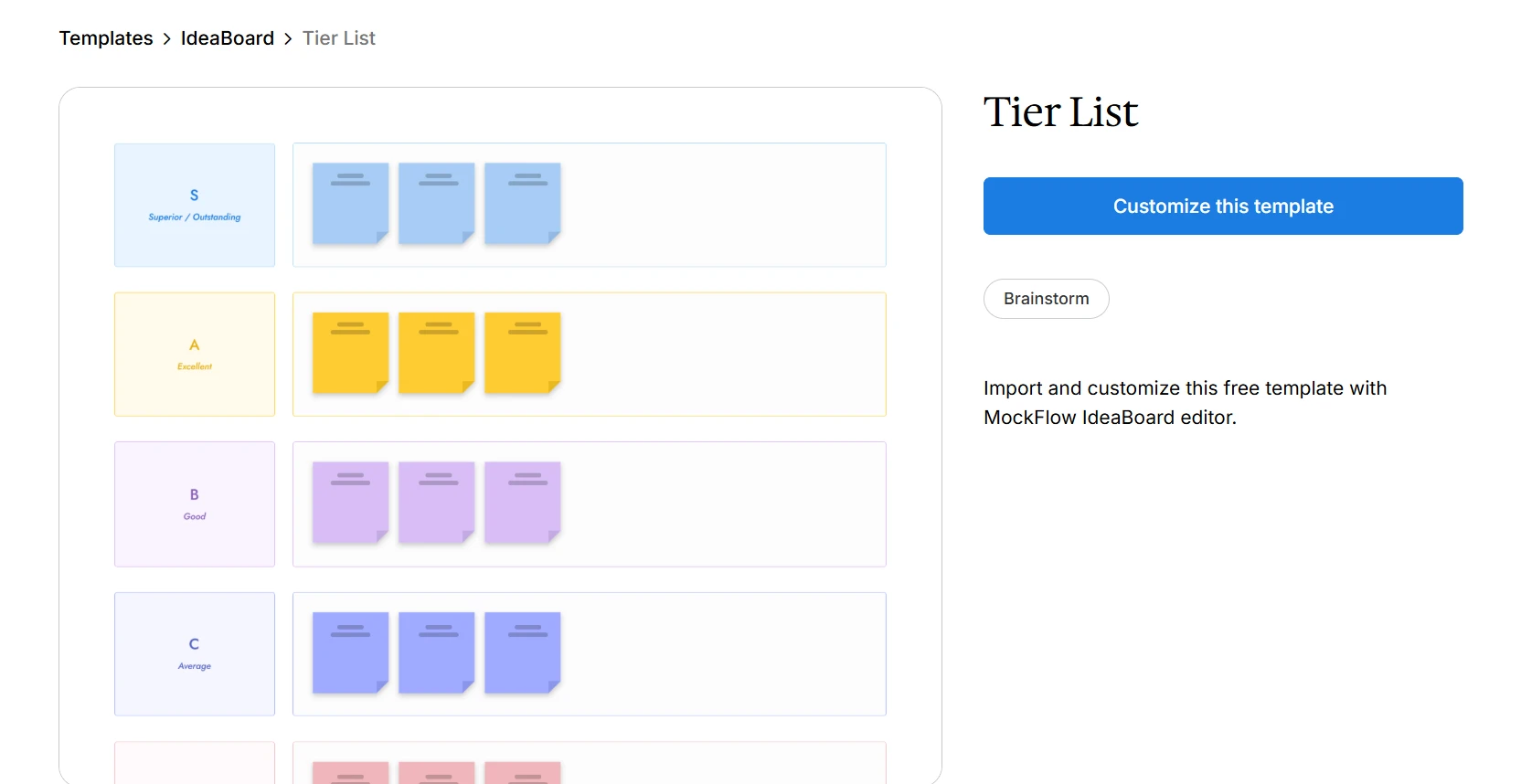
- Tier lists and concept maps: Help compare ideas side by side, group them by importance, or explore relationships between concepts.
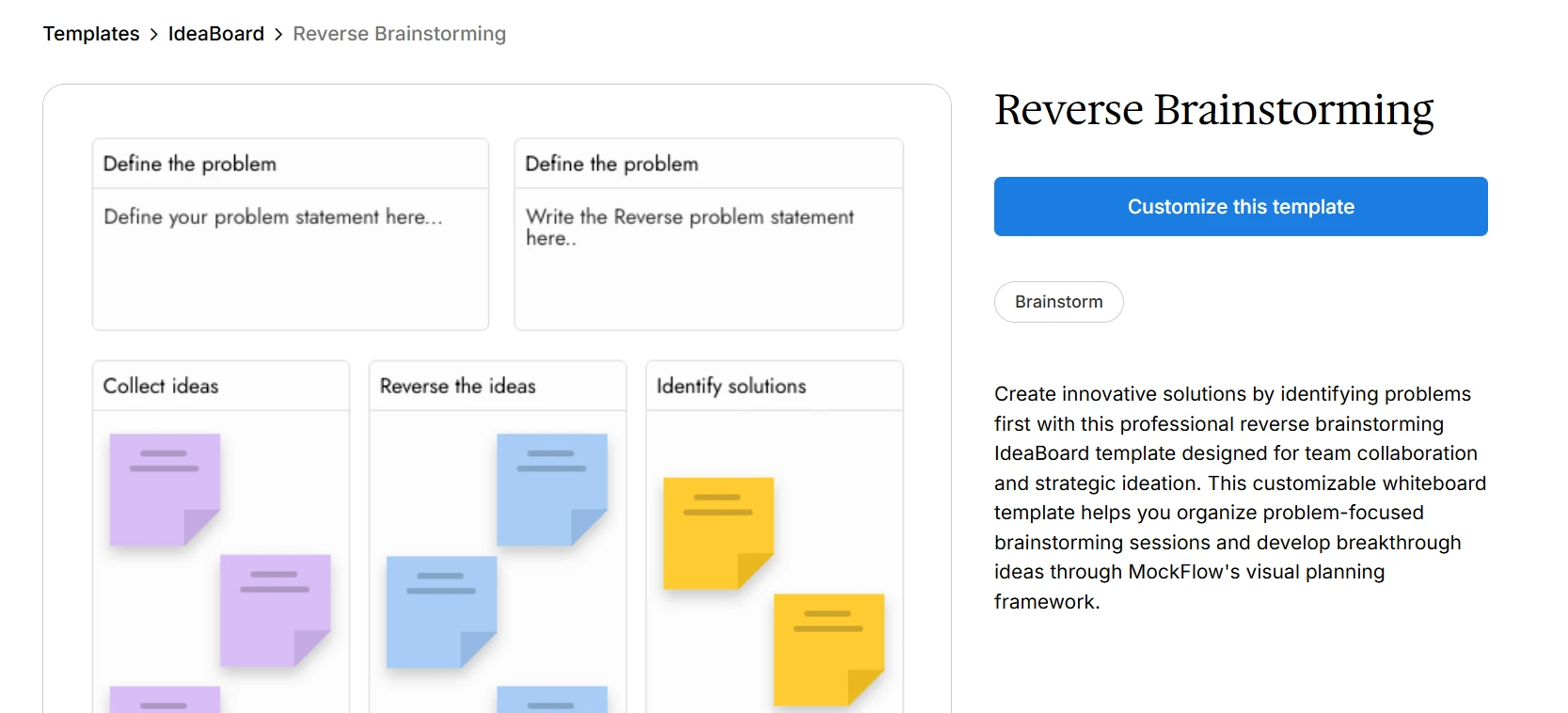
- Reverse brainstorming: Used to identify risks, failure points, or what could go wrong before flipping those insights into solutions.
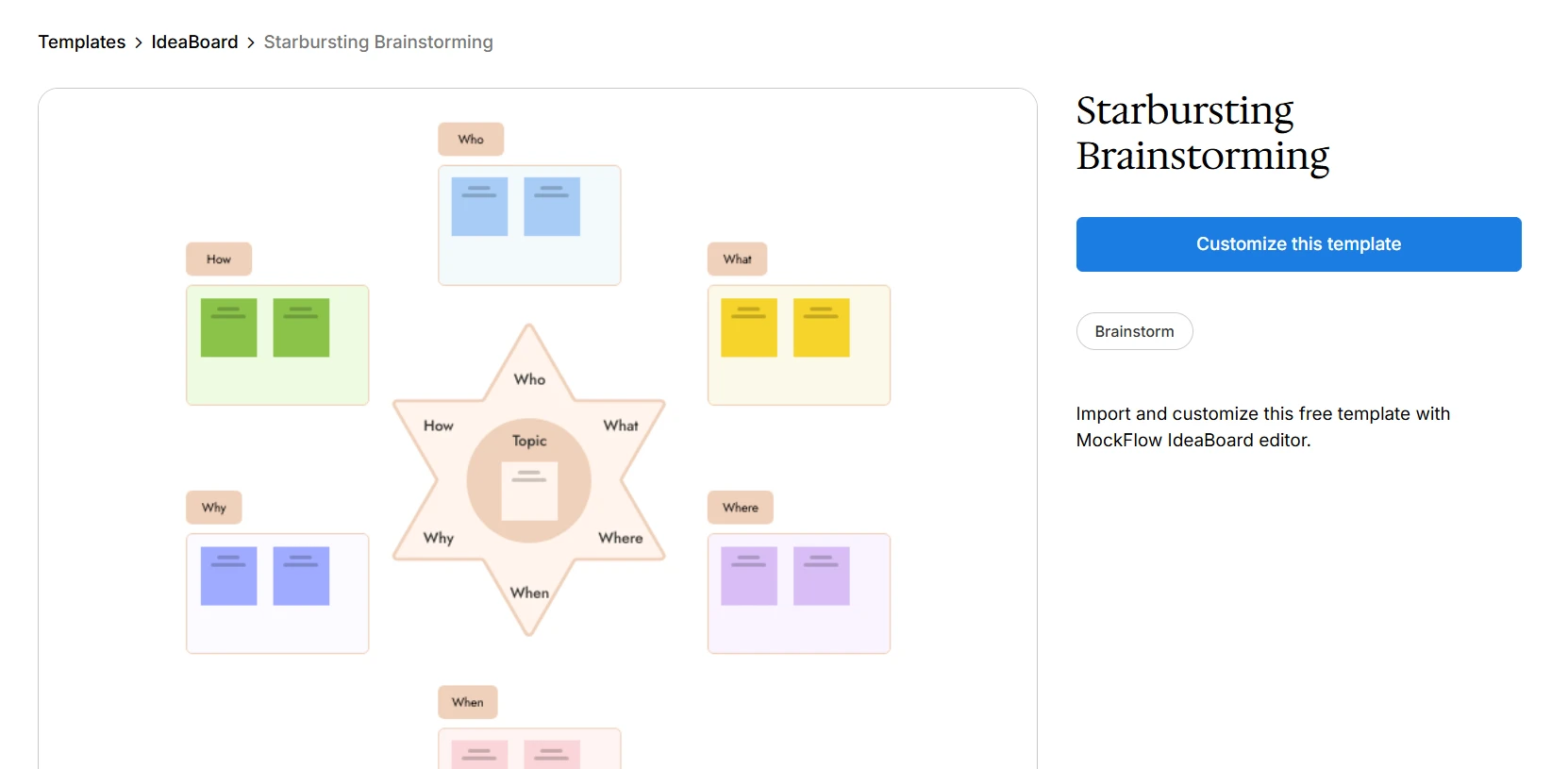
- Starbursting template: Help teams analyze processes or explore ideas through structured questions like who, what, why, and how.
These templates reduce setup time, create consistency across sessions, and help participants focus on thinking instead of figuring out how to start.
7. Consolidate inputs and determine next steps
A brainstorming session only works if ideas lead to direction. Without consolidation, teams leave with notes but no clarity.
Start by grouping related ideas into clear themes. This reduces repetition and helps the team see patterns instead of isolated thoughts. Focus on understanding what each cluster represents before judging its value.
Next, apply light prioritization based on the session objective. Identify ideas that are most relevant, feasible, or worth exploring further. Keep this step short to avoid turning the session into a debate.
End by defining specific next steps:
- What moves forward now
- What needs further analysis
- Who owns each follow-up
Once ideas have been consolidated and next steps are clear, the value of the brainstorming session becomes visible. What started as individual inputs now forms a shared direction the team can act on. This is the point where brainstorming shifts from exploration to execution support.
How to lead a brainstorming session
Leading a brainstorming session is about guiding people through thinking, not contributing ideas yourself. A good leader creates the conditions for focus, balanced input, and progress, while keeping the group aligned to the objective.
At the start, leadership shows up in clarity. Reiterate why the session exists, what kind of thinking is expected, and how the session will flow. When expectations are clear, participants engage with more confidence and less hesitation.
During the session, effective leadership focuses on a few key responsibilities:
- Keep the discussion anchored to the objective when it starts to drift
- Ensure balanced participation, stepping in if a few voices dominate
- Move the session forward deliberately, transitioning between idea generation, discussion, and consolidation
- Prevent early evaluation, so ideas are explored before they are judged
Strong leaders also know when to adjust. If energy drops or discussion stalls, shifting back to individual ideation or regrouping ideas visually can reset momentum.
Leading a successful brainstorm session doesn’t mean controlling the conversation. It means creating enough structure and guidance so the group can think clearly and leave with shared direction.
Conclusion
A brainstorming session works best when it’s treated as a structured business activity, not an informal discussion. The difference between a one-off brainstorm meeting and a repeatable process comes down to preparation, facilitation, and follow-through. When those elements are consistent, teams stop reinventing the wheel and start making better decisions faster.
Using the right tools makes that consistency easier to achieve. Tools like MockFlow IdeaBoard help teams run structured brainstorming sessions that are easy to repeat, revisit, and build on over time.
If you want to make brainstorming sessions more effective and less hit-or-miss, you can try IdeaBoard for free or install our Chrome extension for quick access and see how it fits into your workflow.
FAQs About Brainstorming Sessions
1. What is a brainstorming session?
A brainstorming session is a structured, time-bound team activity used to generate, explore, and organize ideas collaboratively around a clear objective. It follows a defined agenda, involves relevant participants, and relies on facilitation to maintain focus. The session prioritizes idea generation before evaluation and ends with grouped insights and clear next steps.
2. How do you run a brainstorming session effectively?
An effective brainstorming session starts with a clearly defined objective and agenda. It includes the right participants, uses a structured flow, and relies on tools to capture ideas in a single place. Individual ideation happens before group discussion, followed by consolidation, prioritization, and agreed follow-up actions.
3. What are some tips for effective brainstorming meetings?
Effective brainstorming meetings focus on preparation, structure, and follow-through. Set a clear goal, limit participants to relevant contributors, and time-box each activity. Encourage individual thinking before group discussion to reduce bias. Capture all ideas visually and avoid early evaluation. End the meeting with prioritized themes and defined next steps.
4. What are the best practices for group brainstorming sessions?
Best practices for group brainstorming sessions include setting a clear goal, selecting participants with relevant perspectives, and using a structured format. Encourage individual ideation before group discussion to reduce bias. Capture ideas in a shared workspace, avoid early judgement, and close with prioritization and follow-up actions.
5. What tools are best for remote brainstorming sessions?
Remote brainstorming sessions work best with tools that provide a shared visual workspace, real-time collaboration, and structured organization. Tools like IdeaBoard support visual idea capture, reusable templates, and collaborative editing, helping remote and hybrid teams organize ideas and revisit outcomes after the session.
6. What are common mistakes to avoid in brainstorming sessions?
Common brainstorming mistakes include unclear objectives, inviting too many participants, lack of structure, and allowing dominant voices to steer discussion. Other issues include evaluating ideas too early, failing to capture inputs properly, and ending sessions without next steps. Avoiding these mistakes helps ensure brainstorming sessions stay focused and actionable.

10 UI/UX Design Trends to Watch For in 2026
Introduction UI/UX design in 2026 is moving in two directions at once. Interfaces are becoming more adaptive, intelligent, and...

What Is a UI Design System? Components, Benefits and Examples
Have you ever stepped into a beautifully designed room where every piece of furniture and decor complements each other, creating...
Problem Solving Flowchart: How to Design Clear Decision Workflows
Introduction Unclear decisions slow teams down more often than problems do. In fact, Microsoft’s 2025 Work Trend Index report...
