
SCAMPER Technique for Innovation, Ideation, and Brainstorming in 2026
Introduction
Most brainstorming sessions fail because the thinking stays unstructured, repetitive, and hard to turn into action, not because teams lack ideas. Creativity exists, but without structure, it rarely turns into action.
The SCAMPER technique offers a practical fix. It replaces open-ended brainstorming with a clear set of creative prompts that help teams rethink existing ideas, improve solutions, and uncover new possibilities without starting from scratch.
Instead of asking people to “think outside the box,” SCAMPER gives them a structured way to explore better options.
In this guide, we’ll break down what the SCAMPER technique is, what each question means, and how teams apply it in real scenarios, from product innovation to process improvement, to move from scattered ideas to focused, actionable outcomes.
SCAMPER Technique: What Does It Stand For?
The SCAMPER technique is a structured creative thinking method that helps teams generate and improve ideas through guided questioning. SCAMPER stands for Substitute, Combine, Adapt, Modify, Put to another use, Eliminate, and Reverse.
Each prompt encourages systematic brainstorming to rethink products, services, processes, or strategies. The technique supports innovation by expanding idea options without complexity. Businesses, designers, educators, and marketers use the SCAMPER technique to drive practical ideation, improve existing solutions, and facilitate collaborative workshops focused on actionable outcomes.
Research also suggests SCAMPER can produce large, measurable gains in creative thinking when applied consistently. In fact, a 2024 quasi-experimental study found students in a SCAMPER-based program scored 39.94 vs 11.35 on a standardized creative thinking test, a 28.59-point difference.
At its core, SCAMPER works by giving teams a clear starting point instead of asking them to brainstorm from scratch. Each letter represents a specific way to challenge assumptions and explore alternatives around an existing idea.
The acronym breaks down into seven simple but powerful thinking lenses:
- Substitute – What elements can be replaced, swapped, or changed?
- Combine – What ideas, features, or steps can be brought together?
- Adapt – What existing solutions or patterns can be borrowed or adjusted?
- Modify – What can be changed in size, scope, or intensity?
- Put to another use – Who else could use this, or in what new context?
- Eliminate – What can be removed without reducing value?
- Reverse – What happens if the order, roles, or logic is flipped?
Rather than acting as a rigid checklist, the SCAMPER model functions as a flexible, question-driven ideation framework. Teams can apply the prompts selectively based on the problem they are solving, making it useful for brainstorming, product innovation, process improvement, and structured problem-solving.
The 7 SCAMPER Questions Explained
The real power of the SCAMPER technique comes from the questions it encourages teams to ask. Each prompt pushes thinking in a specific direction, helping teams explore variations of the same idea instead of jumping randomly between concepts. Used together, these questions bring structure to creativity without making it feel forced.
Substitute
The Substitute prompt focuses on replacement. It asks teams to look at which elements can change without breaking the core value. This could include materials, tools, people, steps, channels, or assumptions. A common question sounds like, “What happens if we replace this step, resource, or approach with something else?” This often surfaces simpler, cheaper, or more scalable alternatives.
Combine
Combine encourages teams to bring elements together. These elements may include features, processes, audiences, ideas, or workflows. A typical prompt asks, “What happens if we merge these two things?” This line of thinking often reveals efficiency gains, bundled value, or ways to reduce friction for users.
Adapt
Adapt looks outward for inspiration. It asks teams to study how similar problems are solved elsewhere and adjust those ideas to fit the current context. A common question is, “How is this handled in another industry, and what can we borrow?” This supports lateral thinking and helps teams move beyond familiar patterns.
Modify, Magnify, or Minify
This prompt focuses on changing scale or intensity. Teams explore what happens when they amplify, reduce, or reshape parts of an idea. A typical question asks, “What if we make this bigger, smaller, faster, or simpler?” This often highlights hidden opportunities or unnecessary complexity.
Put to Another Use
Put to another use shifts attention to new contexts. It asks teams to think about different users, situations, or problems that could benefit from the same idea. A common prompt sounds like, “Who else could use this, and in what way?” This often uncovers unexpected use cases.
Eliminate
Eliminate challenges teams to remove elements entirely. The goal is simplification, not addition. A typical question asks, “What happens if we remove this step, feature, or rule?” This prompt helps clarify what truly adds value.
Reverse or Rearrange
Reverse explores order and logic. Teams experiment with changing sequences, roles, or assumptions. A common question is, “What if we do this backward or swap responsibilities?” This perspective often reveals blind spots and alternative workflows.
Together, these seven questions turn vague brainstorming into focused exploration. In the next section, we’ll look at how the SCAMPER technique works as a structured brainstorming framework and when it makes the biggest impact in real-world sessions.
How the SCAMPER Technique Works
The SCAMPER technique works best when creativity needs direction, not more freedom. Instead of relying on open-ended brainstorming, it introduces a simple structure that helps teams explore ideas methodically and move conversations toward clear outcomes.
The SCAMPER model as a structured brainstorming framework
SCAMPER replaces free-flow ideation with guided questioning. Rather than asking teams to generate ideas from scratch, it focuses attention on specific ways an existing idea can change.
Each SCAMPER prompt acts as a thinking lens that helps teams:
- Explore multiple variations of the same idea instead of jumping between unrelated concepts
- Reduce ambiguity by narrowing the type of thinking required at each step
- Avoid cognitive overload that often stalls creative sessions
- Spend more time developing ideas rather than searching for them
This structure also helps groups stay engaged through the session. In a 2026 experimental study, the SCAMPER group’s science learning motivation increased from 3.09 to 4.17 (+1.08), while the control group increased from 2.93 to 3.08 (+0.15).
Structure does not limit creativity; it enables it. When teams know what kind of question they are answering, discussions stay focused, and ideas become easier to build on.
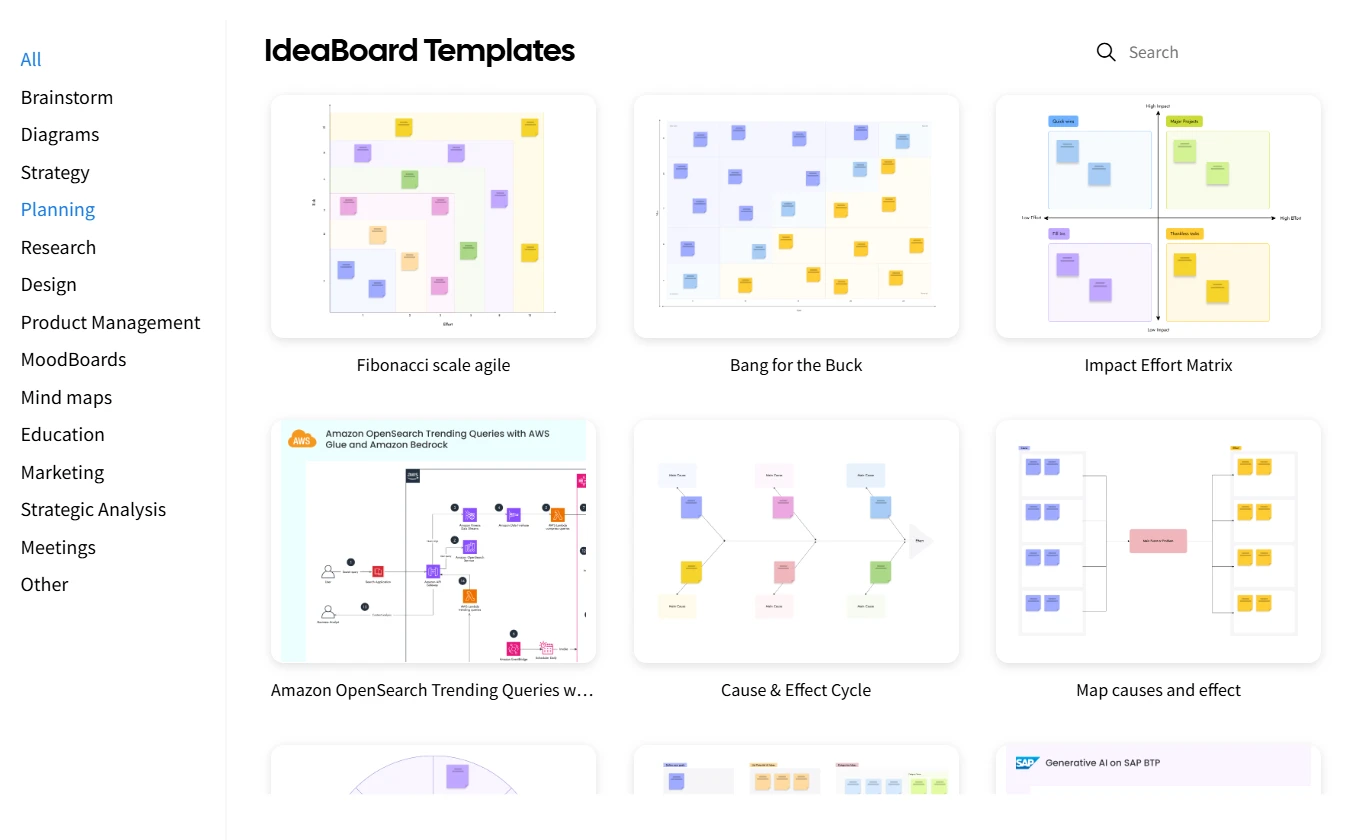
Many teams run SCAMPER sessions on shared visual canvases where ideas evolve in real time. Platforms like IdeaBoard offer an infinite whiteboard, real-time collaboration, and ready-made brainstorming templates, helping teams move faster than starting from a blank board.
When to use the SCAMPER brainstorming technique
The SCAMPER technique works best when teams already have a starting point. It is especially effective for:
- Improving an existing product or feature
- Breaking ideation stagnation
- Working within constraints
- Exploring early-stage concepts before validation
Since SCAMPER focuses on refinement and iteration, it excels in environments where incremental improvement matters more than radical reinvention.
Builders in indie communities often lean on classic frameworks like SCAMPER when constraints tighten, because structured prompts keep idea generation moving when ‘free brainstorming’ stalls.
In the next section, we’ll see how the SCAMPER technique plays out in real situations, using practical examples that show how these prompts lead to actionable ideas rather than abstract discussions.
Applying the SCAMPER Technique to Real-World Problems
The easiest way to understand the value of the SCAMPER technique is to see how it works in situations teams deal with every day. It helps teams make practical, focused changes that improve outcomes step by step.
That focus matters in modern teams. In fact, 75% of global knowledge workers already use AI at work, and 84% say it helps them be more creative. Frameworks like SCAMPER help teams turn that creativity into practical improvements instead of overwhelming idea lists.
Example 1: Improving a food delivery service
Consider a food delivery service struggling with customer retention. Orders come in, but repeat usage stays low. Instead of brainstorming entirely new features, the team applies SCAMPER to improve the existing experience.
- Using Substitute, the team questions current packaging choices and explores replacing single-use plastic with reusable containers. This change improves sustainability while creating a clearer brand differentiator.
- With Combine, the team experiments with bundling food delivery with meal planning or basic nutrition tracking. This adds value without changing the core service.
- Through Eliminate, they remove unnecessary menu steps and confirmation screens, reducing friction and speeding up ordering.
None of these ideas reinvents the business. Together, they create incremental improvements that make the service easier to use, more distinctive, and more likely to retain customers.
Example 2: Redesigning an internal team meeting process
SCAMPER also works beyond customer-facing products. Many teams struggle with meetings that feel repetitive and unproductive, even when everyone shows up prepared.
- Using Reverse, teams flip the meeting structure by sharing updates asynchronously before the meeting instead of during it. Live time shifts toward discussion and decisions.
- With Eliminate, they remove routine status reporting altogether, cutting down meeting length and fatigue.
- Through Combine, brainstorming and decision-making sessions merge into a single focused discussion, reducing handoffs and follow-up meetings.
These small changes dramatically improve clarity, engagement, and decision speed, showing how SCAMPER supports process improvement as effectively as product innovation.
The key lesson is simple: you do not need to apply every SCAMPER prompt every time. Effective sessions select the prompts that best match the problem at hand. This flexibility keeps ideation focused, practical, and easy to act on.
How to Run Brainstorming Sessions with SCAMPER Technique
Running a SCAMPER session is less about creative flair and more about good facilitation. When the process is clear, and the group stays aligned, SCAMPER helps teams move from scattered ideas to focused, actionable outcomes without losing momentum.
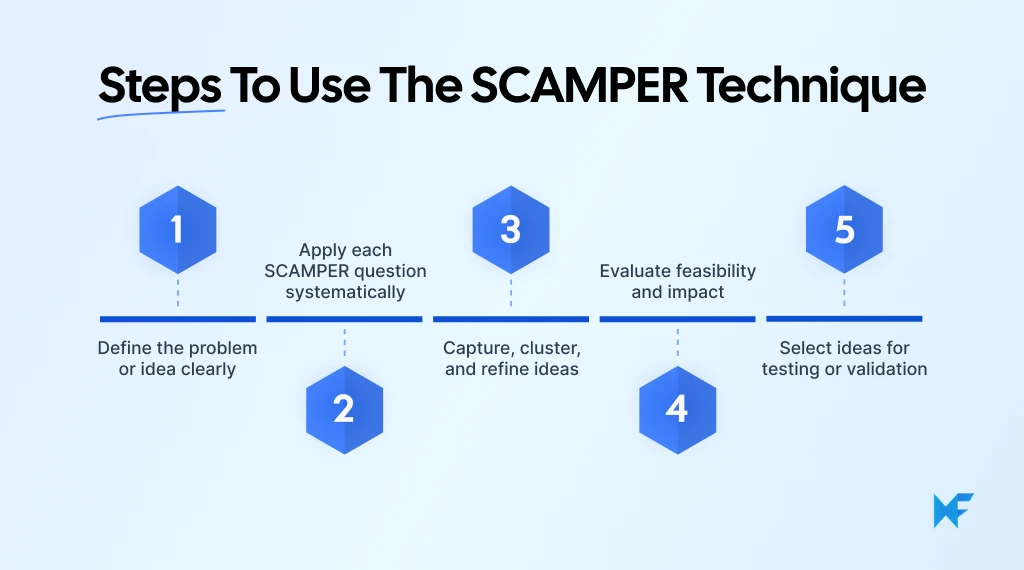
The steps below show how teams can run SCAMPER sessions that consistently lead to usable ideas.
Step 1: Define the problem or idea clearly
Every effective SCAMPER session starts with a well-defined focus. Teams need to agree on exactly what they are trying to improve, redesign, or rethink. This could be a product feature, a customer journey, an internal workflow, or a specific constraint that needs a workaround.
A clear problem statement gives the group boundaries to think within, keeps ideas relevant, and prevents the conversation from drifting into abstract or unrelated territory. When everyone understands the starting point, each SCAMPER prompt becomes easier to apply.
Step 2: Apply each SCAMPER question systematically
Rather than jumping between ideas, facilitators guide the group through SCAMPER prompts one at a time. This structure keeps discussions focused and ensures each type of question gets proper attention.
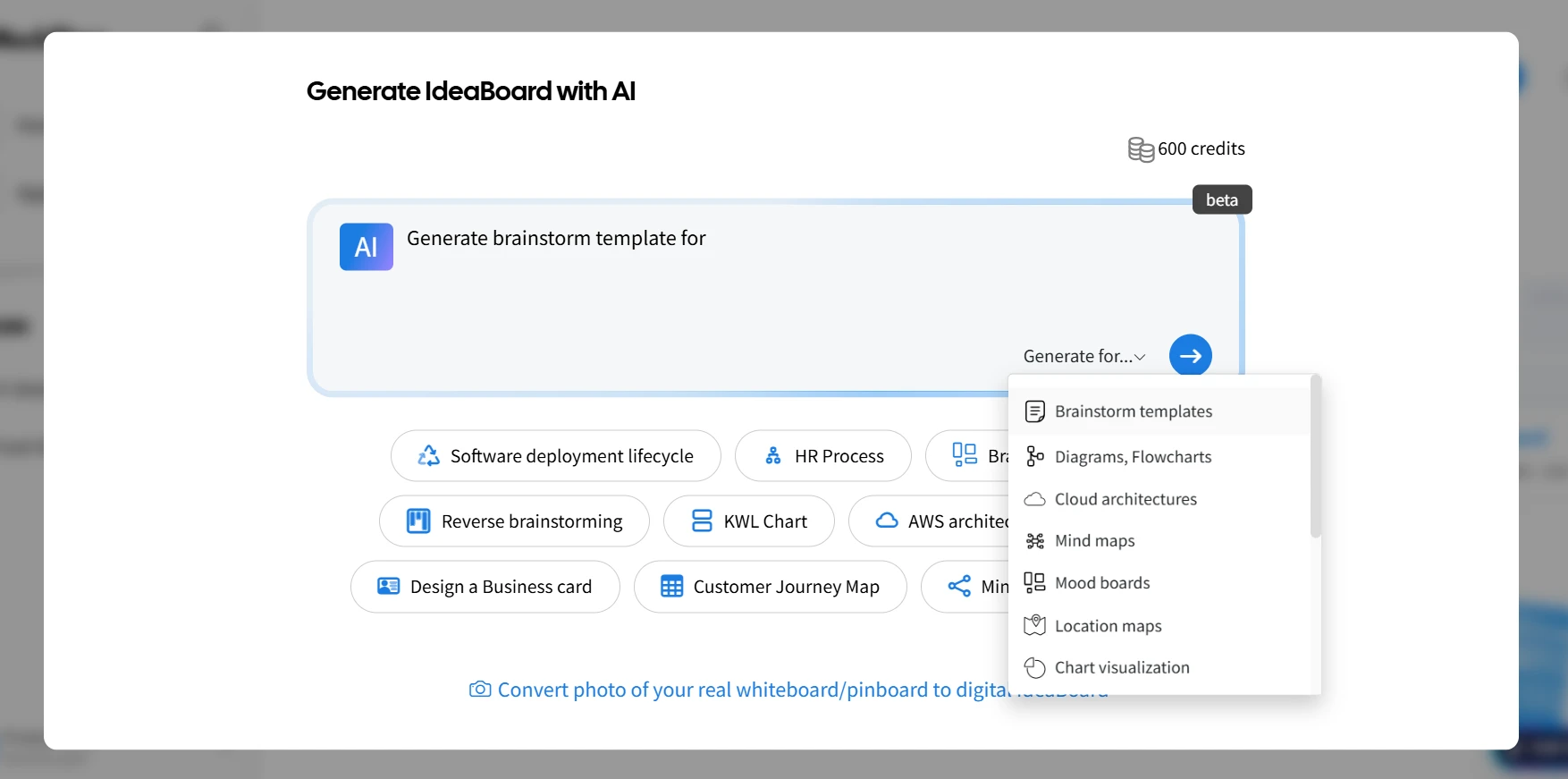
Using pre-built prompts can make this process easier to run consistently. MockFlow offers an AI Toolbox with prompt library that offers editable prompts for brainstorming and strategy sessions, allowing facilitators to quickly set up structured SCAMPER-style discussions using AI without manual preparation.
Not every prompt needs equal time. Strong facilitators adapt on the fly, skipping prompts that do not fit the problem and slowing down when a question sparks momentum. This flexibility helps the group stay engaged without forcing unnecessary steps.
Step 3: Capture, cluster, and refine ideas
Ideas surface quickly in group settings, and losing them breaks momentum. Capturing ideas visually as they emerge keeps everyone aligned and encourages participation from quieter voices. Clustering similar ideas helps the team spot patterns, remove duplicates, and build on promising directions.
Many teams use visual whiteboards like IdeaBoard to capture ideas in real time, group related concepts, and keep the entire discussion anchored in a shared space.
Microsoft’s 2025 Work Trend Index reports that 30% of meetings now span multiple time zones, and meetings starting after 8 p.m. are up 16% year over year, which makes a shared, visual workspace more practical than scattered notes.
Step 4: Evaluate feasibility and impact
After ideation, the session needs a shift from creativity to judgment. Teams review ideas through simple lenses such as effort, potential impact, and alignment with goals or constraints.
This step prevents good ideas from getting lost in volume. Clustering makes evaluation easier by surfacing which ideas deserve deeper exploration and which can be parked for later.
Step 5: Select ideas for testing or validation
The most common failure of brainstorming sessions is stopping at ideas. Effective SCAMPER sessions always end with decisions. Teams identify which ideas to prototype, test, or validate next and assign clear ownership.
Collaboration tools that support comments, visual organization, and shared ownership make this transition smoother by keeping ideas, context, and next steps in one place.
When facilitated this way, SCAMPER sessions stay focused, practical, and energizing. Tools like IdeaBoard has pre-built SCAMPER templates that help teams get started quickly with a ready-to-use layout at hand, so brainstorming leads to progress rather than another unfinished conversation.
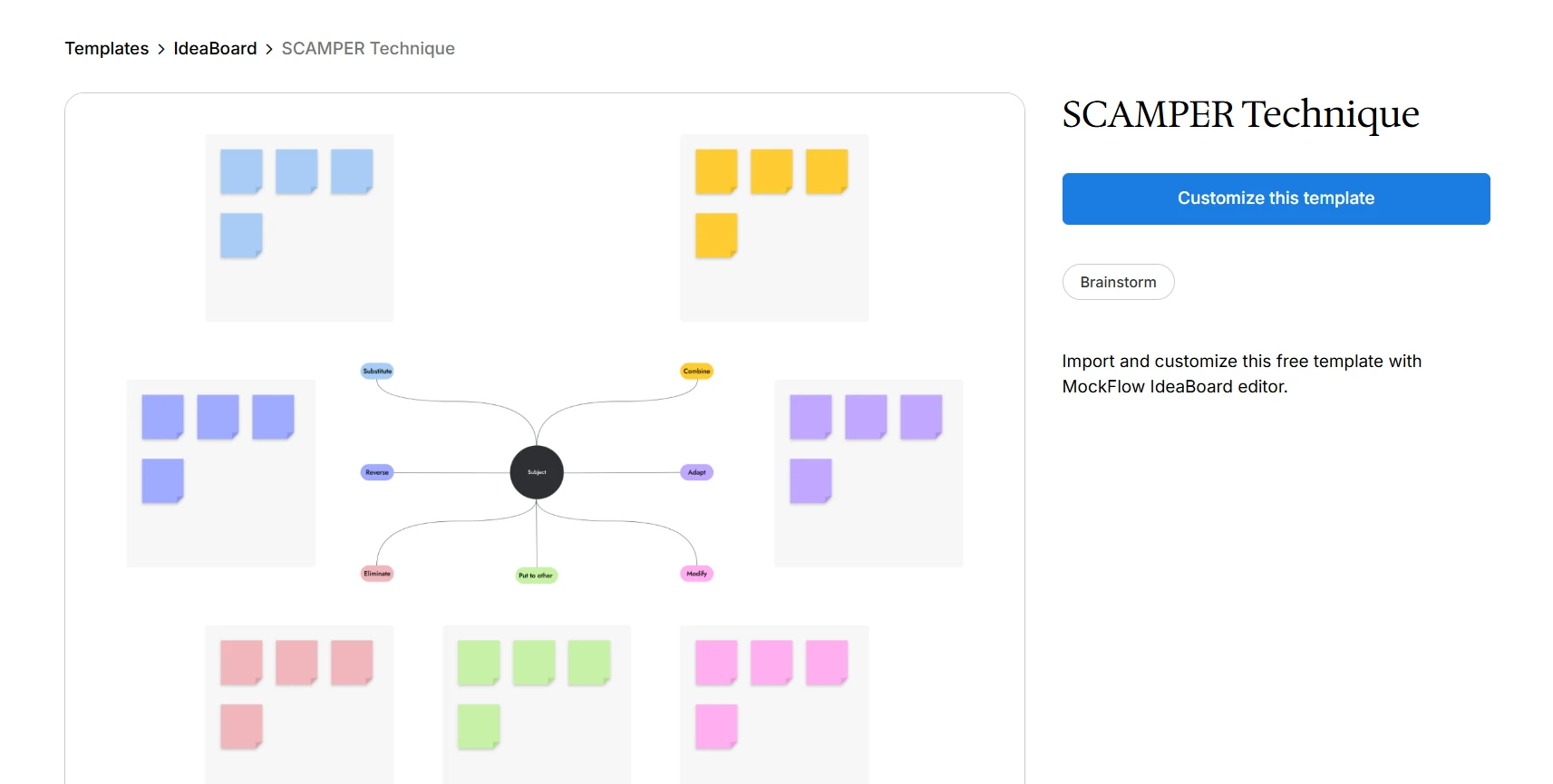
Click and edit this SCAMPER Technique template with IdeaBoard
If you’re curious about how structured SCAMPER sessions work in a real team setting, a free IdeaBoard demo can show you how guided prompts, visual organization, and collaboration come together to turn ideas into action.
Conclusion & Next Steps
Most teams struggle with turning creative discussions into decisions that actually move something forward. Brainstorming happens, but without structure and follow-through, the output rarely survives beyond the meeting.
If you’re serious about improving how your team generates and acts on ideas, the next step is putting a repeatable framework like the SCAMPER technique into practice, supported by a workspace that keeps thinking visible, organized, and actionable.
If you book a demo with IdeaBoard, here’s what the next step typically looks like:
- See how SCAMPER prompts can be mapped onto a shared visual canvas instead of scattered notes
- Explore ready-made brainstorming and ideation templates designed for structured sessions
- Learn how teams capture, cluster, and refine ideas in real time without losing context
- Understand how collaboration, comments, and visual organization help move from ideas to action
If you’re curious about making SCAMPER a consistent part of how your team thinks and works, sign up on IdeaBoard and see how structured ideation can actually translate into progress.
FAQs about SCAMPER Technique
1. What is the SCAMPER Technique?
The SCAMPER Technique is a structured creative thinking method that helps generate and improve ideas through guided questions. It uses seven prompts to rethink existing products, services, processes, or strategies in a systematic way.
2. How does the SCAMPER Technique work in brainstorming?
The SCAMPER Technique works by prompting teams to ask targeted questions under each SCAMPER category. These questions guide brainstorming sessions, expand idea options, and help teams explore improvements without starting from scratch.
3. What does SCAMPER stand for in creative thinking?
SCAMPER stands for Substitute, Combine, Adapt, Modify, Put to another use, Eliminate, and Reverse. Each term represents a specific type of question used to examine and improve an existing idea or solution.
4. How can I use the SCAMPER Technique for product innovation?
Product teams use the SCAMPER Technique to improve features, redesign workflows, or explore new use cases. By applying each SCAMPER prompt, teams can identify practical enhancements and incremental innovations for existing products.
5. Is the SCAMPER Technique useful for business problem-solving?
The SCAMPER Technique supports business problem-solving by providing a clear framework for idea generation. Teams apply it to improve processes, reduce constraints, and explore alternative strategies through structured questioning.
6. What are the benefits and limitations of the SCAMPER Technique?
The SCAMPER Technique offers simplicity, flexibility, and ease of use across teams. It works best for improving existing ideas but may be less effective for generating entirely new concepts without a starting point.

What are Ecosystem Maps? Examples, Template, and How to Create One
When teams talk about how a business or product really works, the conversation rarely stays within one function. Someone...

Storyboard vs Wireframe: When to Use Each in UX Design
TL;DR A storyboard breaks the experience into scenes: who the user is, what triggers the need, what steps they take, where...
Bubble Map: Templates, Comparisons, and Practical Uses
Introduction There’s something about seeing ideas laid out visually that just feels easier to follow. You’re not reading line by...
