How to Use Reverse Brainstorming for Creative Problem-Solving in 2026
Introduction
So, reverse brainstorming. It’s not exactly your usual “let’s come up with solutions” kind of brainstorming. Instead of figuring out what works, you start by thinking about what could make the situation worse. Sounds a bit unconventional, right? But that’s exactly what makes it such a powerful tool for unlocking creativity.
We’ve all had those moments in brainstorming sessions where the ideas feel a bit... predictable. The reverse thinking technique shakes things up. By flipping the problem, you force yourself to step outside the usual patterns and get to the heart of the issue. It’s about challenging the status quo, seeing things from a completely different angle, and coming up with solutions you might have missed otherwise.
In this post, we’re diving into how reverse brainstorming works, why it’s so effective, the different techniques, and how you can start using it in your own team to break through the noise and spark fresh, innovative ideas.
What is Reverse Brainstorming?
Reverse brainstorming is a creative problem-solving technique that challenges traditional thinking. By reversing the problem, like asking what actions would worsen the situation, teams uncover deeper insights and innovative solutions.
This method encourages unconventional thinking, reduces groupthink, and fosters collaboration. It helps identify root causes, uncover hidden opportunities, and improve overall efficiency in problem-solving.
Reverse thinking disrupts the norm by focusing on negative ideas, which are then transformed into actionable solutions, making it a powerful tool for teams seeking breakthrough ideas in any industry.
In short, instead of asking how to fix a problem, you ask how to make it worse. It’s a counterintuitive approach that leads to new perspectives and often results in innovative, effective solutions.
How Does Reverse Brainstorming Work?
Reverse brainstorming works by using negative thinking to uncover positive solutions. When facing a challenge, teams flip the problem on its head and think about the opposite. For example, rather than brainstorming ways to improve a product, the team might brainstorm how to make the product worse. This exercise often leads to discovering root causes, gaps, and opportunities that would have gone unnoticed.
Through this process, teams can tackle complex problems more creatively, shifting their focus from solving symptoms to addressing core issues.
Advantages of Reverse Brainstorming
Research on the brain’s natural negativity bias suggests that our brains are wired to pay more attention to negative outcomes than positive ones, making it easier for us to engage with ‘worst-case scenarios’ and uncover valuable insights. According to this study on negativity bias, focusing on what could go wrong can spark more profound problem-solving and innovation.
Here are some key advantages:
- Disrupting Traditional Thinking: One of the core benefits of reverse brainstorming is that it disrupts the usual thought processes. By focusing on what could go wrong, teams are forced to think outside the box, leading to breakthrough ideas and fresh approaches.
- Identifying Root Causes: When brainstorming what could worsen a situation, teams are often able to pinpoint the root causes of their challenges, rather than just addressing surface-level symptoms. This deeper understanding makes it easier to implement long-lasting solutions.
- Encouraging Innovative Ideas: Reverse brainstorming fosters a culture of creativity. It encourages participants to step away from conventional problem-solving strategies and engage in more open-ended, outside-the-box thinking.
- Reducing Groupthink: Traditional brainstorming sessions can sometimes lead to groupthink, where participants simply agree with the first solution that is presented. Reverse brainstorming helps mitigate this by prompting diverse and sometimes contradictory ideas that encourage a more thorough exploration of potential solutions.
Studies show that flipping the problem, or thinking oppositely, can lead to creative breakthroughs. PMC Study on Creativity highlights that techniques like reverse thinking, which focus on generating negative outcomes, help uncover hidden insights that traditional brainstorming methods miss.
Reverse Brainstorming Techniques
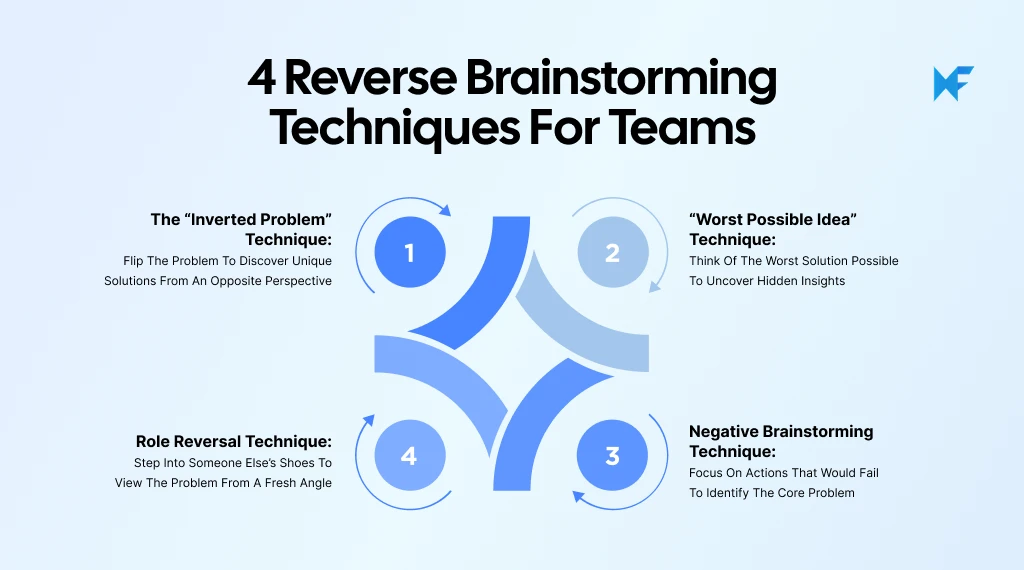
This problem-solving technique encourages teams to explore unconventional solutions by first considering ‘bad’ ideas. As noted in this ResearchGate study, thinking through ‘impossible ideas’ helps uncover hidden opportunities and drives creative problem-solving with reverse brainstorming.
To get the most out of it, using a few structured techniques can help steer your team in the right direction.
Technique 1: “Worst Possible Idea”
This technique encourages your team to think of the absolute worst possible solutions to a problem. By exaggerating the negative outcomes, you can uncover insights that can be flipped into innovative solutions. The more extreme the ideas, the better.
Imagine you're working on a product launch, and instead of brainstorming ideas for success, you ask, “What would make this launch a disaster?” You might come up with ideas like “launch without any marketing” or “delay the product for months.” Now, flip those ideas: create a strong marketing plan and ensure timely delivery. This approach helps highlight the critical elements that will make your product launch successful.
Technique 2: Negative Brainstorming
Negative brainstorming focuses on deliberately considering what could go wrong, like what actions or strategies would lead to failure. By examining these potential pitfalls, teams are able to identify vulnerabilities and pivot toward more robust, positive solutions.
For instance, if you're brainstorming ways to reduce customer churn, you could ask, “What could drive customers away?” The list might include “poor customer service” or “lack of personalization.” Once those ideas are out in the open, the team can work on solutions like better training for support teams or implementing personalized offers, directly addressing the root causes of churn.
Quick tip: One effective way to shift your mindset is to literally write the opposite of what you want to achieve. This method encourages you to list actions that would lead to the opposite of your desired outcome. Once you’ve done that, flipping each negative idea into a positive solution can help you think creatively and spark new ideas you might not have considered."
Technique 3: Role Reversal
In role reversal, team members take on different perspectives, such as a customer, competitor, or even the opposite viewpoint. By stepping into someone else’s shoes, the team gains new insights and ideas that may not have been considered from their usual standpoint.
Say your team is working on improving the user experience of a website. Ask a designer to take on the role of a frustrated user, or a developer to act as a competitor. From this reversal thinking, new ideas may emerge, like simplifying the navigation or adding more intuitive features, which might have been overlooked in the original brainstorming session.
Technique 4: The “Inverted Problem”
This technique flips the problem on its head. Instead of asking “How can we increase sales?” you ask, “How can we make fewer sales?” This counter-intuitive approach forces the team to think differently, uncovering insights that may not emerge from traditional brainstorming.
If you’re focused on boosting sales, asking “How can we make fewer sales?” might lead you to insights like “focus on higher-value customers” or “limit the scope of our product to attract a more specific audience.” By considering the opposite goal, you identify strategies that are both surprising and effective in growing your business in the long run.
To sum up, these techniques aren’t just about being creative for the sake of it. They help you break free from the usual thought patterns and get to more meaningful, actionable ideas. Each one brings something different to the table, and when combined, they can really take your problem-solving to the next level.
Reverse Brainstorming Examples in Action
Now that we’ve covered the techniques, let’s look at some examples of reverse brainstorming to see how it plays out in real-world situations. This method is effective across industries like marketing, product development, HR, operations, and can help teams tackle challenges in ways that traditional brainstorming might miss.
Example 1: Marketing Teams: Strengthen Brand Awareness
Imagine a marketing team tasked with improving brand awareness. Instead of brainstorming ways to boost visibility, they reverse the problem by asking, “What could damage our brand reputation?” They might come up with ideas like poor customer service, misleading advertising, or lack of engagement on social media.
By identifying these negative actions, they can flip them into solutions like better customer support, authentic campaigns, and more interactive social content. It helps the team not only to strengthen the brand’s presence but also to avoid costly missteps.
Example 2: Product Teams: Speed Up Time to Market
For a product team working on accelerating time to market, negative brainstorming could involve asking, “How could we make our product launch slower?” Ideas might include delays in development, lack of testing, or poor communication between teams.
By addressing these issues, the team can speed up the process by ensuring quicker testing, better cross-functional collaboration, and streamlined workflows. This reverse approach reveals inefficiencies that might have gone unnoticed, ultimately speeding up the launch.
Example 3: HR Teams: Retain Top Talent
An HR team focused on employee retention might ask, “What could make our employees leave?” They might identify factors like lack of career development opportunities, poor work-life balance, or non-competitive benefits.
By turning these negatives around, they could implement programs that promote career growth, offer flexible work schedules, and create more attractive benefits packages. Reverse brainstorming helps HR teams pinpoint areas for improvement in their employee retention strategies, ensuring a happier, more engaged workforce.
Example 4: Operations Teams: Improve Efficiency in Daily Tasks
For an operations team looking to streamline processes, negative brainstorming might involve asking, “What could cause inefficiency in our daily operations?” They might identify problems like redundant tasks, outdated technology, or lack of clear communication.
By reversing these, the team can focus on simplifying workflows, upgrading technology, and improving communication across departments. This technique helps uncover hidden inefficiencies, making it easier to optimize daily operations and boost productivity.
Quick tip: A creative application of reverse brainstorming can be seen in strategy-based environments where players use it to disrupt an opponent’s strategies. In the same way, teams can use it to think about ways to ‘disrupt’ their own operations. For example, asking how to deliberately slow down a process can reveal inefficiencies, which can then be targeted and improved.
How to Use Reverse Brainstorming in Your Team
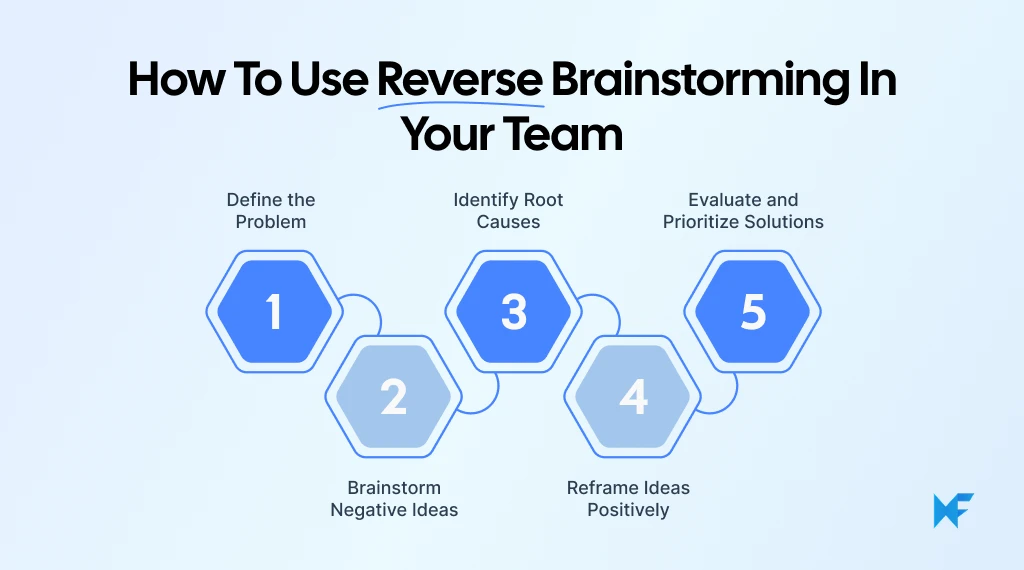
Reversal thinking can be an incredibly effective tool for tackling problems in creative ways. To make the process smooth and structured, here’s a step-by-step guide you can follow with your team.
Step 1: Define the Problem
Before diving into brainstorming, make sure the problem is clearly defined. This might seem like a simple task, but it’s crucial to ensure everyone on the team has a shared understanding of the issue at hand. Without a clear, concise definition, you risk going off-track and generating irrelevant ideas.
Take the time to discuss the problem thoroughly and ensure everyone understands the specifics and the context. If needed, break the problem down into smaller parts to make it easier to approach. The more precise your definition, the more targeted your brainstorming session will be.
Step 2: Brainstorm Negative Ideas
Now that the problem is defined, it’s time to start thinking backwards. Ask your team to come up with the worst possible ideas or actions that could worsen the situation. Encourage wild, out-of-the-box thinking, and don't be afraid to go extreme. The goal isn’t to generate solutions at this point but to explore all the ways things could go wrong. The more exaggerated the ideas, the better.
Let your team members feel free to think without limits. They should focus on negative actions like what could actively make the problem worse? These ideas might seem absurd at first, but they are key to understanding the real pain points or obstacles.
Step 3: Identify Root Causes
Once you have a list of negative ideas, step back and take a critical look. It’s time to dig deeper and identify the root causes of the issues your team just brainstormed. The negative ideas will often highlight core problems that might not have been obvious at first glance.
Ask questions like, “What lies beneath this bad idea?” or “What’s the underlying issue behind this negative outcome?” This is where reverse brainstorming gets interesting. By focusing on negative scenarios, you often uncover the root causes of problems that are difficult to identify using traditional brainstorming methods.
Step 4: Reframe Ideas Positively
Now comes the turning point: take the negative ideas and reframe them into positive solutions. For each "worst-case scenario," think about how you can address it constructively. The idea is to transform these exaggerated negative actions into concrete, actionable steps that solve the problem effectively.
For example, if one of the negative ideas was “Increase the price of our product without adding any value,” the positive reframing might be, “Find ways to add more value through additional features or services that justify the price increase.” This reframing process helps your team generate actionable solutions that tackle the root causes identified earlier.
Step 5: Evaluate and Prioritize Solutions
With your list of positive solutions in hand, it’s time to evaluate which ones are the most feasible and impactful. Not all solutions will be practical, so it’s essential to assess each one for its potential to resolve the problem and its ease of implementation.
As a team, discuss the impact of each solution and how realistic it is to carry out. Consider resources, timelines, and the overall effect each solution could have. Once you’ve evaluated them, prioritize the solutions that can be implemented most effectively and will deliver the greatest impact.
By following these five steps, your team can use reverse brainstorming to uncover innovative solutions to complex problems. When used correctly, it can lead to breakthrough ideas that wouldn’t have been discovered through traditional methods.
Using the Right Tool for Reverse Brainstorming
Using the right tool can make this technique much more effective, especially when you need to organize and collaborate on a large number of ideas. A structured platform helps keep everything on track and ensures that no insights are missed.
MockFlow IdeaBoard is an excellent tool for reverse brainstorming. It’s designed to help teams quickly capture, organize, and prioritize ideas while facilitating collaboration. Here’s how it supports this method:
- Dedicated Template: IdeaBoard offers a pre-built reverse brainstorming template that guides the session structure, including sections like “Define the problem” and “Reverse the ideas,” so your team can start right away.
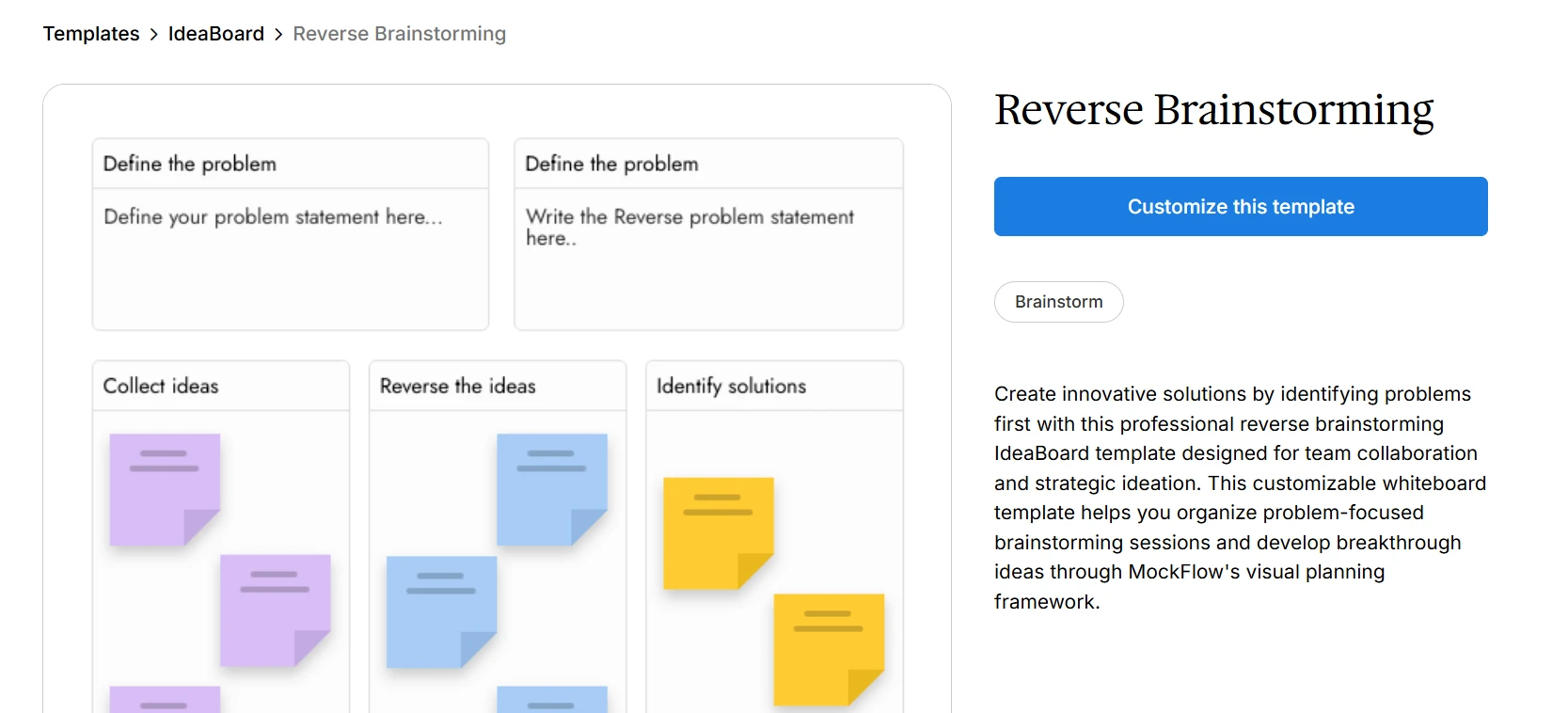
- Infinite Canvas & Diagramming Tools: The infinite canvas, sticky notes, arrows, and connectors let you visualize and organize a growing set of ideas without worrying about space.
- Templates & AI Prompt Library: IdeaBoard offers ready-to-use templates for all brainstorming needs. The AI Toolbox offers editable prompts tailored to reverse brainstorming, helping you kickstart sessions with ready-made frameworks.
- Real-Time Collaboration: Team members, especially remote teams, can add ideas simultaneously, helping capture diverse perspectives and speed up the ideation process.
- Multimedia Commenting: With voice and video comments, you can leave richer context on ideas, perfect for explaining or contrasting solutions.
- Exporting & Sharing Capabilities: Once the brainstorming session is over, you can export the board as images or PDFs, making it easy to share and document.
- Trello Power-Up: If your team uses Trello, you can integrate IdeaBoard directly into your Trello workflow, making reverse brainstorming seamless within task management.
By using IdeaBoard, you can ensure that these brainstorming sessions are structured, collaborative, and productive. It combines visual organization with real-time feedback, helping your team move from problem identification to actionable solutions efficiently.
Conclusion
Reverse brainstorming goes beyond traditional ideation methods by asking teams to consider what could make a problem worse, a concept that is rooted in deeper cognitive strategies. As research on brainstorming suggests, challenging conventional thinking by focusing on negative outcomes often reveals more impactful and innovative solutions.
If you’re ready to take your brainstorming sessions to the next level, we encourage you to try this innovative problem-technique with your team. To make the process even more effective, consider using MockFlow IdeaBoard. It’s a great tool that helps structure your session, enables real-time collaboration, and makes organizing ideas effortless.
Ready to give it a go? Try IdeaBoard for free and see how it can enhance your reverse brainstorming process. Sign up for free or install IdeaBoard on Chrome to get started today!
FAQs about Reverse Brainstorming
1. What is reverse brainstorming, and how does it work?
Reverse brainstorming is a creative problem-solving technique where teams explore the negative aspects of a problem to uncover new solutions. Instead of asking, "How can we solve this?" participants focus on "What could make this worse?" This method reveals hidden challenges and sparks innovative ideas by turning conventional thinking upside down.
2. How can reverse brainstorming improve team collaboration?
Reverse brainstorming enhances team collaboration by encouraging diverse perspectives. When teams focus on the opposite of the problem, they break away from groupthink, fostering an environment where each participant feels empowered to contribute unique insights. This collaborative process strengthens the collective problem-solving capability of the team.
3. How is reverse brainstorming different from traditional brainstorming?
Unlike traditional brainstorming, where the goal is to generate solutions directly, reverse brainstorming flips the approach. It asks participants to consider how to worsen a situation, uncovering potential barriers or overlooked causes. This shift in perspective can lead to more creative and actionable solutions that traditional methods might miss.
4. What are the steps involved in reverse brainstorming?
The steps in reverse brainstorming include:
- Define the problem clearly.
- Brainstorm negative ideas: what could make the problem worse.
- Identify root causes from the negative ideas.
- Reframe those negative ideas into positive, actionable solutions.
- Evaluate and prioritize the solutions for effectiveness and feasibility.
5. Can reverse brainstorming be applied in all industries?
Yes, idea reversal techniques can be applied across all industries. Whether in marketing, product development, or operations, this method helps teams think outside the box to find innovative solutions, tackle complex problems, and overcome challenges specific to their field.
6. What tools can help facilitate reverse brainstorming sessions?
Tools like MockFlow IdeaBoard are specifically designed to support this brainstorming technique. IdeaBoard offers features like pre-built templates, infinite canvas for visual organization, real-time collaboration, and AI-powered prompts, making it easier for teams to structure, capture, and refine their brainstorming ideas.

8 Types of Storyboards for Film, Animation, UX, Games, and Marketing
TL;DR Storyboards are visual plans that organize scenes, actions, timing, flow, and ideas before production. Common storyboard...

How to Create a Landing Page Wireframe (Step-by-Step Guide)
Your SEO team has executed a brilliant strategy, ensuring your website receives the impressions and clicks it deserves. The...

Virtual Team Building Games: 14 Ideas for Remote & Hybrid Teams
Introduction Remote teams are now the norm, not the exception. For all the benefits of flexibility and location freedom, remote...
