
Structured Brainstorming: How It Works, Benefits & Techniques
Introduction
A productive brainstorming session should give everyone room to contribute and help the team move toward useful ideas. Yet discussions can easily lose direction when a few voices dominate, suggestions pull the group in different directions, or there's no clear way to decide what comes next.
Structured brainstorming gives teams a clear process for contributing ideas, exploring different perspectives, and evaluating possible solutions without restricting creativity.
With the right structured brainstorming techniques, teams can encourage balanced participation, keep discussions focused, and reach decisions with greater clarity.
This guide explores how structured brainstorming works, the techniques teams can use, and a practical five-step process for running effective sessions.
What is structured brainstorming and when should teams use it?
Structured brainstorming is a method of generating ideas through a planned sequence of activities. A facilitator guides participants from exploring possibilities to evaluating potential solutions.
Building on Alex Osborn's brainstorming principles, it separates the process into two stages:
- Divergent thinking: Generating ideas without immediate criticism.
- Convergent thinking: Reviewing ideas to identify promising solutions.
Techniques like brainwriting and round-robin provide different ways to organize idea generation. The World Economic Forum’s Future of Jobs Report 2025 identifies analytical thinking as essential for around 7 in 10 employers. For brainstorming, that means giving teams time to examine assumptions and compare options after generating ideas.
Structured brainstorming is especially useful for:
- Product and feature planning: Bring together perspectives from design, development, and customer support to identify improvements based on shared priorities.
- Cross-functional collaboration: Help departments with different priorities explore a problem from multiple perspectives.
- Strategic decision-making: Examine possible directions systematically before deciding which ones to pursue.
- Recurring workshops: Use a consistent framework to make sessions easier to facilitate and document.
- Remote and hybrid teams: Establish participation guidelines that accommodate people working from different locations.
Structured vs. unstructured brainstorming: Key differences
Structured brainstorming uses a predefined framework, while unstructured brainstorming allows ideas to develop more spontaneously.
Aspect | Structured brainstorming | Unstructured brainstorming |
Objective | Defined beforehand | May emerge during discussion |
Agenda | Planned activities | Flexible discussion |
Participation | Guided by rules | Open contributions |
Facilitator | Usually assigned | Optional |
Idea generation | Agreed framework | Free-flowing |
Evaluation | Separate, organized stage | Often informal |
Best suited for | Focused problem-solving | Quick, informal exploration |
The two methods can also complement each other. Teams can begin with spontaneous ideation and then use a structured framework to organize and evaluate their suggestions.
Key benefits of structured brainstorming
Structured brainstorming improves the quality of team discussions by giving everyone a fair opportunity to contribute. It helps teams explore more ideas before making decisions, keeps conversations focused, and provides a reliable way to turn suggestions into actionable priorities.
A shortlist still needs validation. Test selected ideas before implementation through a small trial or prototype, and use the findings to decide which suggestions deserve further work.
Here's how structured brainstorming benefits teams:
- Get everyone involved: Turn-taking or independent contributions give each participant a chance to share ideas without competing for attention.
- Keep discussions on track: A clear problem statement and agenda help your team stay focused on the goal and make better use of meeting time.
- Explore more possibilities: Separating idea generation from evaluation gives your team time to consider different approaches before settling on a solution.
- Bring in different perspectives: Gather independent input from designers, developers, and customer-facing colleagues to uncover opportunities that one team might overlook.
- Make sense of collected ideas: Group related suggestions into themes to spot recurring concerns and identify opportunities worth exploring.
- Leave with clear next steps: Use a dedicated evaluation stage to agree on priorities and assign responsibility for moving selected ideas forward.
- Run consistent sessions: Reuse established formats to simplify preparation and maintain a reliable approach across future brainstorming workshops.
Top 6 structured brainstorming techniques for teams
Structured brainstorming techniques help teams generate better ideas through focused participation and guided discussions. Each technique offers a different way to approach a problem, giving teams a practical framework to explore possibilities and make more informed decisions.
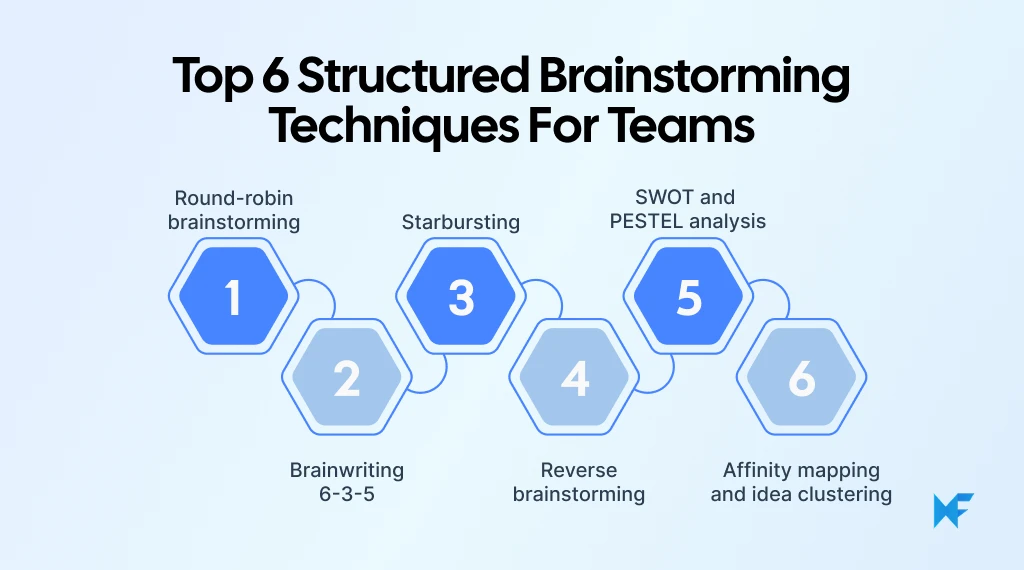
Choosing the right technique depends on what your team needs to accomplish during the session.
1. Round-robin brainstorming
Round-robin brainstorming is a structured technique where participants take turns sharing one idea at a time. The process follows a fixed order, giving everyone an opportunity to contribute before the next round begins.
Here's how it works:
- Present a specific problem or question to the group.
- Ask each participant to share one idea in sequence.
- Record every suggestion without immediately evaluating it.
- Continue with additional rounds until the team has explored enough possibilities.
For example, when brainstorming improvements to customer onboarding, each team member can suggest one change per round. A designer might propose simplifying account setup, while a customer support representative might suggest clearer instructions based on common user questions.
When to use it: Round-robin brainstorming works well for cross-functional teams and workshops where balanced participation matters. The turn-taking format prevents more vocal participants from dominating the discussion and gives everyone time to develop their ideas.
You can use MockFlow's round-robin brainstorming template to get the session started without setting up the board yourself. Participants can add their suggestions across rounds, making it easier to track contributions and review everyone's ideas together.
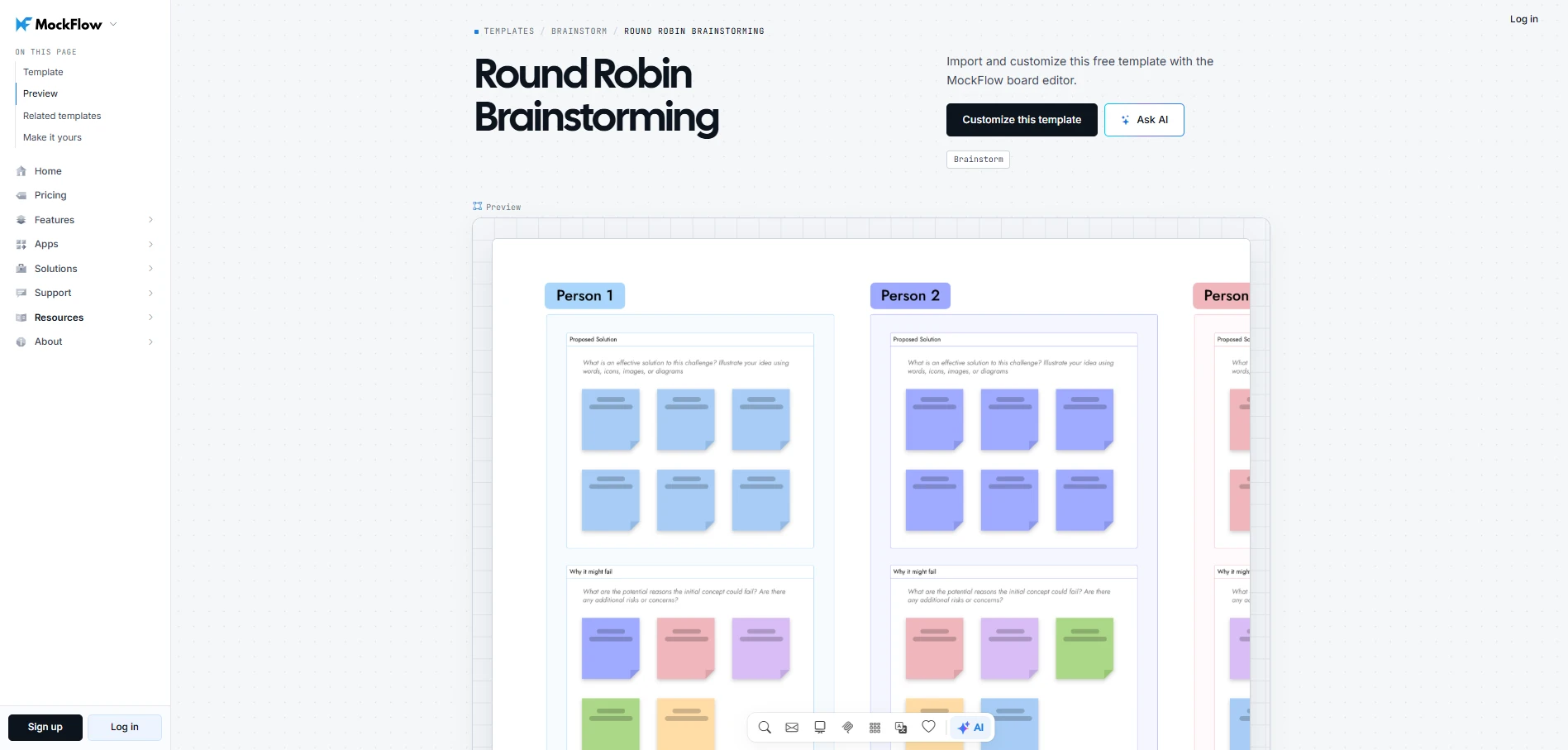
Customize this round robin brainstorming template
2. Brainwriting 6-3-5
Brainwriting 6-3-5 is a structured brainstorming technique where six participants write three ideas in five minutes. The ideas are then passed to other participants, who build on existing suggestions through successive rounds.
Here's how it works:
- Each participant writes three ideas independently within five minutes.
- Participants pass their ideas to the next person, who reviews and builds on them.
- The process continues for six rounds before the team reviews the collected ideas.
Silent contributions reduce interruptions and give participants time to think without pressure from the group.
When to use it: Brainwriting 6-3-5 works well when teams need a variety of ideas quickly. For example, a marketing team planning a campaign can develop initial concepts independently, expand on colleagues' suggestions, and then review the results together.
MockFlow's brainwriting 6-3-5 template gives participants a shared structure for recording their ideas across rounds. You can focus on keeping the exercise moving while everyone builds on the suggestions already collected.
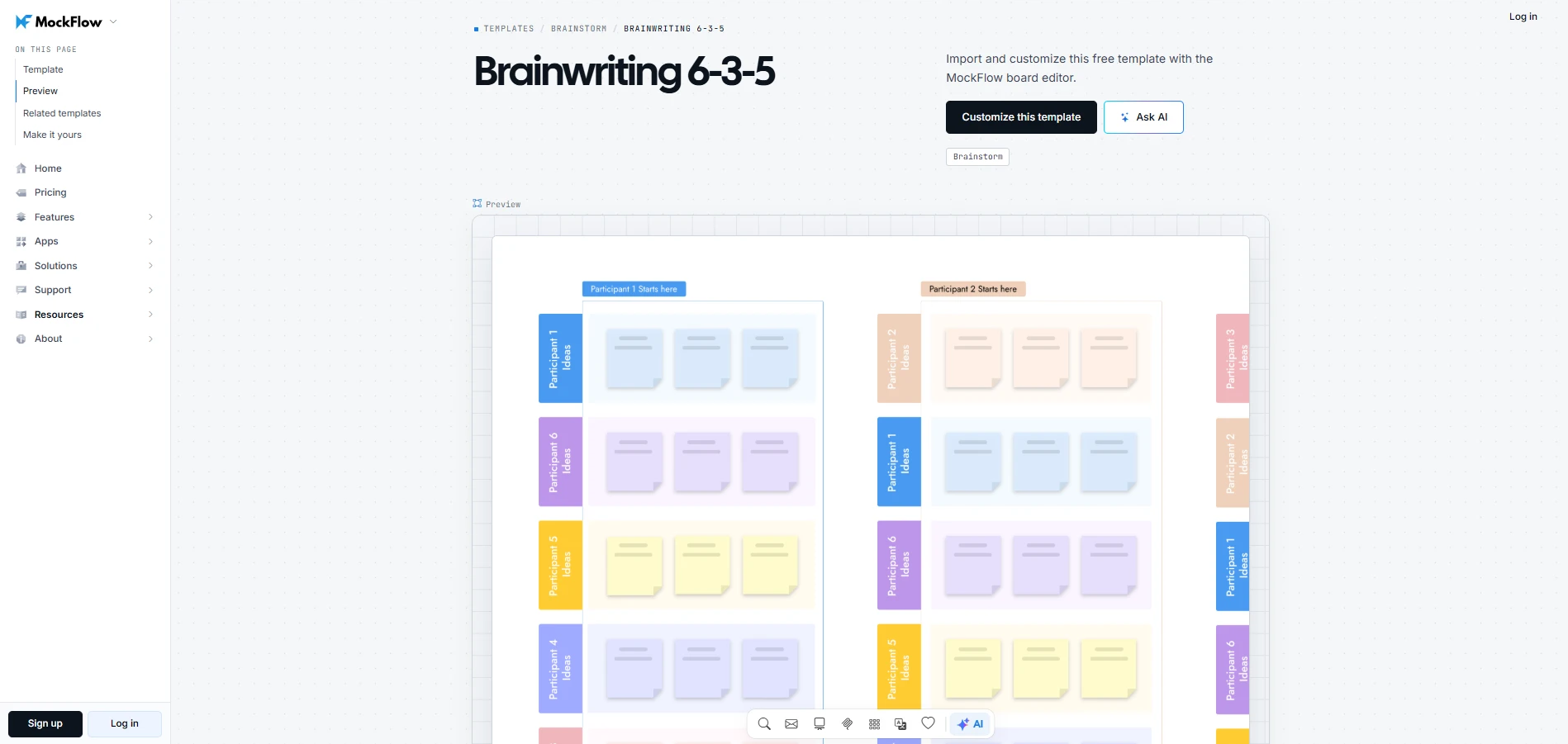
Customize this brainwriting 6-3-5 template
3. Starbursting
Starbursting is a question-based brainstorming technique that helps teams examine an idea before deciding how to implement it. The process uses six guiding questions to explore who is involved, what the idea aims to achieve, when and where it applies, why it matters, and how it could work.
Here's how it works:
- Place the idea at the center of the board.
- Develop questions under each category. For a new product feature, ask:
- Who will use the feature?
- Why would users need it?
- How will it fit into their workflow?
- Review the questions to identify missing information and assumptions that need validation.
When to use it: Starbursting is useful during early product exploration or project planning, when teams need to clarify requirements before developing solutions. By focusing on questions first, teams can avoid building solutions around untested assumptions.
You can start with MockFlow's starbursting brainstorming template, which organizes the six question categories around a central idea. Participants can move straight into exploring questions without spending time setting up the framework.
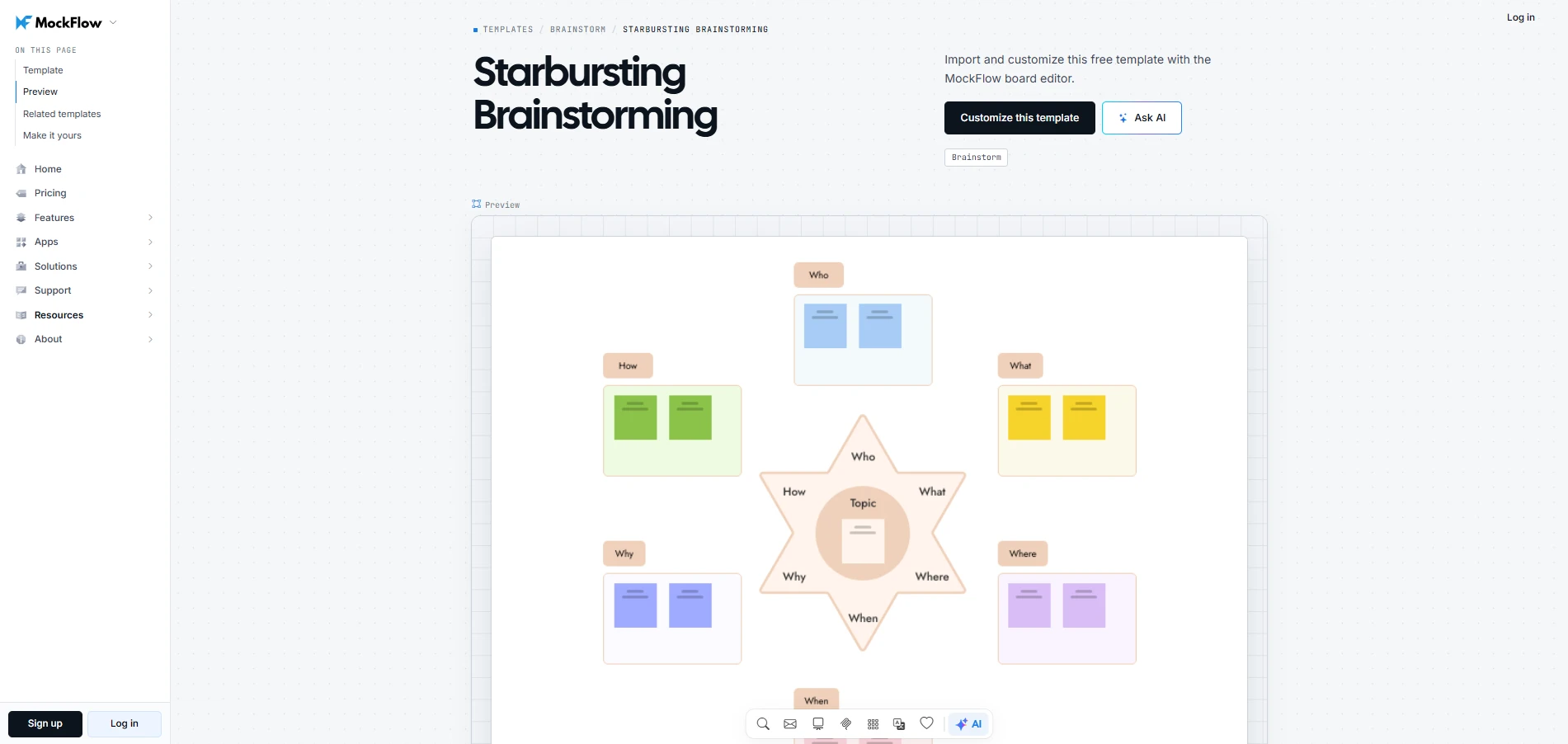
Customize this starbursting brainstorming template
4. Reverse brainstorming
Reverse brainstorming is a problem-solving technique where teams explore how to create or worsen a problem before identifying solutions. The approach helps uncover risks and weaknesses that might otherwise go unnoticed.
Here's how it works:
- Reverse the problem: Ask, "How could we make user onboarding unnecessarily difficult?"
- Generate negative ideas: Participants might suggest hiding instructions or adding unnecessary registration steps.
- Identify underlying issues: Recognize how unclear guidance or complicated registration could frustrate users.
- Convert ideas into solutions: Introduce clearer instructions and simplify the registration process.
When to use it: Reverse brainstorming works well for identifying process weaknesses or improving customer experiences, especially when conventional ideas aren't addressing the underlying problem.
MockFlow's reverse brainstorming template gives your team a structured space to capture what could go wrong and work through possible solutions. You can keep the negative ideas visible while discussing how to address the problems they reveal.
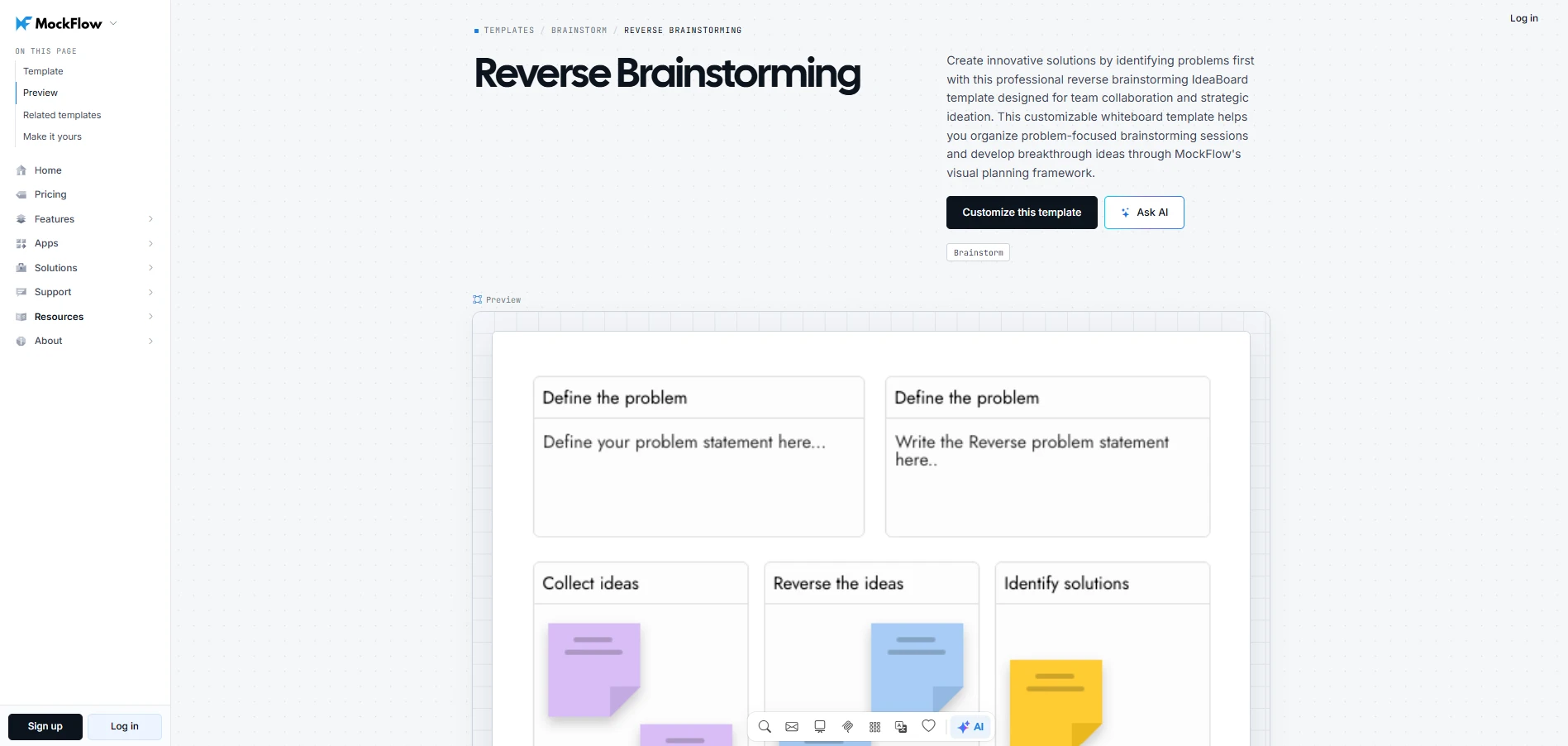
Customize this reverse brainstorming template
5. SWOT and PESTEL analysis
SWOT and PESTEL analysis are structured frameworks that help teams explore a problem through predefined categories. Both are useful when strategic decisions require a broader understanding of influencing factors.
SWOT analysis examines four areas:
- Strengths: Internal advantages the team can build on.
- Weaknesses: Internal limitations that need attention.
- Opportunities: External conditions that could support growth.
- Threats: External risks that could affect success.
PESTEL analysis examines six external factors:
- Political: Government policies and political conditions.
- Economic: Market conditions and purchasing power.
- Social: Customer behaviors and changing preferences.
- Technological: Emerging technologies and industry developments.
- Environmental: Sustainability expectations and environmental conditions.
- Legal: Regulations and compliance requirements.
For example, a team exploring a new market can use SWOT to assess its competitive position and PESTEL to examine external conditions that might influence the decision.
When to use them: SWOT helps teams evaluate strategic options, while PESTEL is useful when market changes or external uncertainties could affect a project.
For a SWOT exercise, you can use MockFlow's brand SWOT analysis template to organize contributions under the four categories. Your team can focus on examining the factors affecting a decision without having to create the framework from scratch.
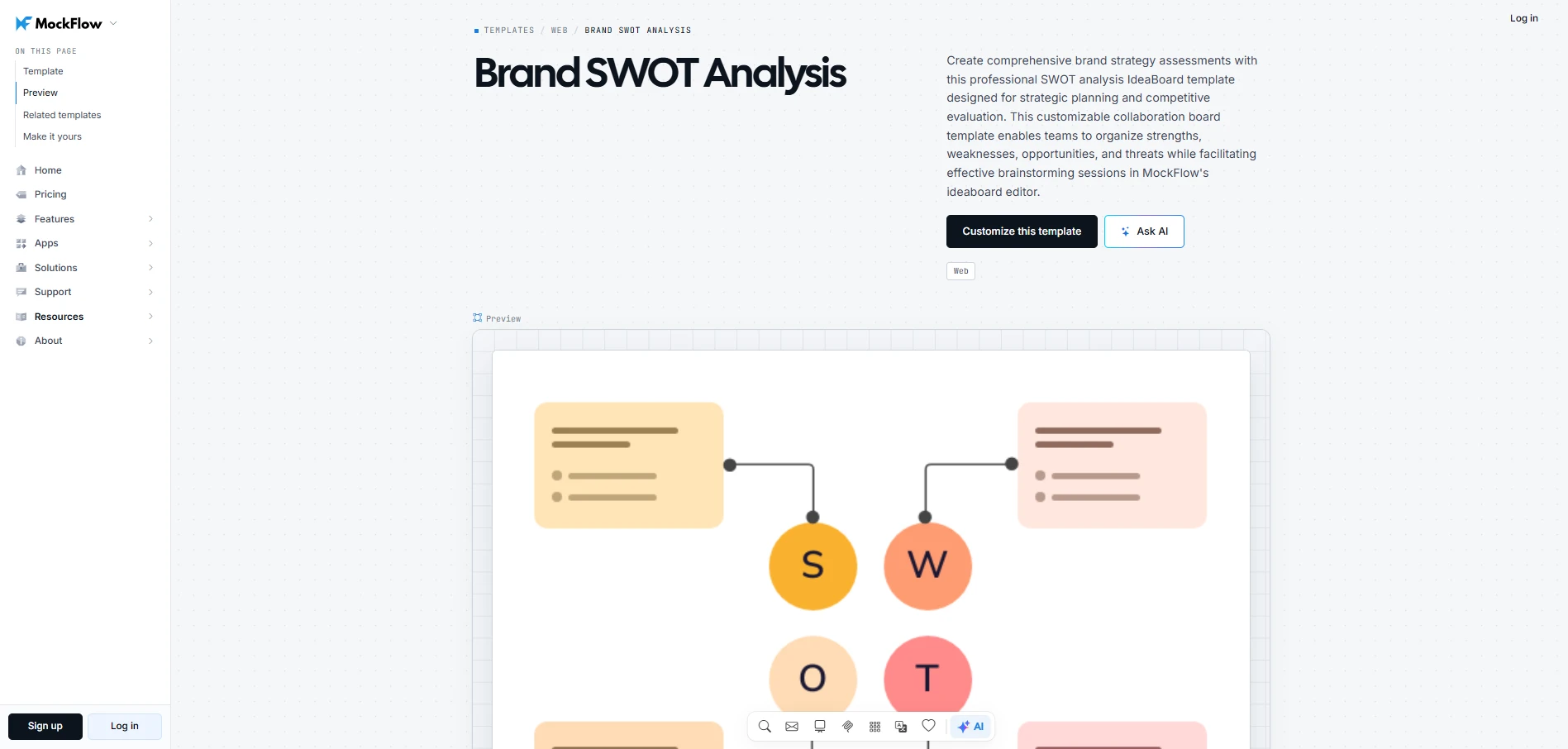
Customize this brand SWOT analysis template
6. Affinity mapping and idea clustering
Affinity mapping is a structured technique for organizing brainstorming ideas into groups based on shared themes. It helps teams identify patterns when a session produces more suggestions than participants can easily review individually.
Here's how it works:
- Collect all ideas on a shared visual board.
- Move related suggestions together based on common themes.
- Label each cluster to highlight recurring concerns or opportunities.
- Review the groups to understand which areas need further attention.
When to use it: Affinity mapping is useful after sessions that generate a large number of ideas. Grouping suggestions makes discussion more manageable and helps teams recognize related concerns.
For example, when brainstorming onboarding improvements, you can group suggestions by account setup, navigation, user guidance, and accessibility. MockFlow's brainstorming board examples offer visual layouts to help you organize contributions and spot patterns more easily.
Related Read: 25 Brainstorming Techniques: Methods, Steps, and Use Cases
How to run a structured brainstorming session in 5 steps
To run a structured brainstorming session, start by defining the problem and preparing a clear agenda. Let participants generate ideas independently before discussing and organizing them. Then evaluate the suggestions and assign next steps. A facilitator guides each stage so the team moves from exploration to decisions.
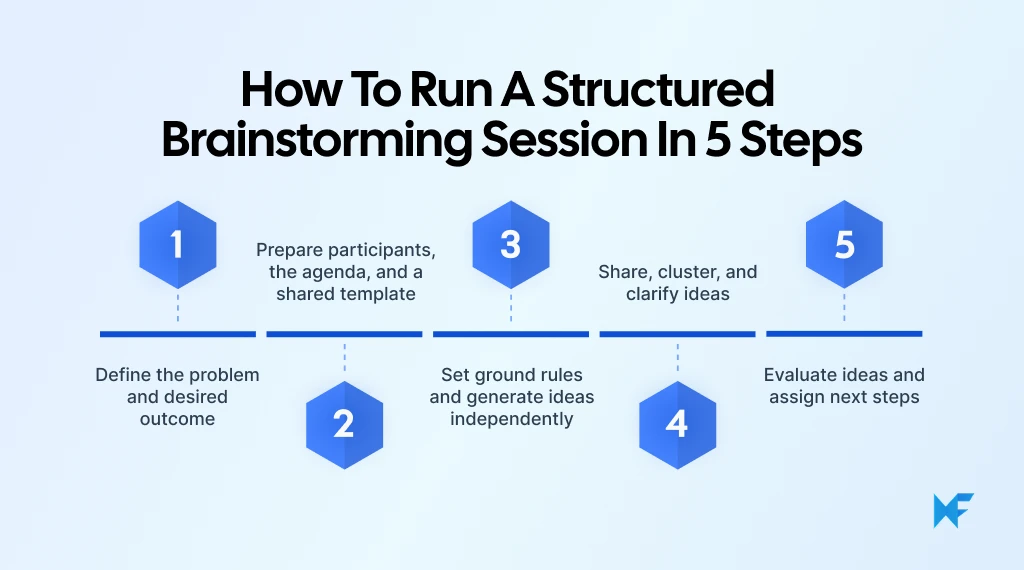
Building on the general principles of running a brainstorming session, a structured approach adds defined participation rules and separate stages for exploring and evaluating ideas.
Step 1: Define the problem and desired outcome
Start with a focused question, such as "How might we make onboarding easier for first-time users?" rather than "How can we improve our product?"
A specific question gives participants a shared direction and makes ideas easier to evaluate.
PwC’s 2025 Global Workforce Hopes and Fears Survey found that only 64% of workers say they understand their organization’s goals. Before asking for ideas, explain how solving the session’s problem supports a team or business goal.
Before moving into idea generation:
- Clarify the expected outcome: Decide whether the team should identify improvement opportunities or shortlist possible solutions.
- Share relevant context: Provide existing user feedback and known constraints so participants can build on what the team already understands.
- Confirm a shared understanding: Make sure everyone agrees on the problem being explored and the outcome expected from the session.
If the challenge involves broader strategic decisions, findings from SWOT or PESTEL analysis can help define the scope.
Step 2: Prepare participants, the agenda, and a shared template
Bring together participants with relevant expertise and assign a facilitator to guide the session. Share the problem and supporting context beforehand, then choose a suitable brainstorming technique and set time limits for each activity.
Here's a sample 45-minute agenda:
Stage | Suggested duration |
Introduce the objective and ground rules | 5 minutes |
Generate ideas independently | 10 minutes |
Share and cluster ideas | 15 minutes |
Evaluate and prioritize | 10 minutes |
Assign follow-up actions | 5 minutes |
Total | 45 minutes |
You can use MockFlow's brainstorming session template to prepare a shared workspace before the meeting. It gives participants a place to add their suggestions and helps you keep the discussion organized as the team moves toward decisions.
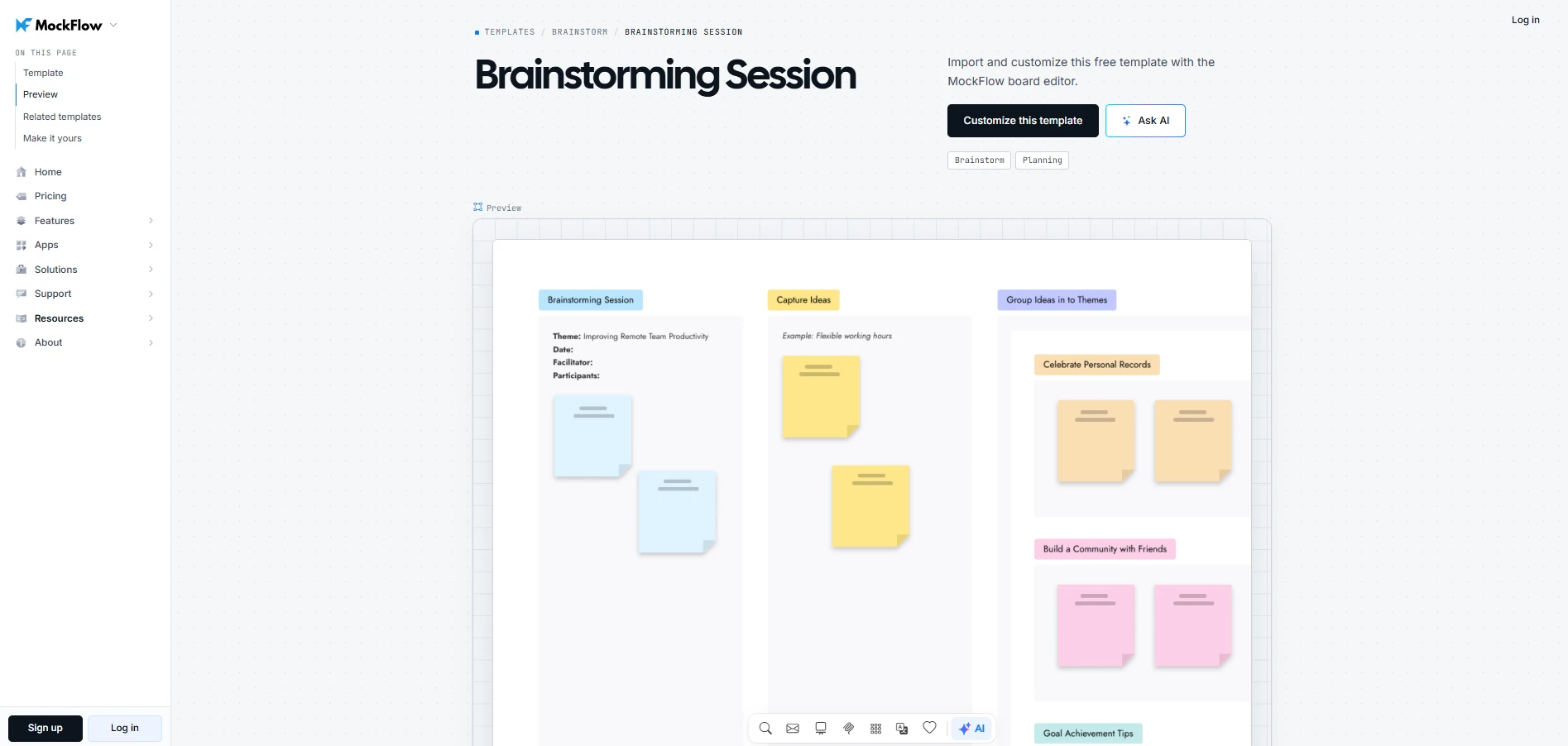
Customize this brainstorming session template
Step 3: Set ground rules and generate ideas independently
Set clear rules for contributing ideas and save evaluation for later. Give participants 10 minutes to independently suggest ways to simplify first-time user onboarding.
Independent thinking encourages a wider range of ideas and prevents early suggestions from influencing the group.
During this stage, the facilitator should:
- Protect thinking time: Let participants work without interruptions or group discussions.
- Encourage exploration: Remind the team to capture different possibilities before considering feasibility.
- Hold off on evaluation: Ensure suggestions are recorded without debating or ranking them.
When reviewing written contributions, focus on ideas rather than authors. Avoid requiring participants to identify their suggestions, and let them volunteer clarification when needed.
Step 4: Share, cluster, and clarify ideas
Bring everyone together to review their suggestions. Use an organized sequence, such as round-robin sharing, to give each participant time to explain their ideas without interruptions.
As the facilitator, keep contributions visible on the shared board and guide the team through three activities:
- Remove repetition: Identify duplicate or overlapping suggestions while preserving unique perspectives.
- Group related ideas: Use affinity mapping to organize suggestions into themes such as navigation, account creation, instructions, and first-use support.
- Clarify suggestions: Ask participants to explain unclear ideas and identify patterns across the groups.
MockFlow's AI assistant, Mida, can turn collected ideas or meeting notes into structured visual boards. Teams can use it to create mind maps that reveal connections between suggestions, then refine the generated layout as discussions progress.

Convert ideas, documents, and images into organized visual workspaces with Mida
Keep the discussion focused on understanding the suggestions. Save judgments about feasibility and value for the next stage.
Step 5: Evaluate ideas and assign next steps
Once the ideas are organized, evaluate them against agreed criteria such as potential impact, feasibility, relevance to the problem, and required effort.
Use voting or ranking to identify a manageable shortlist. For each selected idea:
- Assign ownership: Choose someone responsible for exploring or implementing the suggestion.
- Define the next action: Specify what needs to happen and set a deadline.
- Preserve remaining ideas: Keep unselected suggestions documented for future consideration.
For example, the onboarding team might prioritize a guided onboarding checklist, assign a product designer to develop a prototype, and schedule a review for the following week.
Document the decisions and share them with relevant stakeholders. You can also export your MockFlow board to preserve the session's outcomes for follow-up planning.
How to adapt structured brainstorming for remote teams
Remote structured brainstorming works best when participants can contribute ideas independently and use live discussions to build on the group's input. The process should accommodate different time zones without leaving anyone out of important decisions.
Here's how to adapt structured brainstorming for distributed teams:
- Collect ideas asynchronously: Let participants add suggestions before the meeting so colleagues across time zones have enough time to think and contribute.
- Make instructions easy to follow: Provide written prompts with clear deadlines and contribution guidelines so everyone understands what's expected.
- Use a shared visual workspace: Keep ideas on one accessible board where participants can review contributions and add suggestions from any location. MockFlow's remote collaboration workspace can support this approach.
- Make live discussions more productive: Use meetings to clarify suggestions and explore common themes. Participants can also use voice and video comments to explain ideas when they cannot attend.
- Keep decisions accessible: Document agreed priorities and next steps so everyone can review the outcomes.
For example, a distributed product team can collect onboarding improvement ideas throughout the week, then meet to discuss recurring themes and select priorities. Colleagues who miss the meeting can still review the decisions and contribute feedback.
Related Read: Group Brainstorming Techniques for Remote Teams in 2026
How MockFlow supports structured brainstorming
Structured brainstorming needs a workspace where teams can follow a clear process, contribute ideas, and organize suggestions for evaluation. MockFlow provide a visual workspace that supports each stage, helping teams manage brainstorming sessions without relying on scattered notes or disconnected discussions.
Here's how MockFlow helps teams run structured brainstorming sessions:
- Organize ideas without running out of space: The infinite canvas lets participants arrange sticky notes, shapes, connectors, and diagrams freely. Its drag-and-drop interface makes visual brainstorming accessible even to team members unfamiliar with design tools.
- Spend less time preparing sessions: Ready-made templates for round-robin brainstorming, brainwriting, starbursting, reverse brainstorming, and general brainstorming sessions give facilitators a consistent structure to work with. Teams can customize each framework to suit their goals.
- Prepare brainstorming boards faster with AI: The AI Toolbox helps facilitators generate initial visual layouts from text prompts. Teams can then customize the layouts to match their session goals, reducing manual setup.
- Keep everyone involved during discussions: Real-time collaboration allows participants to add, edit, and rearrange ideas together. Contributions remain visible on the online brainstorming board, making group discussions easier to follow.
- Turn scattered ideas into organized discussions: Visual components help teams cluster related suggestions, identify recurring themes, and arrange shortlisted ideas for evaluation. The AI brainstorming prompt library also provides prompts for exploring and developing ideas.
- Keep brainstorming outcomes accessible: Teams can share their boards with colleagues, allowing participants to revisit suggestions and use agreed priorities during follow-up planning.
For example, a facilitator can start with a brainstorming template, prepare the workspace, invite contributions, and group suggestions before sharing the team's priorities.
Ready to put structured brainstorming into practice? Get started with MockFlow and give your next brainstorming session a clear structure from the beginning.
FAQs
1. What are the three types of brainstorming?
There is no universally accepted classification, but brainstorming can be grouped into three broad types:
- Structured brainstorming: Uses a defined process to guide idea generation and evaluation.
- Unstructured brainstorming: Allows ideas to emerge through open, spontaneous discussion.
- Individual brainstorming: Involves generating ideas independently without immediate group influence.
The categories can overlap. For example, individual brainstorming can be part of a structured group session.
2. What are the 5 steps of structured brainstorming?
A structured brainstorming session typically follows five steps:
- Define the problem and desired outcome.
- Prepare participants, the agenda, and a shared template.
- Establish ground rules and generate ideas independently.
- Share, cluster, and clarify contributions.
- Evaluate ideas and assign next steps.
3. What are the four structured brainstorming techniques?
Four commonly used structured brainstorming techniques are:
- Round-robin brainstorming: Participants take turns sharing ideas.
- Brainwriting: Participants write ideas independently before sharing or developing them.
- Starbursting: Teams explore an idea using six question categories.
- Reverse brainstorming: Teams identify ways to worsen a problem, then turn the findings into solutions.
Other brainstorming techniques are available depending on the session's objective.
4. Which tool is a structured form of brainstorming?
Round-robin brainstorming and brainwriting are structured methods because they follow defined participation rules. Digital tools like MockFlow support these methods through visual workspaces and ready-made templates that help teams organize contributions.
5. What is the difference between structured brainstorming and brainwriting?
Structured brainstorming is a broader approach to organized idea generation that can use different participation methods. Brainwriting is one specific technique within the approach. Participants contribute ideas in writing, often independently, before discussing them as a group.
6. How long should a structured brainstorming session last?
A focused structured brainstorming session typically takes 30 to 60 minutes, depending on group size and problem complexity. Larger workshops may need more time.
Allow separate periods for generating ideas, discussing contributions, evaluating suggestions, and assigning actions. The 45-minute agenda outlined earlier provides a practical starting point.
How to Use Visio in Teams: Setup, Editing & Collaboration Guide
Diagrams often sit apart from the conversations they are meant to support. A team may discuss a workflow in a Microsoft Teams...

Workflow Diagram: Types, Examples, Templates & How to Create
Introduction When we sit down to map a process, it usually starts off simple. A few steps, a couple of decisions, nothing...

How to Run a Team Huddle for Better Team Collaboration
Keeping teams aligned has become harder as projects move faster, priorities shift frequently, and remote collaboration becomes...
