How to Implement Cross Functional Collaboration in Modern Teams
Introduction
If you have ever been in a meeting where everyone agrees collaboration matters, but no one is quite sure how it actually works across teams, you are not alone.
Most of us have seen moments where great ideas stall simply because the right people were not in the room at the same time. That is usually not a motivation problem. It is a collaboration one.
Cross functional collaboration is about changing how work flows between people, not adding more meetings or processes. When teams understand how to work together across roles and responsibilities, decisions feel easier, progress feels faster, and work feels more connected to real outcomes. It creates clarity instead of friction and momentum instead of handoffs.
In this guide, we break down what cross functional collaboration really means, why it matters, and how teams can make it work in practice. You will walk away with a realistic view of what effective collaboration looks like day to day.
What Is Cross Functional Collaboration?
Cross functional collaboration is a structured way for teams from different departments to work toward shared goals. It connects functions like product, marketing, sales, operations, and support through aligned priorities, clear ownership, and transparent communication.
Teams collaborate across workflows instead of operating in silos. Shared processes support faster decision-making and better execution. Leaders enable collaboration through defined roles, consistent practices, and the right tools.
Organizations use cross functional collaboration to improve coordination, reduce rework, and deliver outcomes more efficiently across projects and teams.
Several elements make collaboration genuinely cross functional:
- First, multiple functions are involved from the start, not brought in after decisions are made. Early involvement reduces rework and prevents downstream surprises.
- Second, accountability is shared. Teams succeed or fail together, which strengthens ownership and encourages better decision-making.
- Third, goals and success metrics are aligned. When teams measure progress differently, collaboration breaks down. Shared objectives keep everyone focused on the same outcomes.
When done well, cross functional teamwork replaces siloed execution with coordinated action. It creates clearer priorities, effective brainstorming sessions, faster feedback loops, and stronger organizational alignment, setting the foundation for everything from product delivery to customer experience.
Why Cross Functional Collaboration Is Important
Cross functional collaboration matters because most meaningful outcomes sit between teams, not within them. Product decisions, customer experiences, and operational improvements all depend on multiple functions moving together.
When collaboration is intentional, teams reduce friction, move faster, and make decisions with better context instead of reacting late or working in isolation.
Deloitte research shows that 65% of employees want their employers to prioritize teamwork and collaboration, reinforcing the importance of cross-functional collaboration in modern teams.
Key Benefits of Cross Functional Collaboration
Strong cross functional collaboration changes how teams make progress.
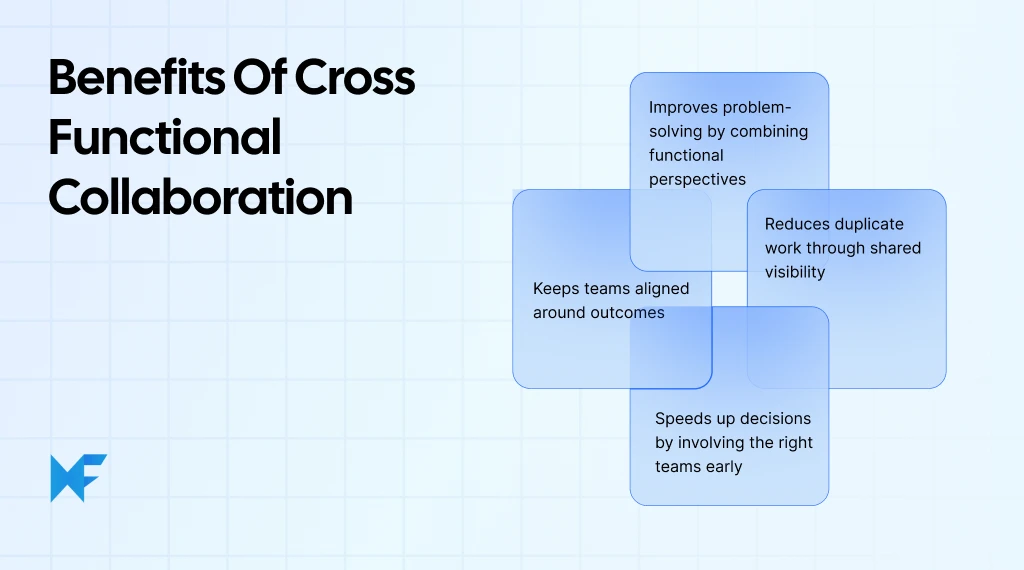
- It speeds up decision-making by bringing the right perspectives into conversations early, reducing long approval chains and repeated revisions.
- It improves problem-solving by combining different functional viewpoints, helping teams identify risks, dependencies, and opportunities sooner.
- It reduces duplicated effort by creating shared visibility into what teams are working on, preventing parallel work on the same problems.
- It strengthens alignment by keeping teams focused on outcomes rather than departmental priorities.
Project leaders have observed that excessive coordination between many teams can slow progress because collaboration overhead increases exponentially with every added relationship; limiting dependencies and aligning around a shared objective reduces that “collaboration tax.”
Business and Team-Level Impact
At the business level, cross functional teamwork increases organizational agility. Teams adapt more quickly because information flows across functions and decisions are made with a clearer view of trade-offs.
At the team level, collaboration builds trust and accountability. People understand how their work connects to others, why decisions are made, and how success is measured. Over time, this creates a more resilient, collaborative work culture that supports consistent execution and long-term alignment.
Examples of Cross Functional Collaboration
These examples highlight how teams across departments coordinate, share ownership, and move toward shared outcomes instead of operating in isolation.
Product Development Teams
Product development is where product managers, designers, and engineers work together from discovery through delivery.
Early collaboration helps teams align on user needs, technical constraints, and success criteria before work begins. Designers collaborate to bring user context, engineers surface feasibility considerations, and product teams balance scope and priorities. This shared understanding reduces rework, shortens feedback cycles, and leads to more thoughtful product decisions.
When teams stay connected throughout development, handoffs are smoother and execution feels continuous rather than fragmented.
Marketing and Sales Collaboration
Marketing and sales collaboration is critical for consistent messaging and revenue growth. When these teams work in silos, leads may be misaligned with sales expectations or messaging may miss real customer objections.
Effective cross functional collaboration here often includes:
- Shared definitions of qualified leads
- Regular feedback loops between sales conversations and marketing campaigns
- Joint planning around launches and promotions
This alignment improves lead quality, shortens sales cycles, and ensures both teams are working toward the same revenue outcomes.
Operations, Support, and Customer Experience
Operations, support, and customer experience teams rely heavily on cross functional partnerships to deliver consistent service. Support insights often reveal friction points that operations can fix upstream, while operations changes directly affect customer experience.
When these teams collaborate:
- Customer feedback flows back into process improvements
- Issues are addressed at the root instead of repeatedly resolved
- Teams build shared accountability for service quality
This kind of remote collaboration turns everyday operational data into continuous improvement, strengthening both efficiency and customer trust.
Challenges in Cross Functional Collaboration
Even when teams agree on the value of collaboration, making it work consistently is not easy. Most challenges do not come from lack of effort, but from structural and behavioral gaps that slow coordination across functions. Understanding these challenges helps teams address them intentionally instead of reacting to symptoms.
1. Communication and Information Silos
One of the most common barriers to cross functional collaboration is fragmented communication. Teams often use different tools, terminology, and documentation styles, which makes shared understanding harder to maintain.
Information may live in multiple places, updates may be shared inconsistently, and important context can get lost as work moves across teams. Over time, this creates misalignment and forces teams to make decisions without full visibility.
This gap is often reinforced by leadership communication breakdowns. In a 2025 global employee communications survey, 41% of respondents rated poor people manager communication as a high-impact barrier to team success.
2. Conflicting Goals and Incentives
Collaboration breaks down quickly when teams are measured by competing KPIs. If one team is rewarded for speed while another is focused on quality or cost reduction, priorities naturally clash.
These misaligned incentives encourage department-first thinking instead of outcome-first collaboration. Without shared goals, even well-intentioned teams may pull in different directions, slowing progress and increasing friction.
3. Unclear Ownership and Decision Authority
Cross functional work often involves many stakeholders, which can blur accountability. When it is not clear who owns decisions versus who contributes input, teams hesitate or over-consult.
Lack of clearly defined ownership is a major drag on collaborative work, because teams often assume someone else is responsible for a deliverable and nothing moves forward until someone explicitly takes accountability.
A 2024 Gartner survey found that 84% of marketing leaders and employees experience high collaboration drag when working across functions, driven by excessive coordination, unclear ownership, and fragmented workflows. It also noted that organizations experiencing this drag are 37% less likely to achieve their revenue goals.
This lack of clarity leads to delayed decisions, repeated discussions, and stalled execution. Effective cross functional teamwork depends on knowing where decisions live and how input flows without creating bottlenecks.
4. Coordination and Time Constraints
Finally, collaboration takes time, and scheduling across teams is rarely simple. Different priorities, meeting loads, and time zones make it harder to maintain momentum.
This pressure is amplified by how work is scheduled. According to Microsoft’s 2025 Work Trend Index, 60% of meetings are now unscheduled or ad hoc, making it harder for teams to plan deep work and coordinate intentionally across functions.
Frequent context switching also adds hidden costs. When collaboration is not structured well, teams may spend more time coordinating than actually executing, reducing the perceived value of working together.
How to Implement Cross Functional Collaboration Effectively
Putting cross functional collaboration into practice requires more than goodwill. It depends on clear structure, shared expectations, and tools that make collaboration easier instead of heavier. The goal is to help teams work together naturally as part of how work gets done, not as an extra layer on top of it.
Here are some best practices to implement cross functional collaboration effectively:
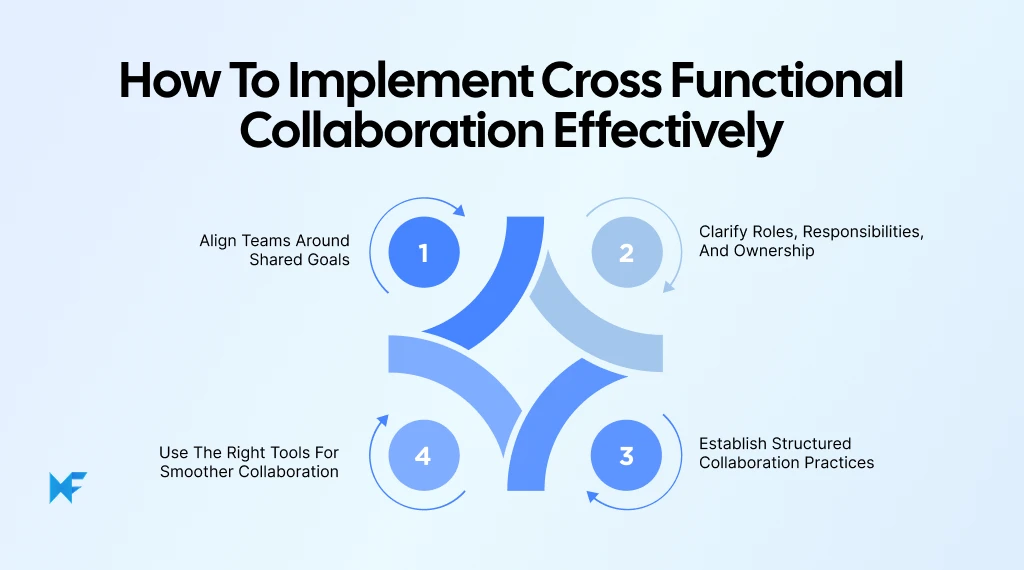
1. Align Teams Around Shared Goals
Collaboration works best when teams are aligned around outcomes, not just activities. Shared goals give everyone a common reference point and reduce competing priorities.
This usually means:
- Defining outcomes that matter across functions, such as customer impact, delivery timelines, or adoption metrics
- Making success metrics visible through shared dashboards and understandable to all teams involved
- Revisiting goals regularly as priorities shift
When teams measure success the same way, decision-making becomes faster and trade-offs feel clearer.
2. Clarify Roles, Responsibilities, and Ownership
One of the fastest ways to stall cross functional teamwork is unclear ownership. Teams need to know who is responsible for decisions, who contributes input, and who executes.
Clear role definition helps by:
- Distinguishing decision-makers from collaborators
- Reducing unnecessary approvals and over-consultation
- Preventing accountability gaps where work quietly stalls
When ownership is explicit and mapped clearly, often through simple flowcharts, collaboration becomes more confident and execution moves forward with less friction.
Quick tip: Alignment improves significantly when teams agree on when decisions are made and who needs to be involved at each stage. Establishing clear decision windows prevents late-stage objections and reduces rework caused by stakeholders entering too late in the process. This simple clarity often matters more than adding additional documentation or meetings.
3. Establish Structured Collaboration Practices
Collaboration improves when teams know how and when to work together. Structure does not mean bureaucracy. It means predictable rhythms and clear communication norms.
Effective practices often include:
- Regular cross-team syncs with clear agendas
- Documented decisions and shared context
- Agreed expectations for response times and updates
These practices reduce ad hoc coordination and help teams stay aligned without constant meetings.
4. Use the Right Tools for Cross Functional Collaboration
The right tools support visibility, shared understanding, and real-time collaboration across teams. Visual workspaces are especially useful because they make ideas, plans, and workflows easy to see and discuss together.
Visual collaboration tools like MockFlow’s IdeaBoard support cross functional collaboration by giving teams a shared canvas where multiple functions can contribute at the same time.
Teams can brainstorm, map workflows, align on goals, and refine ideas together using real-time editing, structured pre-built templates, and visual organization. This kind of shared space helps reduce information silos and keeps collaboration anchored to the work itself rather than scattered across tools.
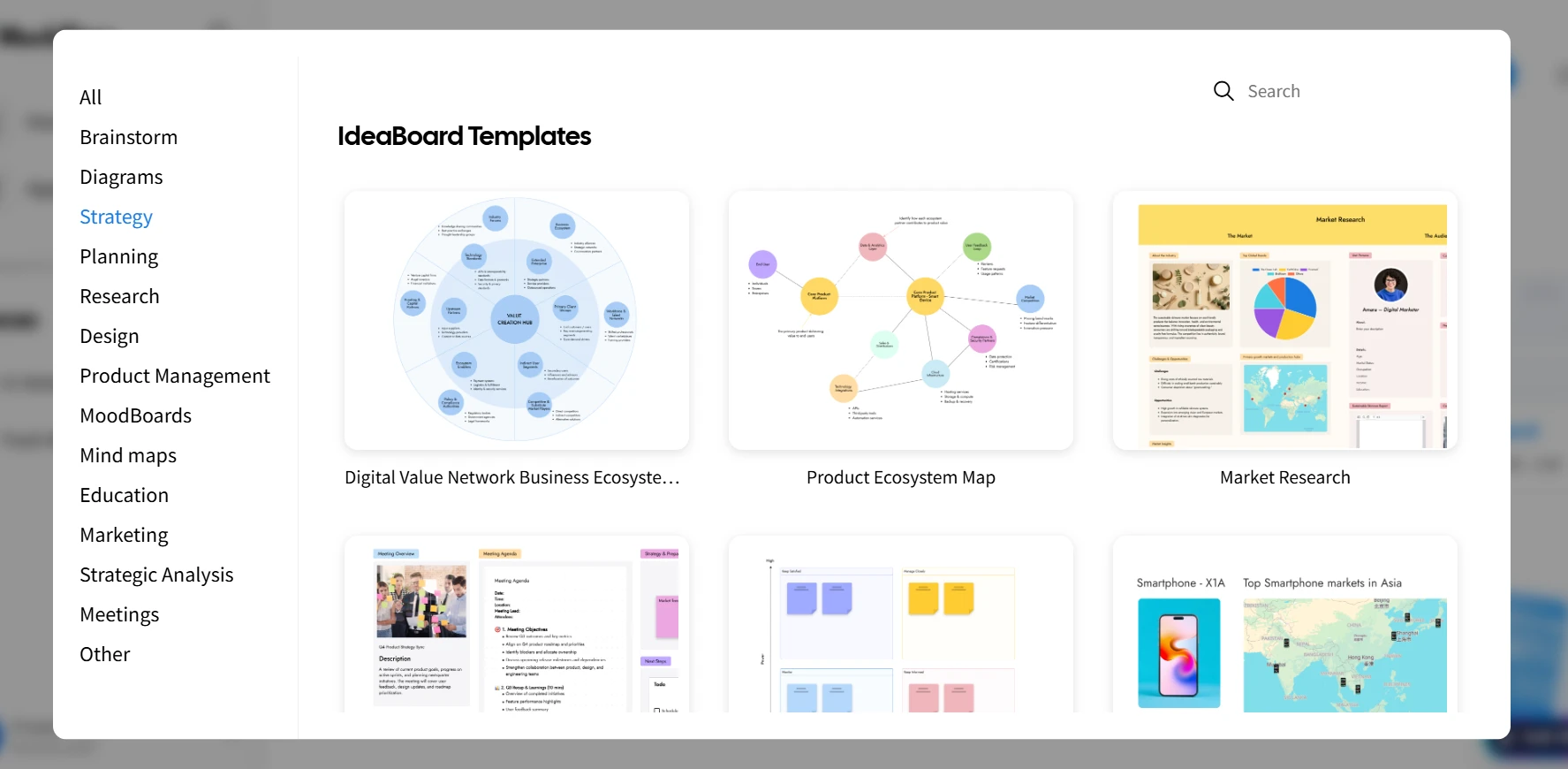
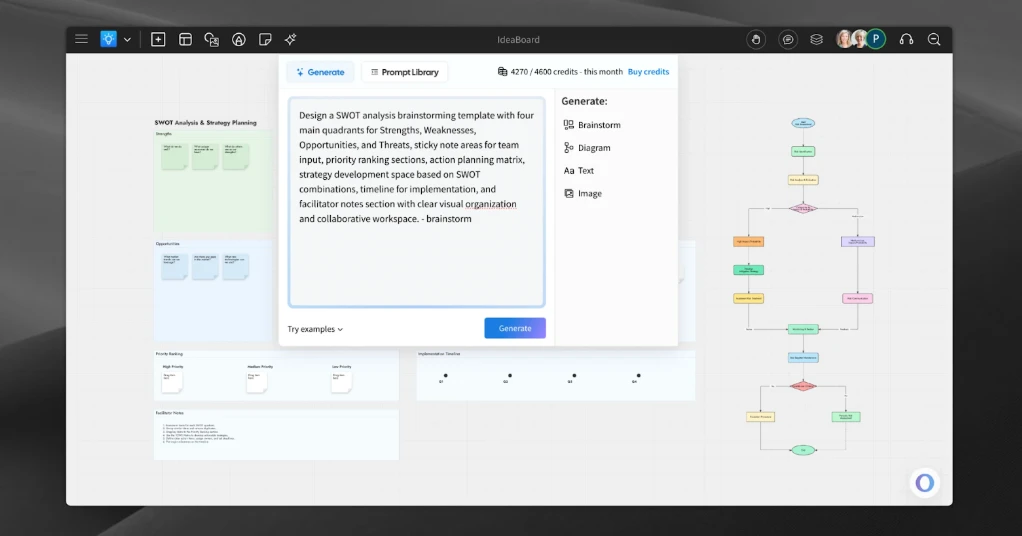
IdeaBoard’s AI-assisted features also help teams quickly generate and reshape visual layouts from simple prompts, making early collaboration faster and more focused. A dedicated ChatGPT app lets teams create visual outputs like mind maps directly within ChatGPT and edit them back in IdeaBoard.
When collaboration tools make it easier to see progress and contribute in context, cross functional partnerships become more consistent and effective.
Since cross-functional discussions often already happen inside Microsoft Teams, IdeaBoard's Microsoft Teams integration means those conversations and the shared MockFlow board can live in the same workspace, instead of ideas getting lost in a chat thread while the actual plan lives somewhere else.
5. Structure the Team Around the Work, Not the Org Chart
Cross-functional teams work best when they are staffed around a specific outcome, not simply pulled together by department. Before work begins, identify which functions are genuinely needed for this initiative, assign a clear team lead who owns coordination, and set a light reporting structure so progress is visible without adding management layers.
This usually means:
- Pulling in only the functions the work actually requires, not every department that might have an opinion
- Naming one person accountable for keeping the team moving, separate from who owns individual decisions
- Keeping the structure temporary and tied to the initiative, so the team can dissolve or reform as priorities shift
Bringing It All Together
Cross functional collaboration works best when it is treated as a habit, not a one-time initiative tied to a specific project or reorg. Teams that collaborate well do so because they share the right mindset, have clear structures in place, and use tools that make working together easier rather than harder.
Mindset sets the foundation. Teams need to see collaboration as shared ownership, not a loss of control. Structure turns that mindset into action through aligned goals, clear decision-making, and consistent collaboration practices. Tools then support the day-to-day reality by creating visibility, reducing friction, and keeping everyone connected around the work itself.
Over time, this combination leads to stronger organizational alignment, better execution, and a healthier collaborative work culture that scales as teams grow.
If you are looking to support this kind of collaboration in practice, you can try IdeaBoard for free and explore how shared visual workspaces help teams align and work together more effectively.
FAQs about cross functional collaboration
1. What does cross functional collaboration mean in a business context?
Cross functional collaboration refers to teams from different departments working together toward shared business goals. Instead of operating in silos, functions such as product, marketing, sales, operations, and support align on priorities, responsibilities, and outcomes. This approach emphasizes shared accountability, transparent communication, and coordinated execution across workflows.
2. Why is cross functional collaboration important for organizations?
Cross functional collaboration helps organizations reduce silos, improve alignment, and make faster decisions. When teams share goals and information, work moves with fewer handoffs and less rework. This leads to better problem-solving, improved execution speed, and stronger organizational agility in dynamic environments.
3. How does cross functional collaboration improve team performance?
Cross functional collaboration improves team performance by aligning teams around common outcomes rather than department-specific metrics. Clear ownership, shared workflows, and consistent communication reduce confusion and delays. Teams gain better context, resolve dependencies faster, and deliver higher-quality results across projects.
4. What challenges do teams face in cross functional collaboration?
Teams often face communication silos, conflicting goals, unclear ownership, and coordination challenges. Department-first KPIs can create misaligned priorities. Too many stakeholders can slow decisions. Time constraints and context switching also make sustained collaboration difficult without structured practices.
5. What tools support cross functional collaboration?
Tools that support cross functional collaboration provide shared workspaces, real-time collaboration, and centralized visibility. Visual collaboration tools like IdeaBoard offer shared canvases and structured templates that help teams brainstorm, plan, and align across departments. These tools reduce fragmentation and keep collaboration connected to actual workflows.

8 Group Brainstorming Techniques for Remote Collaboration in 2026
Introduction Group brainstorming is one of those activities that seems simple at first but can turn into something really...
25 Brainstorming Techniques: How Each One Works and When to Use It
Introduction Brainstorming is a natural part of how we think. We do it casually when ideas move around in a conversation,...

Wireframe Testing: How to Find Usability Issues Early
Wireframe testing is the process of evaluating low-fidelity design layouts with real users before moving into detailed design or...
