
25 Brainstorming Techniques: How Each One Works and When to Use It
Introduction
Brainstorming is a natural part of how we think. We do it casually when ideas move around in a conversation, quietly when we jot notes to ourselves, and collaboratively when teams come together around a shared goal.
At its best, it feels easy and energizing. Thoughts connect, new angles appear, and momentum builds without much effort.
What often shapes the outcome is not creativity itself, but how that thinking is guided. A small amount of structure can help ideas stretch further, bring more voices into the conversation, and reveal patterns that might otherwise stay hidden.
That is where brainstorming techniques quietly do their work. They are not rigid frameworks or clever tricks. They are simple ways to give thinking direction while still leaving room for curiosity and exploration.
This article walks through different brainstorming techniques you can use for idea generation and problem-solving. Consider it a flexible techniques list you can return to whenever you want ideas to move forward with more clarity and confidence.
What are brainstorming techniques?
Brainstorming techniques are structured methods teams use to generate, organize, and refine ideas in group or individual settings. Common types include visual techniques (mind mapping, affinity mapping), group techniques (brainwriting, round-robin), creative techniques (SCAMPER, Crazy 8s), and analytical techniques (reverse brainstorming, Six Thinking Hats). Each technique suits a different goal, team size, or session format.
Why use brainstorming techniques in sessions?
Brainstorming techniques are structured methods for generating, organizing, and refining ideas in individual and group sessions. These techniques support creative thinking, problem solving, and collaboration across workshops, meetings, and remote teams.
Teams use brainstorming methods to explore concepts, capture insights, and prioritize outcomes on whiteboards, digital boards, and visual templates. Visual tools such as mind maps and sticky notes make ideas easier to see and connect. Effective brainstorming techniques improve speed, participation, and clarity in ideation workflows.
Key reasons to use structured brainstorming include:
- Balanced participation: Techniques reduce dominance bias and give equal space for input, especially in group settings with mixed seniority or communication styles.
- Better idea range: Separating idea generation from evaluation increases the number and diversity of ideas before narrowing down options.
- Adaptability to context: Different types of brainstorming suit different goals, from early exploration to analytical problem-solving.
- Clear outcomes: Effective brainstorming techniques keep discussions aligned to the objective, making it easier to organize, prioritize, and act on ideas.
Research published by Springer also shows that teams using structured ideation methods consistently achieve stronger innovation outcomes than those relying on unstructured discussions.
When brainstorming follows a clear approach, ideas become easier to build on and move forward. The result is not just more ideas, but more useful ones.
Now that we know the importance of brainstorming techniques, let’s explore the different types of techniques that can be used by teams for effective problem-solving.
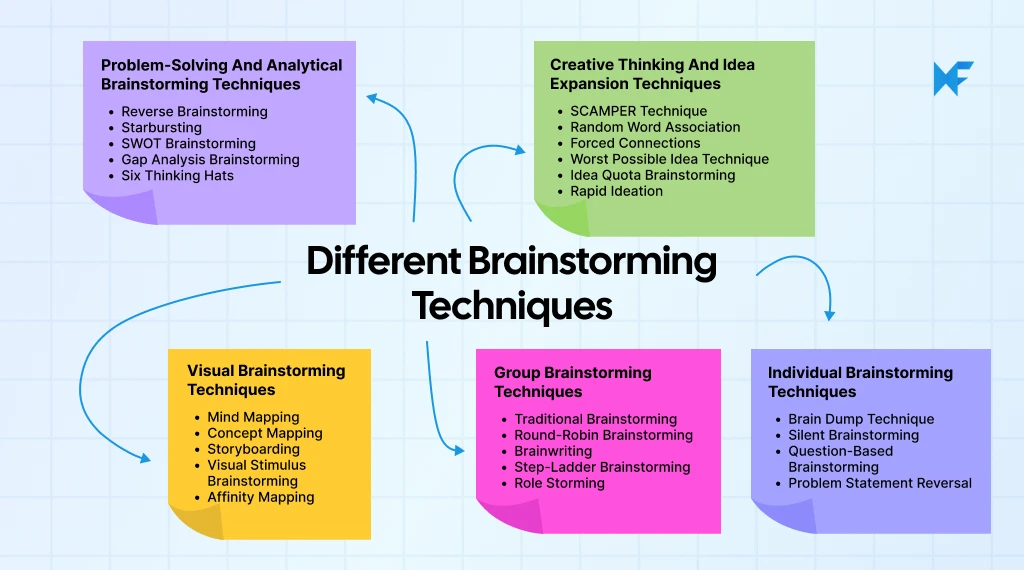
Visual brainstorming techniques
Visual brainstorming techniques focus on arranging ideas so they can be seen, compared, and connected. Instead of listing thoughts in isolation, these methods help teams understand complex topics, spot patterns faster, and identify gaps that may not be obvious in text-based brainstorming.
1. Mind mapping
Mind mapping begins with a central idea placed at the center of a page or board. From there, related ideas branch outward, and sub-ideas continue branching as thinking expands.
This method supports free association while still keeping everything connected. It works well when exploring a broad topic or breaking a concept into parts.
Because ideas stay visually linked, it becomes easier to see which areas are well-developed and which need more thought. Mind mapping also helps avoid linear thinking, allowing ideas to grow naturally in multiple directions at once.
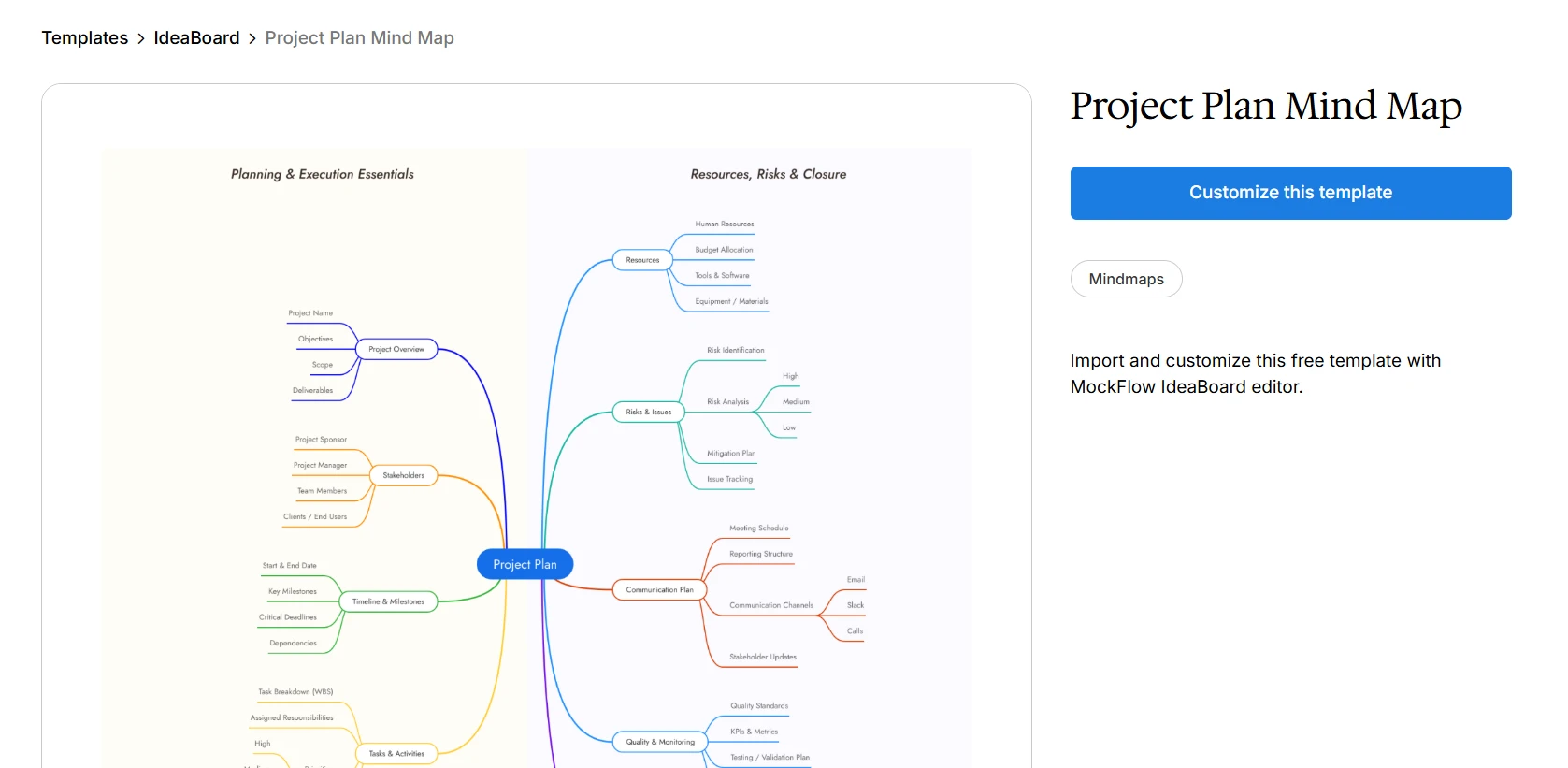
Customize this project plan mind map template with IdeaBoard
2. Concept mapping
Concept mapping is more structured than mind mapping. Ideas are placed as individual nodes and connected using labeled links that explain the relationship between them. These connections might show cause and effect, dependency, or sequence.
Concept mapping is useful when clarity matters more than speed. It helps teams understand how ideas influence one another and where gaps exist. This technique works well for systems thinking, strategy discussions, or complex problems where understanding relationships is essential before making decisions or moving forward.
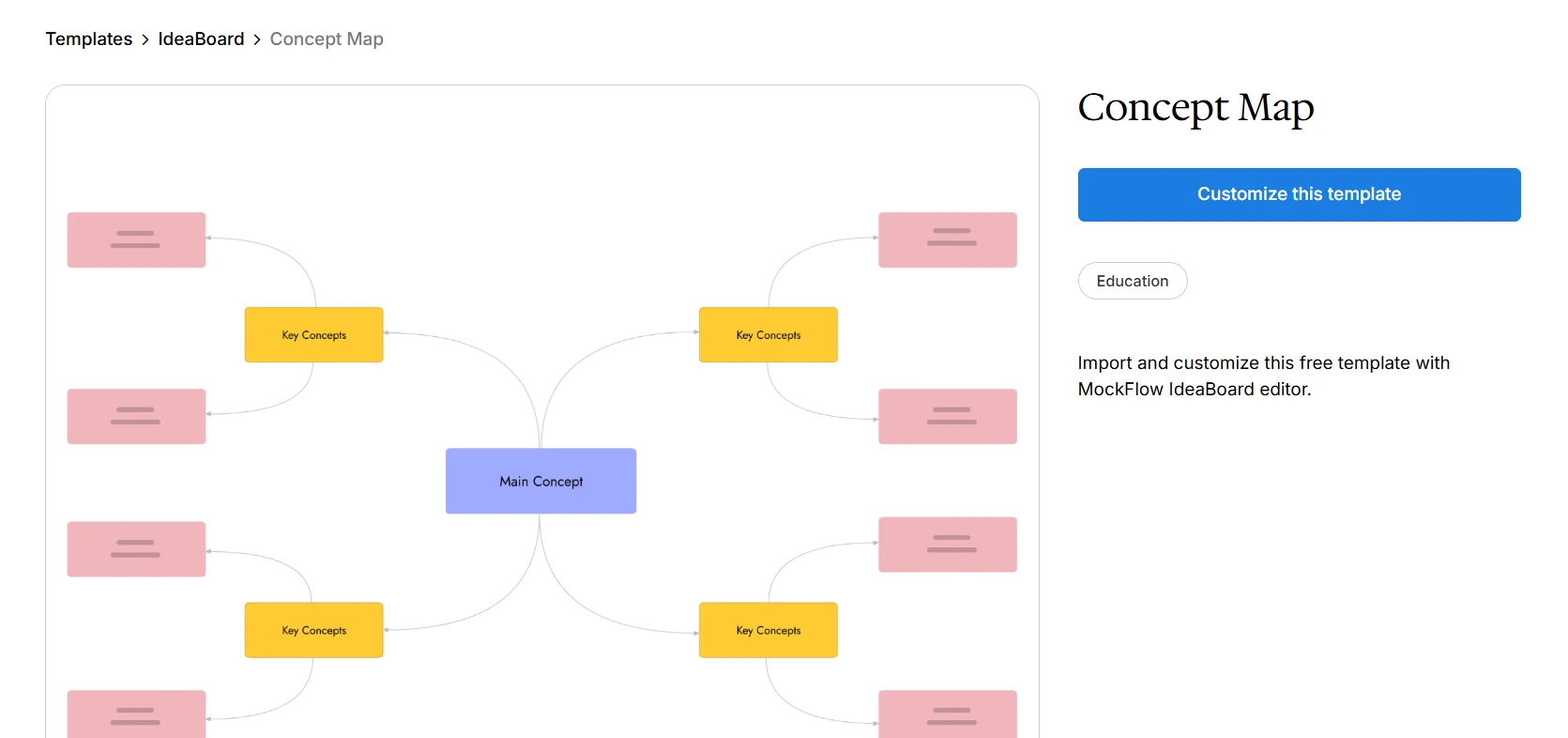
Customize this concept map template with IdeaBoard
3. Storyboarding
Storyboarding organizes ideas in a sequence of steps or frames, showing how something unfolds over time. Each frame represents an action, moment, or decision.
This technique is especially useful for mapping processes, user journeys, or experiences. By laying ideas out in order, it becomes easier to spot friction points, missing steps, or unclear transitions.
Storyboarding helps teams move beyond abstract ideas and think through real-world flow. It is commonly used in product design, marketing planning, and process improvement work.
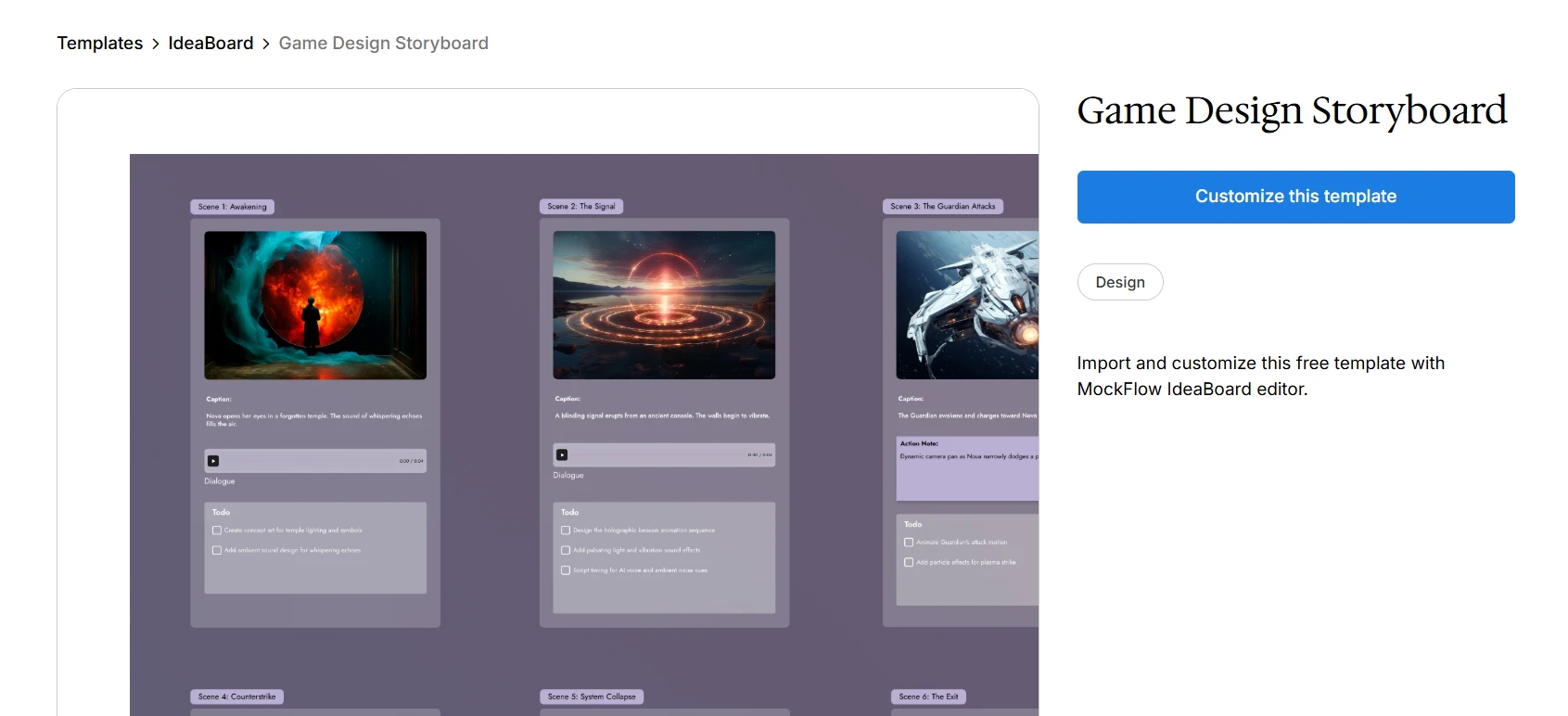
Customize this game design storyboard with IdeaBoard
4. Visual stimulus brainstorming
Visual stimulus brainstorming uses images, videos, or objects to trigger ideas. Instead of starting with a question, participants react to what they see and note any thoughts or associations that arise. The visuals act as prompts that bypass logical filters and encourage intuitive thinking.
This approach is helpful when teams feel stuck or overly analytical. The value comes from unexpected connections rather than direct interpretation of the image.
Visual stimulus brainstorming works well for early-stage ideation and creative exploration.
5. Affinity mapping
Affinity mapping is used to organize large volumes of ideas after generation. Each idea is written separately, then grouped based on similarity or shared themes. The grouping usually happens quietly to reduce influence and bias. As clusters form, patterns begin to emerge naturally.
This technique helps teams move from chaos to clarity by turning scattered inputs into meaningful categories. Affinity mapping is especially useful after high-volume brainstorming sessions, helping teams identify priorities and align on key directions.

Customize this affinity mapping template with IdeaBoard
Group brainstorming techniques
These techniques are designed for shared thinking. The goal is to collect ideas from multiple people while keeping discussions focused and balanced.
These methods add structure so that ideas do not get lost, repeated, or dominated by a few voices. This is increasingly important as Forbes reports that communication gaps remain a top workplace challenge in digital-first environments, often leading to misalignment and missed input during group discussions.
6. Traditional brainstorming
Traditional brainstorming is the most familiar group method. Participants share ideas out loud as they come to mind, and all ideas are recorded without judgment. The focus is on quantity first, not quality.
This approach works best when the group is small, the topic is broad, and the environment feels safe. Without facilitation, it can drift or favor confident speakers.
With clear rules, such as no evaluation during idea generation and visible idea capture, traditional brainstorming can still be effective for early exploration and energy-building.
7. Round-robin brainstorming
Round-robin brainstorming adds turn-taking to group ideation. Each participant shares one idea at a time, moving around the group in a fixed order. People can pass if they are not ready.
This structure ensures equal participation and prevents interruptions. It also gives participants time to think while others speak.
Round-robin brainstorming is useful when groups are large or when quieter members may otherwise stay silent. It keeps sessions orderly while still allowing ideas to build on one another.
8. Brainwriting
Brainwriting replaces speaking with writing. Participants write down ideas individually and then pass them to others, who add or build on those ideas. This continues for several rounds.
Because ideas are written, not spoken, pressure is lower and groupthink is reduced. People focus on the ideas themselves rather than who suggested them.
Brainwriting often leads to more original ideas and deeper development. It works well for remote teams and structured workshops where time and participation need to be managed carefully.
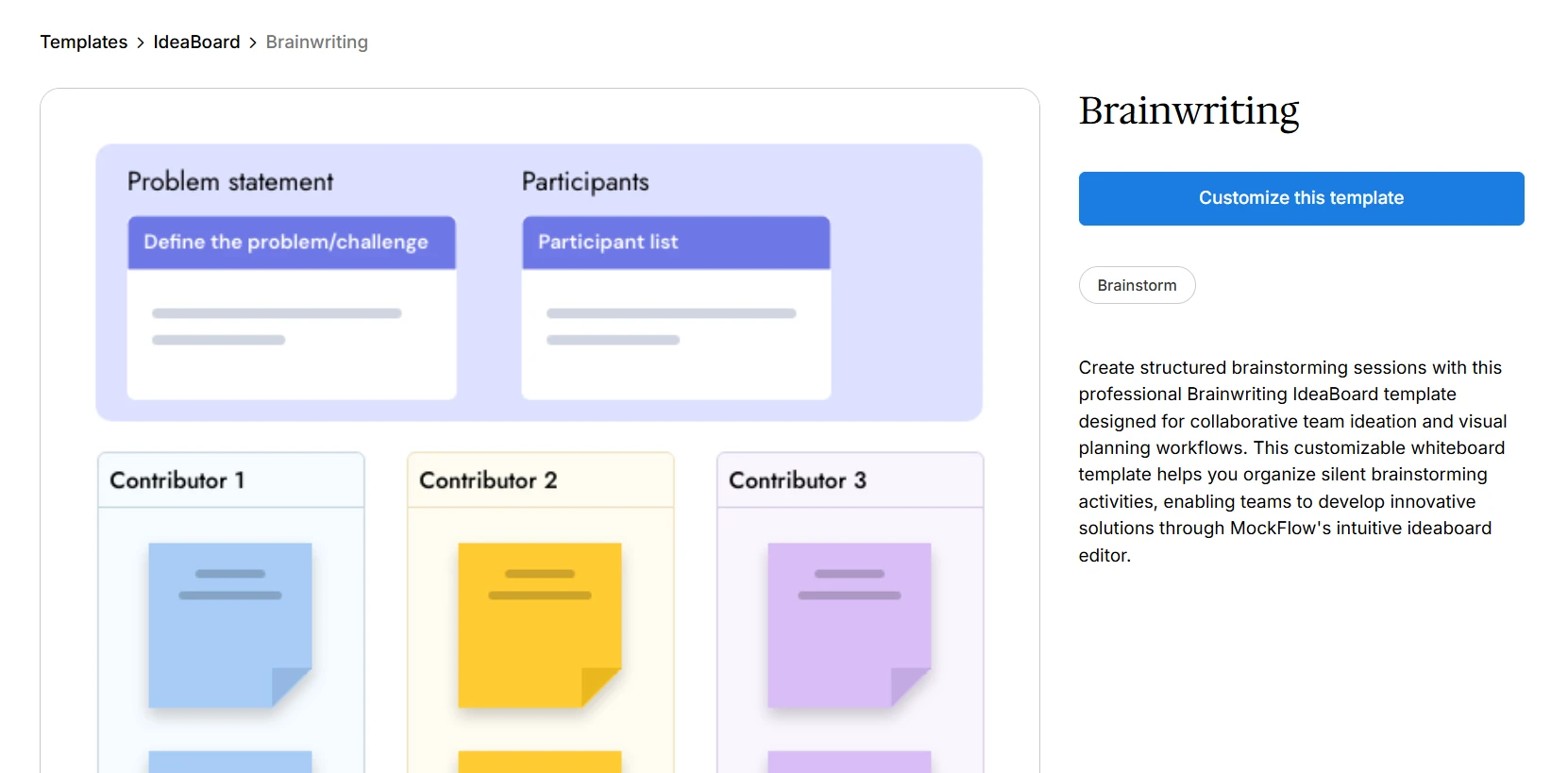
Customize this brainwriting template with IdeaBoard
9. Step-ladder brainstorming
Step-ladder brainstorming introduces people into the discussion one at a time. A small group starts by discussing ideas, then one new person joins and shares their ideas before hearing the group’s discussion. This continues until everyone is included.
The method protects independent thinking and reduces early agreement. Each new participant brings a fresh perspective that has not been influenced by group consensus.
Step-ladder brainstorming is useful when decision quality matters and when teams want to avoid settling too quickly on familiar ideas.
10. Role storming
Role storming asks participants to generate ideas from the perspective of someone else. This could be a customer, a competitor, a leader, or even a fictional character.
Thinking through another role lowers inhibition and encourages unconventional ideas. It also builds empathy and helps teams see problems from different viewpoints.
Role storming works well when teams feel stuck or when ideas start to look too similar. By stepping outside their usual mindset, participants often surface insights that would not appear in a standard discussion.
11. Brain netting
Brain netting is a written, asynchronous form of brainstorming. Instead of discussing ideas in real time, participants add their ideas to a shared digital space like Slack or a brainstorming tool over a set period. Others can build on, comment on, or refine those ideas when they log in.
This approach works well for distributed teams and different time zones. It reduces meeting fatigue and gives people time to think without pressure.
Brain netting also leads to more thoughtful contributions, as ideas are formed with intent rather than speed. It is especially useful when teams want broad input without scheduling long brainstorming meetings.
Creative thinking and idea expansion techniques
Creative thinking and idea expansion techniques are meant to push thinking beyond the first few obvious ideas. These methods work by introducing constraints, prompts, or playful shifts in perspective that stretch how ideas are formed.
12. SCAMPER technique
The SCAMPER technique uses a set of prompts to modify an existing idea or solution. Each letter stands for a different action:
S = Substitute
C = Combine
A = Adapt
M = Modify
P = Put to another use
E = Eliminate
R = Reverse
Instead of starting from scratch, you take something that already exists and deliberately change parts of it. This helps teams explore improvements and alternatives in a structured way.
SCAMPER works well for product features, processes, or campaigns where a base idea is already defined. It encourages systematic creativity and helps uncover options that might not emerge through open-ended brainstorming alone.
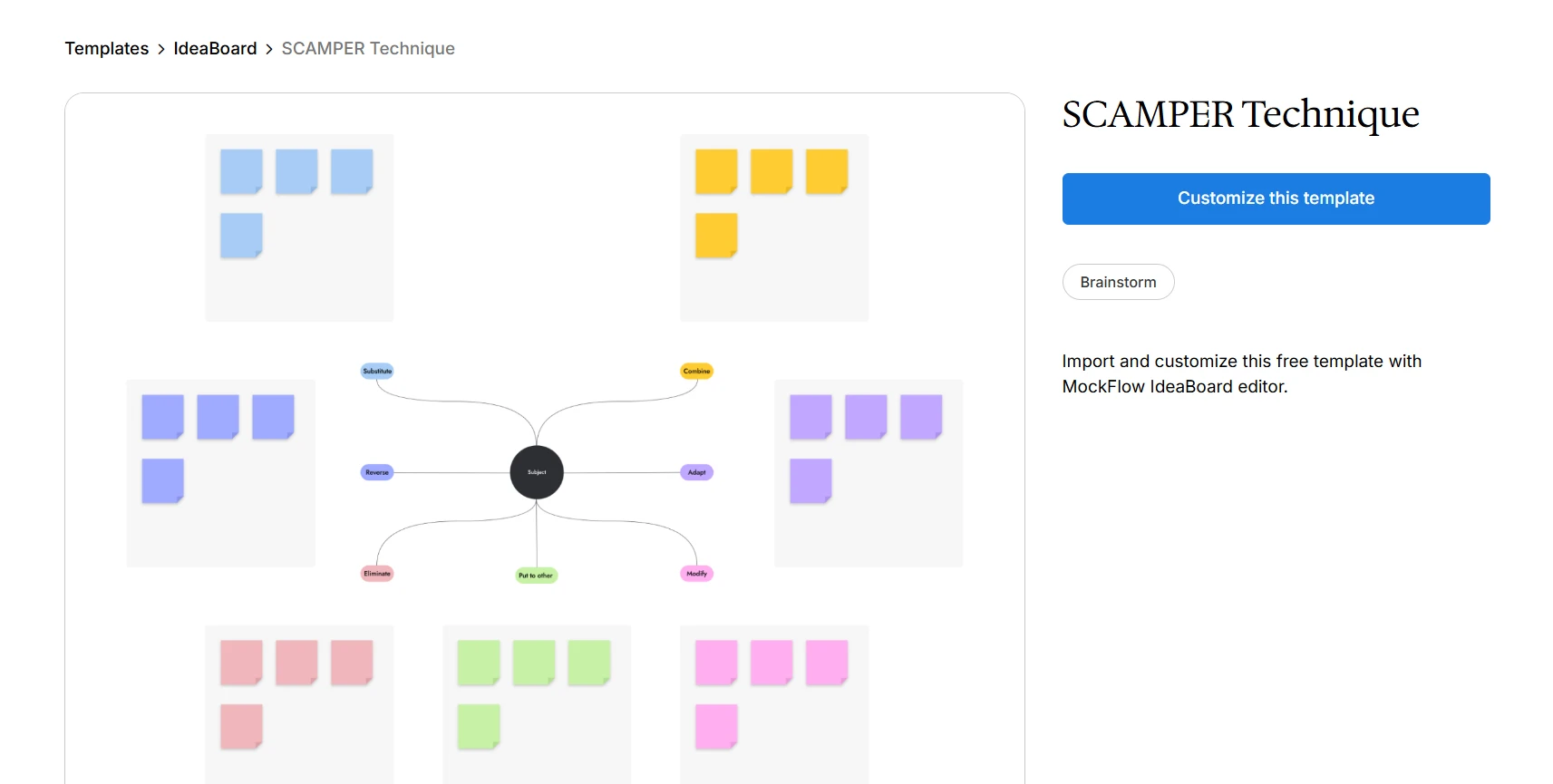
Customize this SCAMPER technique template with IdeaBoard
13. Lotus diagramming
Lotus diagramming is a structured brainstorming technique that helps teams explore ideas in depth without losing focus. The process starts with a central idea placed in the middle of a grid. Around it, related themes or directions are added. Each of these themes is then expanded further with supporting ideas.
This layered approach encourages teams to move beyond surface-level thinking and explore multiple dimensions of a problem evenly.
Lotus diagramming works well when teams have a clear topic but need more depth and variety in ideas. It is especially useful for strategy discussions, product planning, and complex problem-solving where balanced exploration matters.
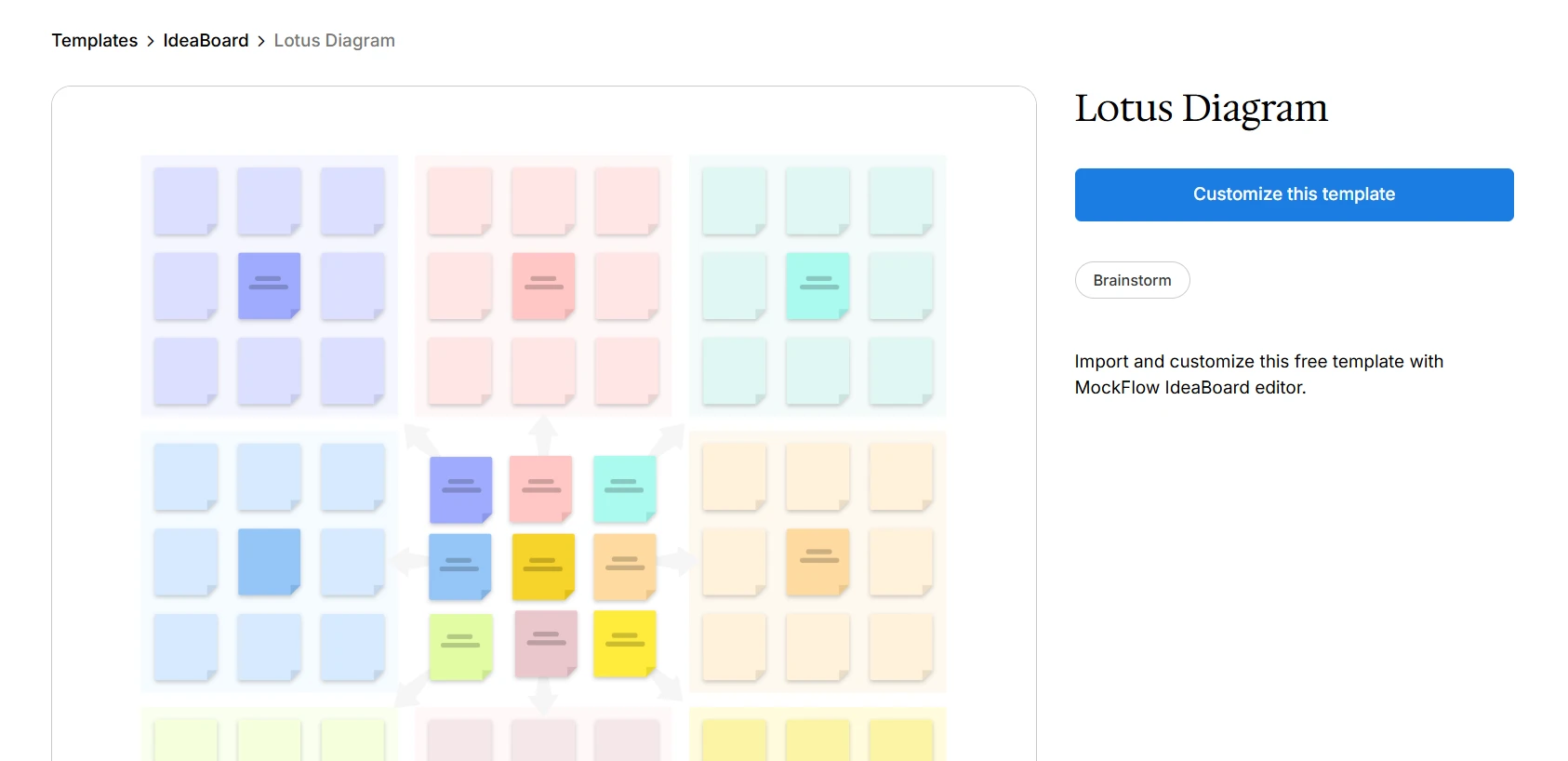
Customize this lotus diagram template with IdeaBoard
14. Worst possible idea technique
The worst possible idea technique asks participants to intentionally generate bad, impractical, or extreme ideas. By removing the pressure to be “right,” people feel freer to speak up. Once the list of bad ideas is complete, the group looks for insights hidden within them.
Often, these extremes highlight real risks, user frustrations, or missing constraints. When reversed, they point toward useful improvements. This technique works well for reducing creative fear and unlocking honest thinking in groups that feel overly cautious.
15. Idea quota brainstorming
Idea quota brainstorming sets a clear target for the number of ideas that must be generated. Instead of stopping when good ideas appear, participants continue until the quota is met. This pushes thinking past the obvious and into more original territory.
The first ideas are often safe and familiar. Later ideas tend to be more creative because the easy options are already used up. This technique works well when teams need variety and depth, not just quick answers.
16. Rapid ideation
Rapid ideation uses short time limits to encourage fast, instinctive thinking. Participants generate as many ideas as possible within tight windows, often in multiple rounds. The speed prevents overthinking and self-editing. Ideas do not need to be complete or realistic at this stage. The goal is momentum.
Rapid ideation works well at the start of brainstorming sessions or when energy is low. It helps teams loosen up and generate raw material that can be refined later.
17. Crazy 8s
Crazy 8s is a fast-paced ideation technique designed to push past obvious ideas. Each participant generates eight ideas in eight minutes, usually one idea per minute.
Ideas can be sketched or written and do not need to be polished or realistic. The strict time limit removes overthinking and forces instinctive responses. This works well because the first few ideas are often predictable, while later ones tend to be more original.
Crazy 8s is useful when teams feel stuck or overly cautious. It creates momentum early in a session and produces a wide range of raw ideas that can be reviewed and refined afterward.
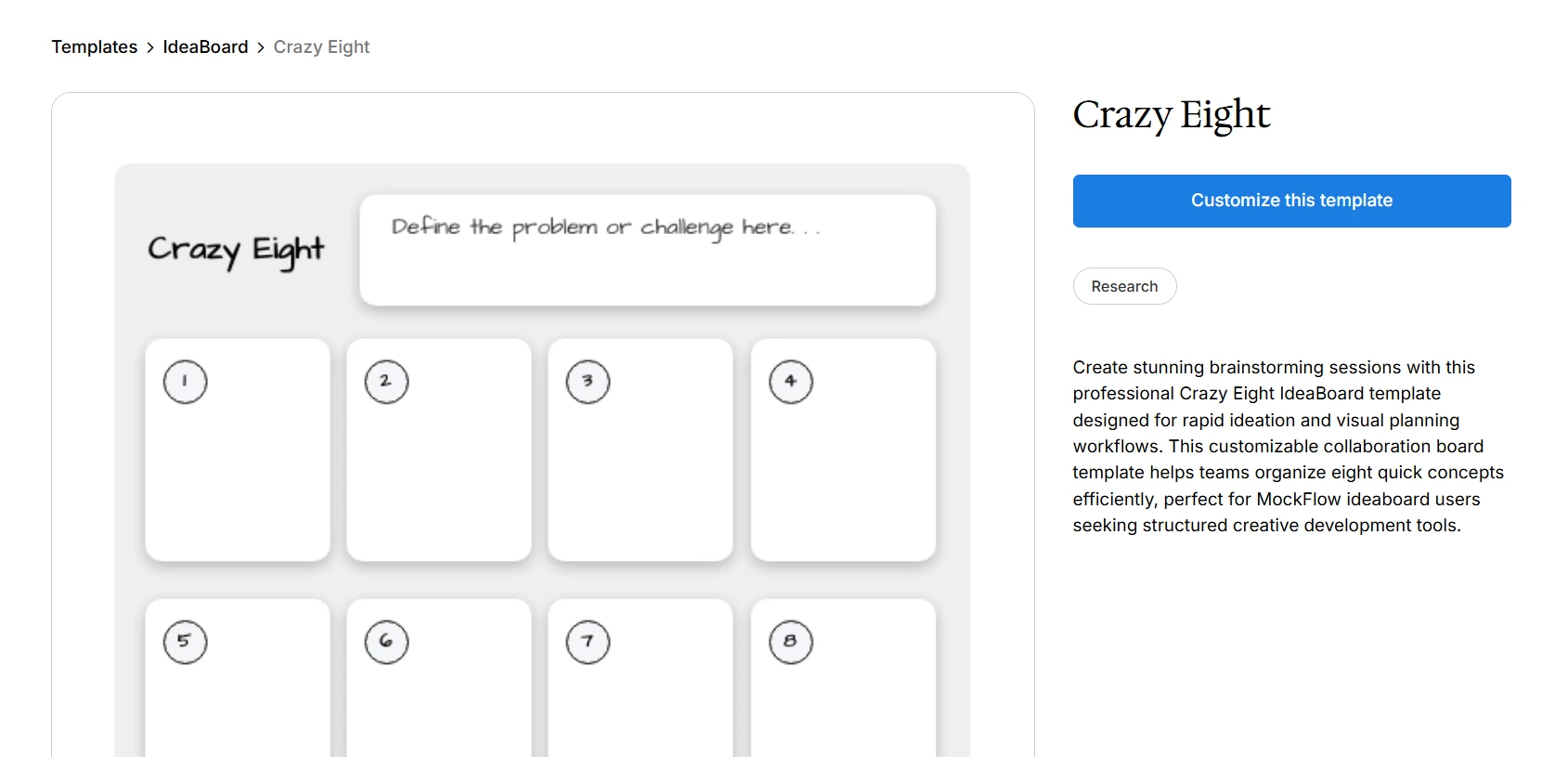
Customize this crazy 8 template with IdeaBoard
Problem-solving and analytical brainstorming techniques
These techniques focus on clarity, evaluation, and decision support. Instead of generating ideas freely, these techniques guide thinking through structured lenses that help teams examine a situation from multiple angles and reach more informed conclusions.
Deloitte’s research highlights how increasing workplace complexity is forcing leaders to balance competing priorities, making structured approaches to problem-solving more critical than ever.
18. Reverse brainstorming
Reverse brainstorming flips the usual approach to problem-solving. Instead of asking how to solve a problem, participants ask how the problem could be created or made worse.
This shift helps surface risks, weak points, and overlooked behaviors. Once these negative actions are listed, the group reverses them into potential solutions.
The technique works well because it removes the pressure to be constructive at first. It encourages honesty and critical thinking, making it easier to identify root causes and prevention strategies that might otherwise be ignored.
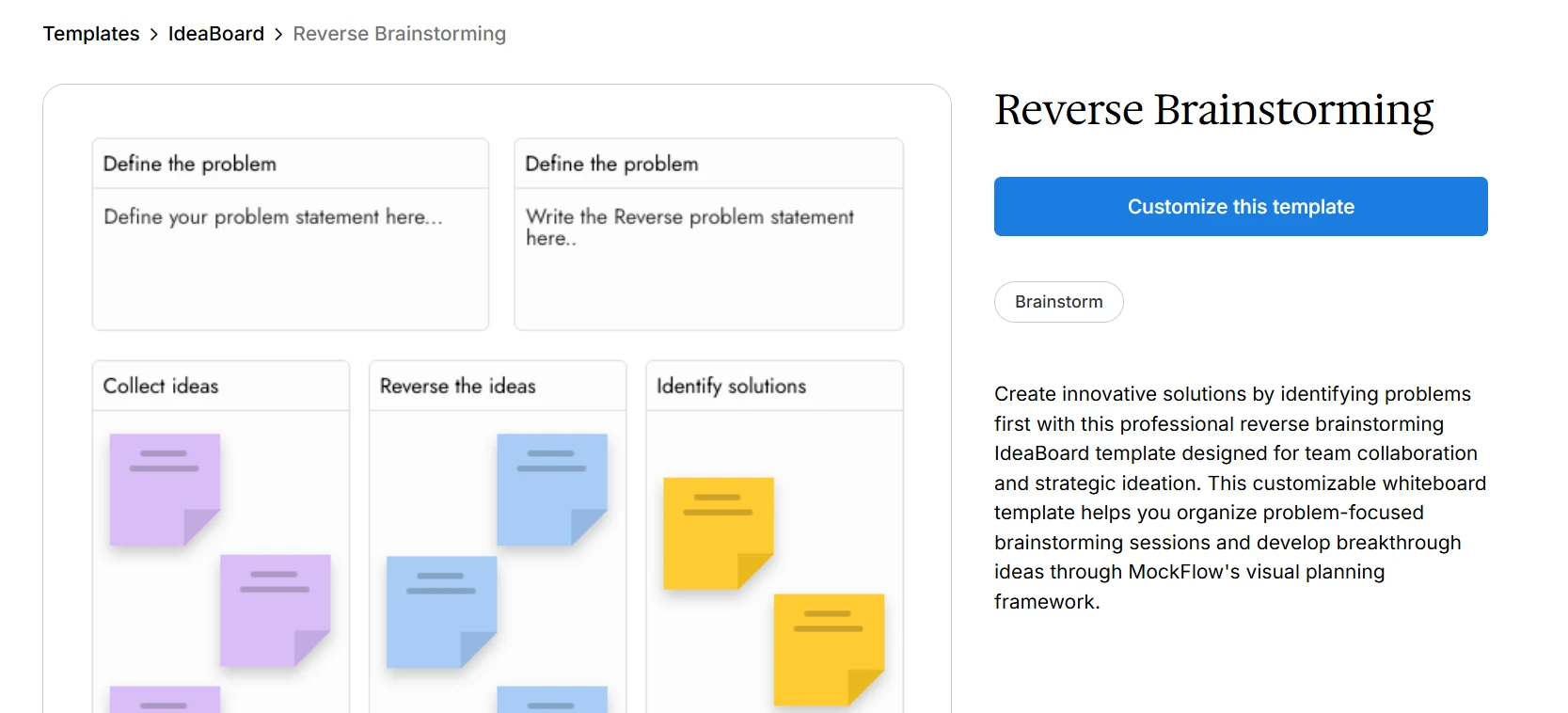
Customize this reverse brainstorming template with IdeaBoard
19. Starbursting
Starbursting focuses on understanding an idea fully before deciding whether it is good or bad. The idea is placed at the center, and the group generates questions around six areas:
- Who?
- What?
- When?
- Where?
- Why?
- How?
Instead of rushing to solutions, the session stays in question mode. This helps find missing details, hidden assumptions, and practical constraints. For example, questions may surface gaps around ownership, timing, resources, or user impact.
Starbursting works best when a concept feels promising but unclear. By the end of the exercise, teams have a clearer picture of what needs validation, what risks exist, and what information is still required before moving forward.
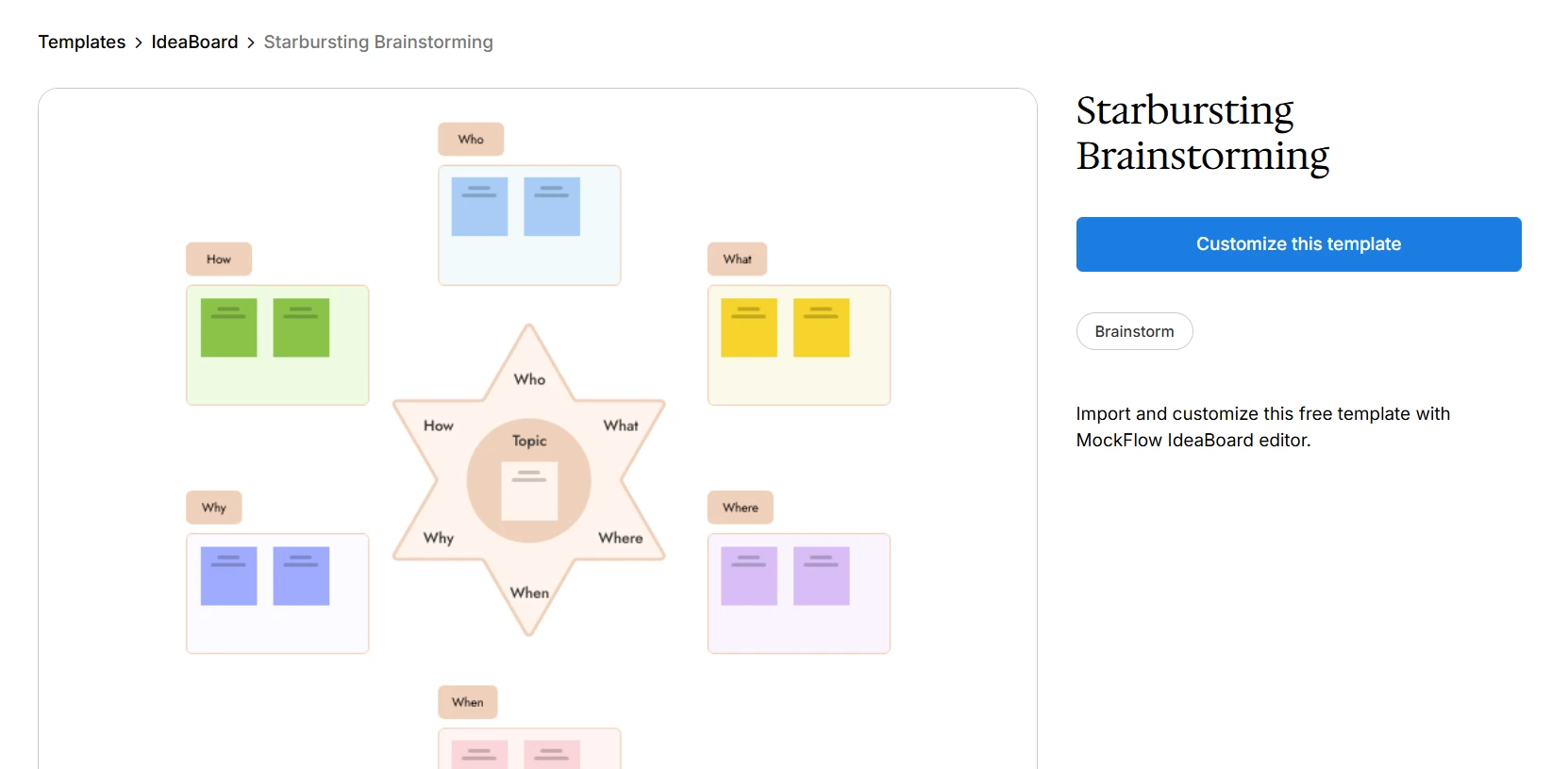
Customize this starbursting brainstorming template with IdeaBoard
20. Question-based brainstorming
Question-based brainstorming shifts the focus from answers to understanding. Instead of listing solutions, participants generate questions about the topic at hand. These questions explore what is unclear, what assumptions are being made, what could go wrong, and what needs validation.
This approach works well because it slows teams down before they commit to solutions. Patterns across questions often reveal the real problem beneath the surface.
Question-based brainstorming is especially useful at the start of a project or when a challenge feels complex or poorly defined. By clarifying what needs to be answered first, teams generate more relevant and focused ideas later.
Academic research published in SAGE journals shows that question-driven exploration improves deeper understanding and leads to more meaningful idea development compared to solution-first approaches.
21. Lightning Decision Jam
Lightning Decision Jam (LDJ) is a structured technique designed to move teams from problems to decisions quickly. Instead of starting with ideas, participants begin by listing problems or friction points related to a topic. These problems are then grouped and prioritized before solutions are discussed.
This order matters because it keeps teams focused on what truly needs fixing. Once priorities are clear, solutions are generated only for the most important issues.
Lightning Decision Jam works well for time-bound meetings where clarity and action matter more than exploration. It is especially useful when discussions feel stuck or when teams struggle to turn ideas into decisions.
22. SWOT brainstorming
SWOT brainstorming examines an idea or situation across four areas: strengths, weaknesses, opportunities, and threats.
- Strengths focus on what is working well or gives an advantage.
- Weaknesses highlight limitations, gaps, or areas that need improvement.
- Opportunities look at external possibilities that could be leveraged for growth or progress.
- Threats identify external risks or factors that could create challenges.
Each area is brainstormed separately to ensure balanced thinking.
This technique helps teams avoid focusing only on positives or negatives. It provides a structured way to evaluate internal factors, such as capabilities and limitations, alongside external factors like market conditions or risks.
SWOT brainstorming is useful for strategy discussions, planning exercises, and decision-making when trade-offs need to be clearly understood.
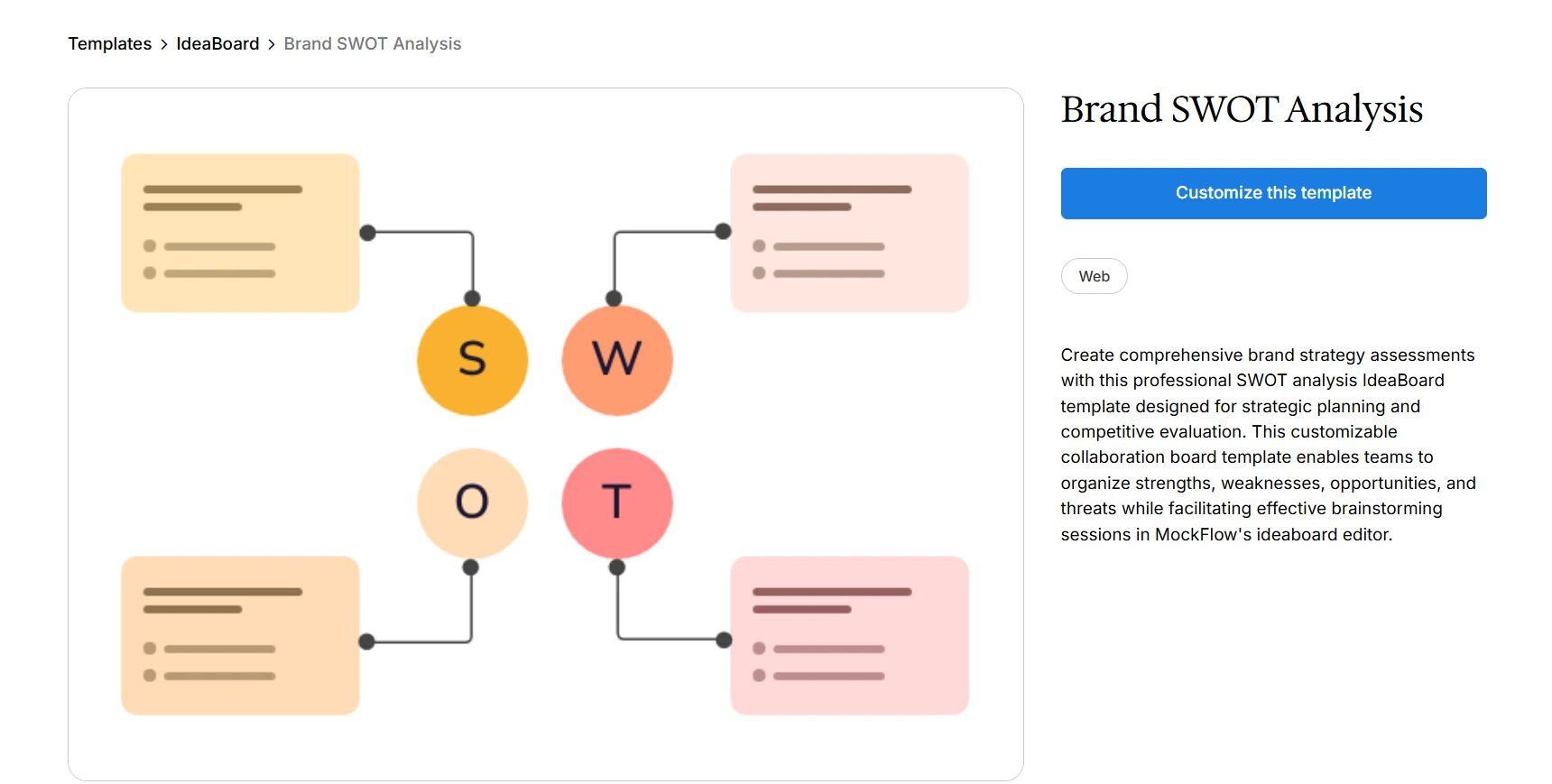
Customize this SWOT analysis template with IdeaBoard
23. Gap analysis brainstorming
Gap analysis brainstorming compares the current state with a desired future state. Participants identify where things are now, where they want to be, and what is missing in between. The focus is on actions, resources, or changes needed to close the gap.
This technique works well for process improvement, goal planning, and performance discussions. By clearly defining gaps, teams avoid vague problem statements and generate ideas that are directly tied to measurable improvement.
24. Rose, Bud, Thorn
Rose, Bud, Thorn is a reflection-based technique used to evaluate a situation from three angles.
- Roses highlight what is working well,
- Buds represent opportunities or areas with potential, and
- Thorns identify challenges or pain points.
Each area is explored separately to keep thinking balanced. This technique works well because it avoids overly positive or negative discussions.
Rose, Bud, Thorn is commonly used in retrospectives, project reviews, and strategy discussions. It helps teams understand the current state clearly while identifying where to improve and what to explore next.
25. Six Thinking Hats
Six Thinking Hats structures discussion by asking participants to think from one perspective at a time. Each hat represents a specific focus, such as facts, emotions, risks, benefits, creativity, or process control.
By aligning everyone on the same mode of thinking, the method reduces confusion and debate. It helps teams separate analysis from emotion and evaluation from idea generation.
Six Thinking Hats works well for complex decisions where discussions tend to drift or become emotional. It ensures balanced input, prevents dominance by strong opinions, and leads to more thoughtful, well-rounded outcomes.
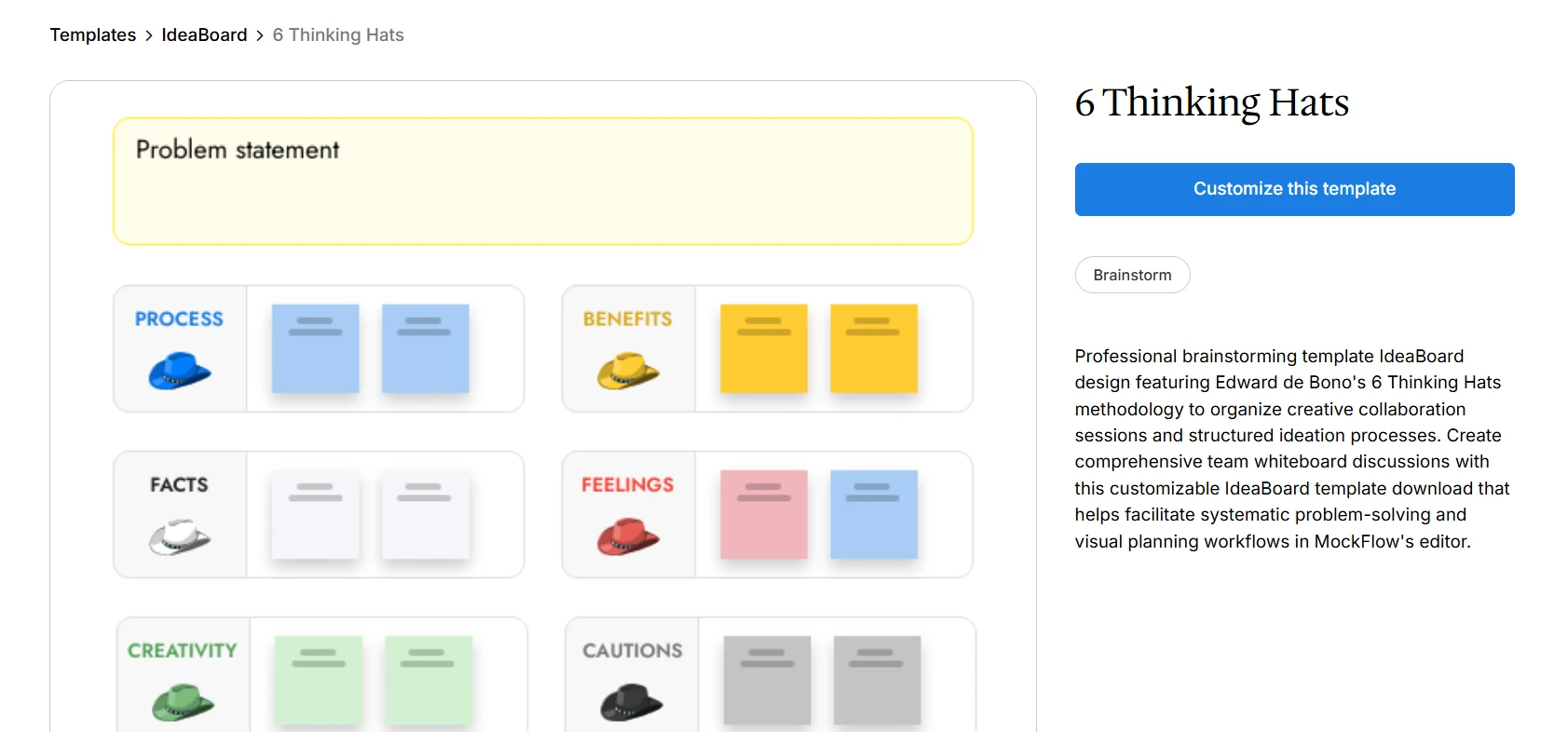
Customize this six thinking hats template with IdeaBoard
Across these different techniques discussed above, one thing stays consistent: when the right technique matches the moment, brainstorming feels easier and more productive. Instead of forcing ideas, teams can guide thinking with intention and clarity.
Tips to apply brainstorming techniques effectively
Good brainstorming is less about the technique itself and more about how the session is run. A little intention before, during, and after the session makes a big difference in the quality of ideas and what happens to them next.
Here are a few practical tips that consistently improve outcomes.
- Be clear about the goal before you start: Know whether the session is meant to explore freely, solve a specific problem, or narrow down options. This helps you pick the right approach and keeps discussions from drifting.
- Separate idea generation from evaluation: Let ideas flow without judgment first. Save prioritization and critique for later. Mixing the two too early shuts down participation and limits range.
- Make participation easy for everyone: Not everyone thinks best out loud. Use writing, silence, or visual methods so quieter voices have equal space to contribute.
- Capture ideas in a shared, flexible space: Using a collaboration tool like IdeaBoard helps teams collect and organize ideas in real time. Teams can start with templates designed for different brainstorming formats, and when momentum stalls or time is limited, AI-assisted layouts and prompts help teams move forward without overthinking setup.
- Close with prioritization and next steps: A session is only useful if ideas move forward. Group related ideas, agree on priorities, and assign clear next actions while everything is still fresh.
When these basics are in place, brainstorming becomes more focused, inclusive, and easier to turn into action.
How to Choose the Right Brainstorming Technique
The right technique depends on two things: the goal of the session
and the team running it.
If you are exploring a problem with no defined answer yet, open-ended
techniques like mind mapping, visual stimulus brainstorming, or rapid
ideation work best. If you need to analyze or evaluate options, use
structured methods like SWOT, starbursting, or Six Thinking Hats. If
your team includes introverts, remote participants, or mixed seniority,
written techniques like brainwriting or brain netting reduce pressure
and improve participation.
Use this checklist before choosing:
- Is the goal exploration or evaluation?
- Is the session in person, remote, or hybrid?
- How many people are involved?
- Does the team have a strong facilitator or does the technique need
to be self-guiding?
When in doubt, start with brainwriting or round-robin. These work
across most team sizes and require no special facilitation.
Conclusion
Brainstorming is most effective when the approach matches the goal. Some situations need open exploration, others need structure and focus. Intentional selection of techniques, regular practice, and a willingness to experiment help teams generate better ideas and move them forward with confidence.
The real value comes from treating brainstorming as a shared habit rather than a one-off activity. When teams are thoughtful about how ideas are generated, captured, and refined, creativity becomes easier to sustain and easier to act on.
If you want a simple way to support this process, you can sign up and try MockFlow’s IdeaBoard for free. It gives teams a flexible space to think together, organize ideas, and move from brainstorming to next steps without friction.
Sign up for a free IdeaBoard demo today.
FAQs about brainstorming techniques
1. What are brainstorming techniques?
Brainstorming techniques are structured methods used to generate, explore, and organize ideas in individual or group settings. They replace unplanned discussions with repeatable approaches such as mind mapping, brainwriting, or problem reversal, which helps teams move from a blank page to useful concepts faster and with more clarity.
2. What are the best brainstorming techniques for teams?
Team-based brainstorming techniques include traditional brainstorming, round-robin sessions, brainwriting, step-ladder brainstorming, and role storming. These methods increase participation, reduce bias, and help teams surface diverse perspectives during workshops, meetings, and cross-functional discussions.
3. How do brainstorming techniques work in group sessions?
In group sessions, brainstorming techniques provide structure for how ideas are shared, captured, and evaluated. Methods such as round-robin or brainwriting ensure everyone contributes, while visual and analytical techniques help teams organize and compare ideas before selecting the strongest options.
4. Which brainstorming techniques help with creative thinking?
Creative thinking techniques include SCAMPER, random word association, forced connections, worst-possible-idea exercises, and rapid ideation. These methods push teams beyond obvious ideas by encouraging experimentation, unexpected links, and divergent thinking before narrowing down options.
5. How can brainstorming techniques be used for problem-solving?
Problem-solving techniques such as reverse brainstorming, starbursting, SWOT, gap analysis, and Six Thinking Hats help teams analyze challenges from multiple angles. These methods uncover risks, assumptions, and opportunities, making it easier to move from defining a problem to finding practical solutions.
6. How do digital brainstorming techniques work for remote teams?
Digital brainstorming techniques rely on visual collaboration tools with shared boards, templates, and real-time editing. Teams can add notes, group ideas, and refine concepts together, which recreates the energy of in-person brainstorming while supporting remote and hybrid work.
Bubble Map: Templates, Comparisons, and Practical Uses
Introduction There’s something about seeing ideas laid out visually that just feels easier to follow. You’re not reading line by...
Rapid Ideation: How to Generate, Refine, and Act on Ideas Faster
Quick Answer: Rapid ideation is a structured brainstorming approach that helps generate a large volume of ideas quickly...

Nominal Group Technique: A Practical Guide to Group Decisions
Introduction The nominal group technique (NGT) is a structured group decision-making method used when teams need to choose...
