How to Run a Brainwriting Session for Better Idea Generation
Introduction
Brainwriting technique has a quiet quality to it. It does not rely on energy in the room or fast exchanges of ideas. It asks for something simpler. A moment to think, and a place to write things down before anyone reacts.
Writing creates distance from judgment. It gives thoughts a chance to exist on their own, without being shaped by tone, confidence, or timing. People tend to write things they would never say out loud, and that is often where the most useful ideas come from.
Teams use brainwriting in many ways. Sometimes it is quick and structured. Other times it is loose and open-ended. What stays consistent is the shift in attention from speaking to thinking.
This article looks at brainwriting as a practical way to improve idea generation. You will see how to use it in different settings, when it works best, and how to structure sessions so ideas are easier to develop, review, and turn into action.
What is Brainwriting?
Brainwriting is a structured approach to idea generation that prioritizes thinking over talking. Instead of relying on verbal discussion, it creates space for individuals to develop ideas independently before group interaction begins. This shift helps teams surface more thoughtful and original inputs without social pressure.
Brainwriting is a silent, written brainstorming technique where participants generate and build ideas individually before any discussion. It replaces speaking with writing to ensure equal contribution and reduce groupthink. Teams write ideas in structured, time-boxed rounds and expand on others’ inputs to increase idea volume and diversity.
The brainwriting technique works well for collaborative problem-solving, creative exploration, and inclusive workshops. Brainwriting supports remote, hybrid, and in-person teams by keeping ideation focused, documented, and low-pressure while improving idea retention and creativity.
According to Gartner’s idea generation guide, structured ideation methods such as brainwriting are among the best practices for generating high-quality ideas in R&D and innovation teams, building trust among team members.
How Does the Brainwriting Technique Work?
The brainwriting technique follows a simple, structured flow that keeps idea generation focused and unbiased. Everything starts with a clearly defined problem statement so all participants are aligned before ideation begins.
Once the prompt is set, the session moves into a silent writing phase. Participants write ideas individually, without discussion or feedback. This phase is usually time-boxed to maintain momentum and reduce overthinking.
A typical brainwriting flow looks like this:
- A shared problem or question is presented to the group
- Participants write ideas silently and independently
- Ideas are captured as short statements, notes, or sketches
- Ideas may be rotated or expanded by others without discussion
- Group review and discussion happen only after writing is complete
By postponing conversation, brainwriting keeps early ideas from anchoring the group. Every participant contributes before opinions start to influence direction, which leads to a higher volume of ideas and more independent thinking.
This structure makes brainwriting especially effective when balanced input and idea quality matter more than speed or debate.
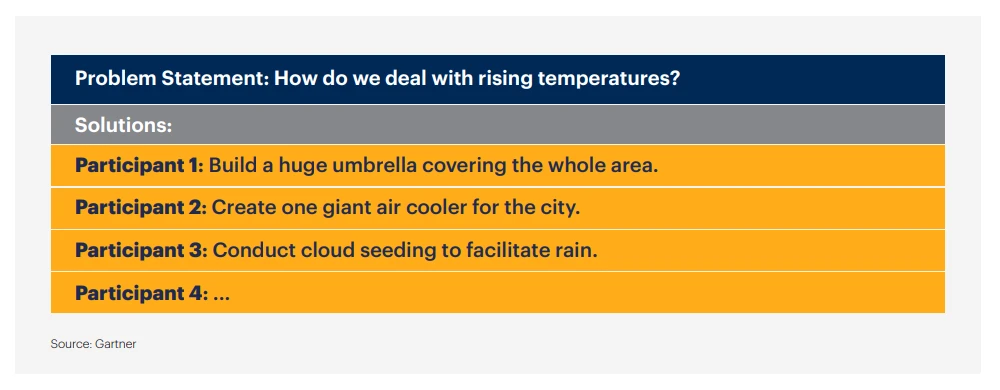
Source: Gartner
Brainwriting vs Brainstorming
Traditional brainstorming relies on spoken ideas and immediate reactions. Brainwriting relies on written idea generation and delayed evaluation. Verbal sessions often reward confidence and speed, while brainwriting rewards clarity and independent thinking.
Because ideas are developed privately first, brainwriting reduces groupthink, limits hierarchy-driven influence, and works especially well for mixed personalities, remote teams, and structured workshops where balanced input matters.
A peer-reviewed study published in SAGE journals found that structured approaches to idea exploration help groups avoid premature agreement and develop stronger shared understanding. This is exactly what brainwriting enables by separating idea generation from discussion.
Benefits of Using Brainwriting for Idea Generation
Brainwriting is used because it changes how ideas surface, not just how many are produced. By removing verbal discussion from the early stages, it creates conditions where ideas are shaped by thinking rather than influence.
Here’s why teams use brainwriting for idea generation:
- Equal participation: Everyone contributes at the same time, regardless of role, seniority, or communication style.
- Reduced groupthink and bias: Ideas are formed independently, limiting anchoring on early suggestions or dominant opinions.
- Higher idea volume and diversity: Silent, parallel writing leads to more ideas and a wider range of perspectives.
- Clear written record: Every idea is documented from the start, making it easier to review, revisit, and build on later.
While the method itself is simple, brainwriting works best when the workspace does not interrupt the flow of writing and expansion.
Visual collaboration tools like MockFlow’s IdeaBoard support this by offering an infinite canvas, real-time silent collaboration, and ready-made brainstorming templates that remove setup friction and keep the focus on ideation rather than facilitation.
Users can also generate custom brainstorming layouts with AI from simple text prompts or using the editable prompt library tailored for brainstorming use cases.
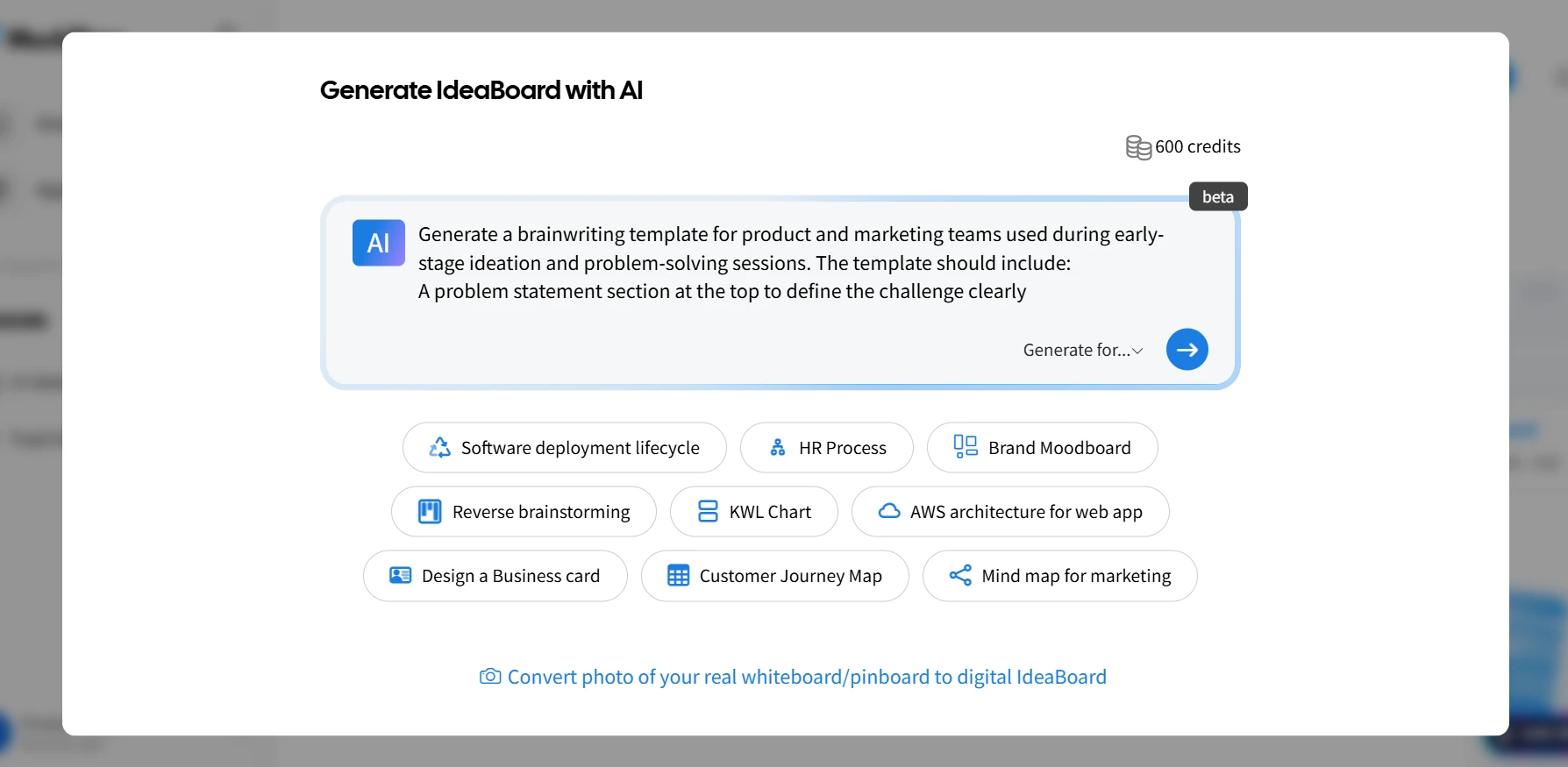
In a controlled brainwriting study with 16 participants, 50% reported that AI assistance introduced a unique or expanded perspective on the problem, and 44% said it significantly helped them generate new ideas, reinforcing how AI-supported layouts help during early ideation stages.
When Should We Use Brainwriting?
Brainwriting is most effective when the goal is idea exploration before discussion. It works best in situations where teams want independent thinking, broad participation, and a strong base of ideas before evaluation begins.
Brainwriting is a good fit when:
- You want input from everyone, not just the most vocal contributors
- Teams include mixed personalities or seniority levels, where hierarchy may influence discussion
- The problem space is broad or undefined, and early convergence would limit creativity
- Workshops focus on creativity, discovery, or problem framing, not immediate decisions
- Remote or hybrid collaboration makes verbal brainstorming harder to manage
And since a Zoom survey showed that most executives now prefer flexible or hybrid work models, asynchronous and written collaboration becomes increasingly necessary.
Because brainwriting emphasizes writing over speaking, it creates a low-pressure environment that supports deeper thinking and better idea retention.
That said, brainwriting may be less suitable when decisions are already clear, time is extremely limited, or the task is purely about execution rather than exploration. In those cases, direct discussion or decision-making frameworks tend to be more efficient.
Common Brainwriting Methods and Variations
Brainwriting can be adapted to different team sizes, goals, and time constraints. While the core idea remains silent, written idea generation, the structure can change depending on whether the focus is speed, depth, or collaboration style. Some variations prioritize idea volume, while others emphasize refining and strengthening ideas over multiple rounds.
Below are the most commonly used brainwriting methods and variations, each suited to different scenarios.
The 6-3-5 Brainwriting Method
The 6-3-5 Brainwriting method is one of the most structured and widely used brainwriting formats. It is designed to generate a large number of ideas quickly while keeping participation equal and focused.
The method follows a fixed structure:
- 6 participants take part
- Each participant writes 3 ideas per round
- Each round lasts 5 minutes
- Ideas are passed to the next participant after each round
As ideas move across rounds, participants expand and improve existing inputs instead of starting from scratch. This repeated building process helps push thinking beyond surface-level solutions and introduces multiple perspectives to the same idea.
Because 6-3-5 depends on clear rounds and disciplined timing, teams can rely on a dedicated 6-3-5 brainwriting template to keep the process organized. A ready-made template helps track contributors, rounds, and idea evolution without manual setup, which is especially useful in remote or hybrid sessions.
Teams can apply the method immediately using a structured 6-3-5 brainwriting template available on IdeaBoard:
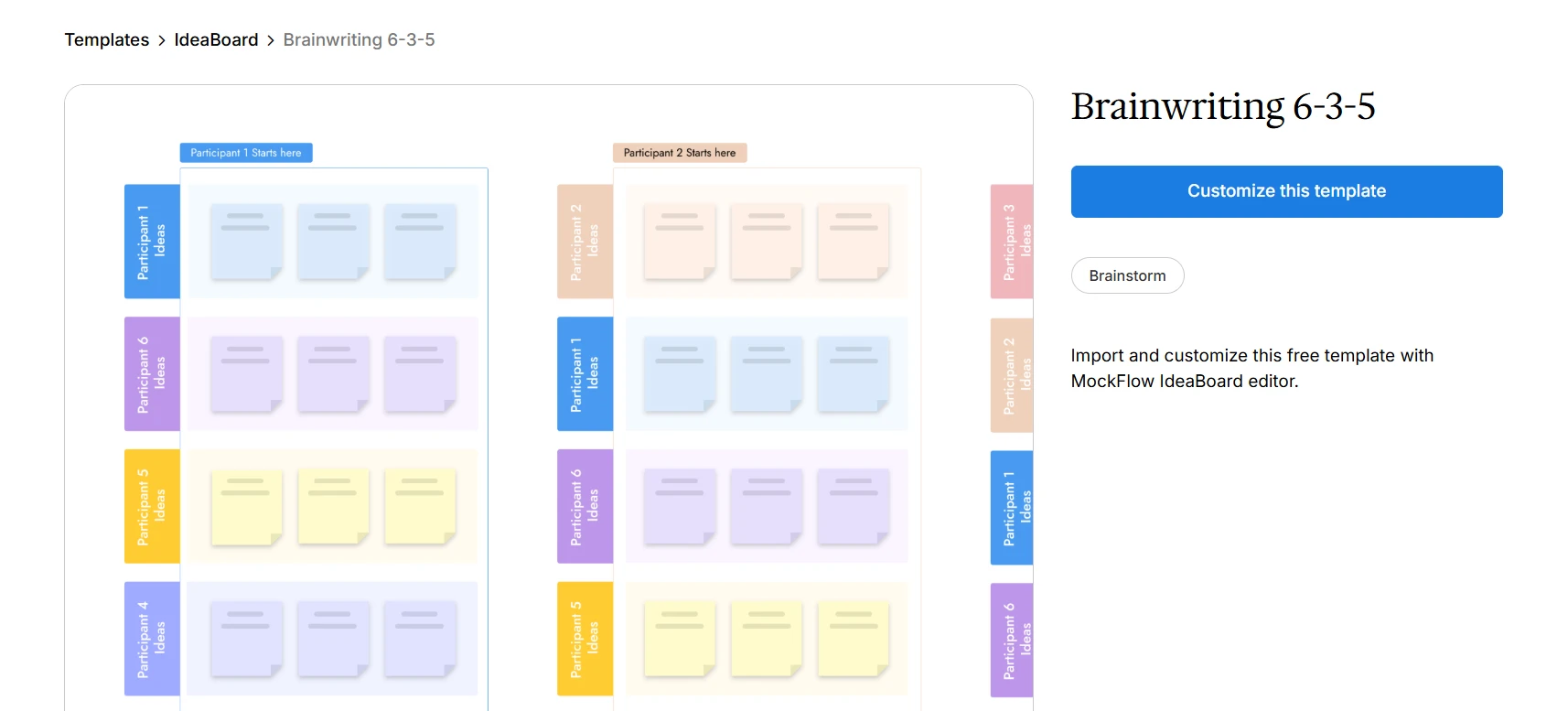
6-3-5 Brainwriting Template (click on the image to edit the template on IdeaBoard)
Open Brainwriting
Open brainwriting is a flexible variation of brainwriting that removes rigid time limits and fixed rounds. Instead of moving ideas in strict cycles, participants contribute and build on ideas at a pace that suits the session or context.
This approach works well when the goal is exploration rather than speed. Ideas are still written silently, but contributors are free to return to the board multiple times, add new thoughts, or expand existing ones as clarity develops.
Open brainwriting is especially useful when:
- Teams are working across time zones or asynchronously
- Sessions span hours or days rather than minutes
- Creative discovery matters more than idea volume
- Participants benefit from reflection between contributions
Because ideas remain visible and editable, open brainwriting supports deeper thinking and iterative refinement.
Brainwriting with Idea Rotation
Brainwriting with idea rotation adds structure to written ideation by intentionally passing ideas through multiple contributors. Each participant starts by writing their own ideas silently. After a round, those ideas are shared or rotated so others can expand, clarify, or strengthen them.
The emphasis here is not on producing many ideas, but on improving the quality of existing ones through multiple perspectives.
This variation typically involves:
- Silent individual idea writing in the first round
- Controlled rotation of ideas between participants
- Additions such as extensions, alternatives, or clarifying notes
- No verbal discussion until all writing rounds are complete
Idea rotation works well when teams want to pressure-test concepts, uncover blind spots, or evolve rough ideas into stronger proposals.
Each of these above variations serves a different purpose. By choosing the right format based on time, team structure, and goals, teams can adapt brainwriting to support deeper thinking, stronger ideas, and more inclusive collaboration.
Brainwriting Technique Example
Consider a product team that wants ideas to improve onboarding for new users. Instead of starting with discussion, the team uses brainwriting to generate ideas independently.
The session follows a simple flow:
- A clear prompt is shared, such as improving the onboarding experience
- Participants write ideas silently for a fixed time
- Ideas are captured as short, action-oriented statements
- No explanation or feedback is allowed during writing
After the first round, ideas are shared and expanded:
- Participants add refinements or alternatives to others’ ideas
- Similar ideas begin to surface from different perspectives
- Strong directions become visible through repetition and buildup
Only after all writing rounds are complete does the team review ideas together. At this point, discussion is more focused because the group is reacting to a rich set of documented inputs rather than raw opinions. Brainwriting helps the team reach clarity faster while ensuring that every participant contributes meaningfully.
How to Use Brainwriting Step by Step
Brainwriting is most effective when it follows a clear, repeatable structure. The steps below outline a practical workflow teams can use to run focused, low-pressure ideation sessions that lead to usable outcomes.
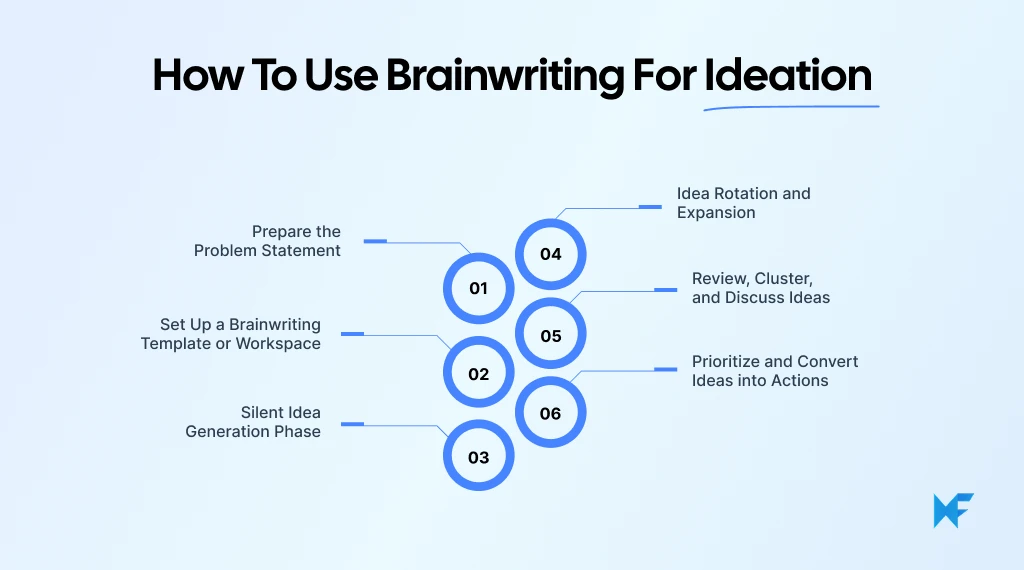
1. Prepare the Problem Statement
Everything starts with a well-defined prompt. The problem statement should be specific enough to guide thinking, but open enough to invite multiple directions.
Avoid vague or compound questions. A focused, outcome-oriented prompt ensures participants spend their energy generating relevant ideas instead of clarifying what the task actually is.
2. Set Up a Brainwriting Workspace
Brainwriting depends on silent, parallel contribution, which makes the workspace critical. Each participant needs clear space to write, review, and build on ideas without interruption.
Using a dedicated brainwriting layout in IdeaBoard makes this process seamless. The board gives every participant equal visual space, keeps ideas visible as they evolve, and removes setup friction so the session starts with writing, not arranging.
A structured brainwriting template also helps maintain consistency across sessions, especially for remote or hybrid teams running recurring workshops.
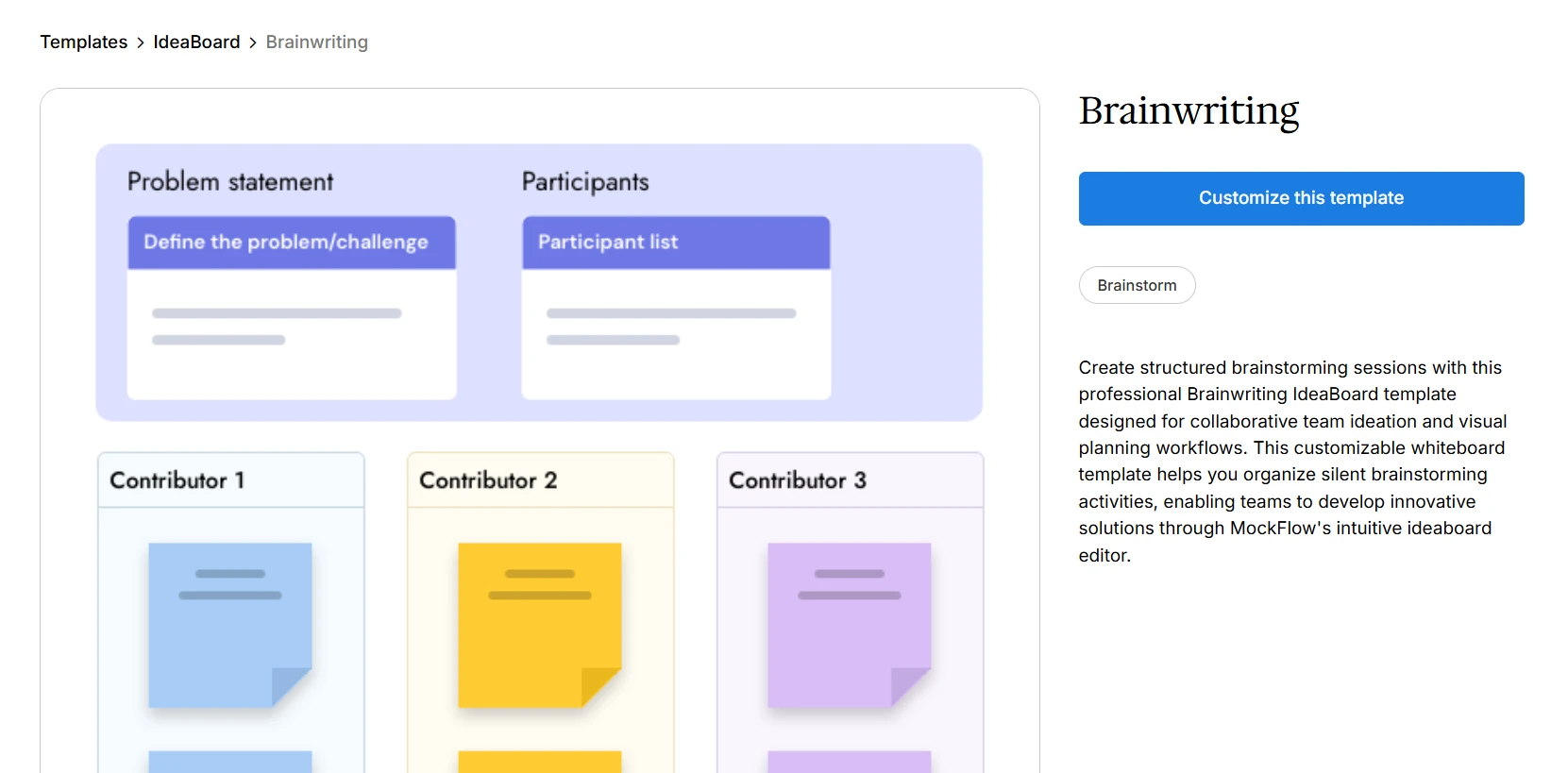
Brainwriting Template (click on the image to edit the template on IdeaBoard)
3. Silent Idea Generation Phase
Participants now write ideas independently and silently. This phase is intentionally free of discussion, feedback, or explanation.
Writing happens within a defined time window to maintain momentum. The focus is on capturing thoughts quickly and openly, without self-editing or concern for polish. This is where the highest volume of raw ideas emerges.
4. Idea Rotation and Expansion
Once initial ideas are captured, participants begin building on one another’s inputs. Ideas are expanded, clarified, or combined directly on the board.
This written exchange applies multiple perspectives to the same ideas while preserving independent thinking. Because everything happens in writing, ideas improve without being derailed by early opinions or debate.
5. Review, Cluster, and Discuss Ideas
Only after all writing rounds are complete does discussion begin. At this stage, teams review ideas together and start making sense of the output.
Ideas are grouped visually, patterns become obvious, and strong themes surface naturally. The discussion is more focused because it reacts to documented thinking rather than unformed opinions.
6. Prioritize and Convert Ideas into Actions
The final step is moving from ideas to next steps. Teams prioritize promising directions, assign ownership, and define follow-up actions.
Because brainwriting produces a clear written trail, nothing gets lost. The board remains a shared reference that teams can return to as ideas move into validation or execution.
Tips for Running Successful Brainwriting Sessions
Even though brainwriting is simple by design, small facilitation choices can significantly affect the quality of outcomes. The tips below help ensure sessions stay focused, inclusive, and productive.
- Separate ideation from evaluation: Make it clear that writing ideas comes first. Discussion and judgment should only happen after all ideas are captured.
- Use clear time limits: Time-box writing rounds to maintain focus and prevent overthinking. Short constraints encourage faster, more instinctive ideas.
- Encourage imperfect ideas: Reinforce that ideas do not need to be polished. Rough thoughts often lead to stronger concepts when expanded later.
- Protect psychological safety: Set expectations that all written inputs are valid during ideation. This reduces self-censorship and increases participation.
- Keep the session silent during writing: Avoid explanations, reactions, or clarifications until the writing phase is complete to preserve independent thinking.
- Document and organize outcomes clearly: Cluster ideas, highlight themes, and label next steps so insights remain actionable after the session ends.
- Use a shared visual workspace: Capture ideas in a structured board like MockFlow’s IdeaBoard so ideas stay visible, organized, and easy to build on without interrupting flow.
IdeaBoard offers ready-made brainwriting templates, shared boards, and real-time collaboration that help teams focus on ideas instead of facilitation. You can try the free IdeaBoard demo and see the difference in your very next session.
Conclusion
Brainwriting brings structure and balance to idea generation by giving everyone equal space to think before discussion begins. By shifting brainstorming from speaking to writing, teams reduce bias, improve participation, and surface ideas that might otherwise stay unheard. The result is clearer thinking, stronger collaboration, and a documented trail of ideas that is easy to revisit and act on.
Research published by Springer also shows that teams using structured ideation methods consistently achieve stronger innovation outcomes than those relying on unstructured discussion alone. Brainwriting provides that structure without adding unnecessary complexity.
When supported by a visual workspace like IdeaBoard, brainwriting becomes easier to run consistently across teams and sessions.
If your next brainstorming session needs better participation and stronger outcomes, brainwriting is a practical place to start. Sign up for free today!
FAQs about Brainwriting
1. What is brainwriting in brainstorming?
Brainwriting is a silent, written brainstorming technique where participants generate ideas individually before any discussion. Instead of speaking ideas aloud, everyone writes them down, which helps capture more original ideas and ensures equal participation across the group.
2. What is the brainwriting technique used for?
The brainwriting technique is used to generate a high volume of ideas in a structured and inclusive way. Teams use it for problem-solving, early-stage ideation, product discovery, and creative workshops where balanced input and reduced bias matter.
3. Can brainwriting be combined with other brainstorming techniques?
Brainwriting often works best as a starting phase before other techniques. Teams commonly follow brainwriting with affinity mapping, prioritization frameworks, or structured discussion to evaluate and develop ideas more effectively.
4. How do facilitators keep brainwriting sessions focused?
Facilitators keep brainwriting focused by using a clear problem statement, strict time limits, and defined writing rounds. Separating ideation from discussion prevents drift and keeps participants engaged in writing rather than evaluating ideas too early.
5. What is the 6-3-5 brainwriting method?
The 6-3-5 brainwriting method involves six participants writing three ideas every five minutes. Ideas rotate across multiple rounds, allowing participants to build on each other’s inputs. This method creates structure, speed, and consistent idea generation.
6. Does brainwriting work for remote or hybrid teams?
Brainwriting works well for remote and hybrid teams because it supports parallel, written contribution without requiring constant discussion. Digital templates and shared workspaces help teams collaborate silently while maintaining structure and clarity.

5 Asynchronous Collaboration Strategies for Modern Remote Teams
Introduction When our teams work across different time zones, schedules rarely line up perfectly. Someone is starting their day...
What is Wireframe? - Definition, Types, and Best Practices for 2026
Every great digital product starts with a clear plan. Before colors, fonts, or visuals come into play, designers begin by...
Dot Voting: How to Prioritize Ideas and Make Team Decisions
Your brainstorming session has produced more ideas than the team can realistically pursue. Now you need a clear way to decide...
