How to Use the Starbursting Technique for Brainstorming in 2026
Introduction
Some ideas feel “done” the minute we say them out loud. A new feature. A campaign hook. A process change. Everyone nods, someone suggests a direction, and the room starts building on top of something we have not fully inspected yet.
Starbursting asks us to do the opposite: hold the idea still and circle it with questions.
That is the whole technique. We take one concept, put it in the center, and expand outward using who, what, when, where, why, and how.
No racing to answers. No debating execution too early. Just a structured way to surface what we know, what we are assuming, and what we have not even thought to ask yet.
In this guide, we will cover what starbursting is, walk through a practical example, and show how to run starbursting brainstorming session, including how to capture it cleanly in a tool like MockFlow’s IdeaBoard.
What is the starbursting technique and how does it work?
Starbursting is a structured, question-based brainstorming technique used to explore ideas thoroughly before moving to solutions. The method places a single idea at the center and expands outward using six guiding prompts: who, what, when, where, why, and how.
This simple radial structure forces teams to slow down and examine the idea from multiple angles instead of defaulting to opinions or execution debates.
This outward expansion is what makes starbursting effective for idea exploration. The structure prevents tunnel vision and keeps any one perspective from dominating the discussion. As questions build, patterns start to emerge. Gaps become obvious. Assumptions surface without being forced.
By the end, we are not left with a loose collection of thoughts but a shared, well-rounded understanding of the idea, its unknowns, and what needs attention next.
The six core starbursting questions
The starbursting technique is built around six simple but powerful prompts: Who, What, When, Where, Why, and How. Each one directs attention to a different dimension of the idea, ensuring structured questioning instead of random exploration.
- 'Who' helps identify everyone involved or affected, from users and stakeholders to decision-makers and dependencies.
- 'What' clarifies the nature of the idea itself, uncovering scope, definitions, and hidden ambiguity.
- 'When' brings timing, sequencing, and urgency into focus, often revealing constraints teams overlook early on.
- 'Where' examines context, environments, and channels where the idea will live or operate.
- 'Why' tests purpose and value, surfacing assumptions and alignment with broader goals.
- 'How' explores feasibility at a high level without forcing premature solutions.
Together, these six prompts form the backbone of starbursting brainstorming, keeping exploration disciplined, comprehensive, and useful.
A peer-reviewed study published in SAGE journals found that structured questioning helps groups avoid premature convergence and develop more comprehensive shared understanding during collaborative tasks.
Why use the starbursting technique for brainstorming?
Most brainstorming methods reward speed and volume. Starbursting rewards depth and balance. By forcing teams to ask questions before offering opinions, it changes how ideas are explored and how decisions are shaped. The value lies less in creativity alone and more in clarity.
Here are the core benefits of using starbursting brainstorming in real sessions:
- Deeper idea exploration: The structured questioning approach ensures ideas are examined from multiple angles, not just the most obvious ones. This leads to more complete understanding and fewer surprises later.
- Reduced cognitive and group bias: Because everyone works through the same six question types, no single viewpoint dominates. The framework naturally slows down premature agreement and confirmation bias.
- Stronger collaboration across roles: Starbursting gives equal weight to different perspectives. Product, marketing, design, and operations can all contribute without competing for airtime or steering toward solutions too early.
- Clearer next steps: A Forbes Advisor analysis estimates that poor workplace communication can cost organizations over $12,500 per employee each year through rework, delays, and misunderstandings. With starbursting, teams walk away with clearly defined unknowns, risks, and areas that need validation or follow-up, instead of scattered ideas.
Brainstorming tools like MockFlow’s IdeaBoard support this process well by offering an infinite canvas, real-time collaboration, and ready-made brainstorming templates that make capturing and organizing starburst questions easy as they emerge.
When should we use brainstorming techniques like starbursting?
Starbursting can be used when the goal is to explore an idea fully before locking into answers. It is most effective in moments where clarity, alignment, and shared understanding matter more than speed.
Starbursting is especially useful when:
- You are at an early stage of idea development and still defining the problem
- The idea involves multiple stakeholders, dependencies, or constraints
- There are hidden assumptions, risks, or unknowns that need to be surfaced
- Teams need a common understanding before moving into planning or execution
- You are exploring new products, features, campaigns, or process changes
Starbursting may not be the right choice when:
- The problem is already clearly defined and well understood
- Solutions are known and the task is to prioritize or execute
- Time is extremely limited and deep exploration is not feasible
Used at the right moment, starbursting creates clarity that makes every next step more effective.
Starbursting technique example
Let’s look at a simple scenario to understand how starbursting brainstorming plays out in practice.
A team is exploring the idea of launching a new customer onboarding flow for a SaaS product. Instead of jumping into flows or feature ideas, they place “New customer onboarding flow” at the center of the board and stay in question mode.
They then build out the six starbursting branches, using each prompt to explore the idea from a different angle:
- Who: Who is this onboarding for? Which user segments matter most? Who owns the experience internally?
- What: What does onboarding include? What success looks like? What is explicitly out of scope?
- When: When does onboarding start and end? When should users reach activation milestones?
- Where: Where does onboarding happen, in-app, email, sales touchpoints, or all three?
- Why: Why are we changing onboarding now? Why this approach over alternatives?
- How: How will this be delivered at a high level? How will success be measured?
As the board fills up, gaps become obvious. The team realizes they lack clarity on user segments and activation goals. Instead of moving forward with assumptions, they now know exactly what needs validation before any solutions are designed.
If you want to run such exercises yourself, you can set up the same layout using IdeaBoard’s ready-made starbursting brainstorming template. Starting with a structured board helps you focus on the questions instead of spending time arranging the framework.
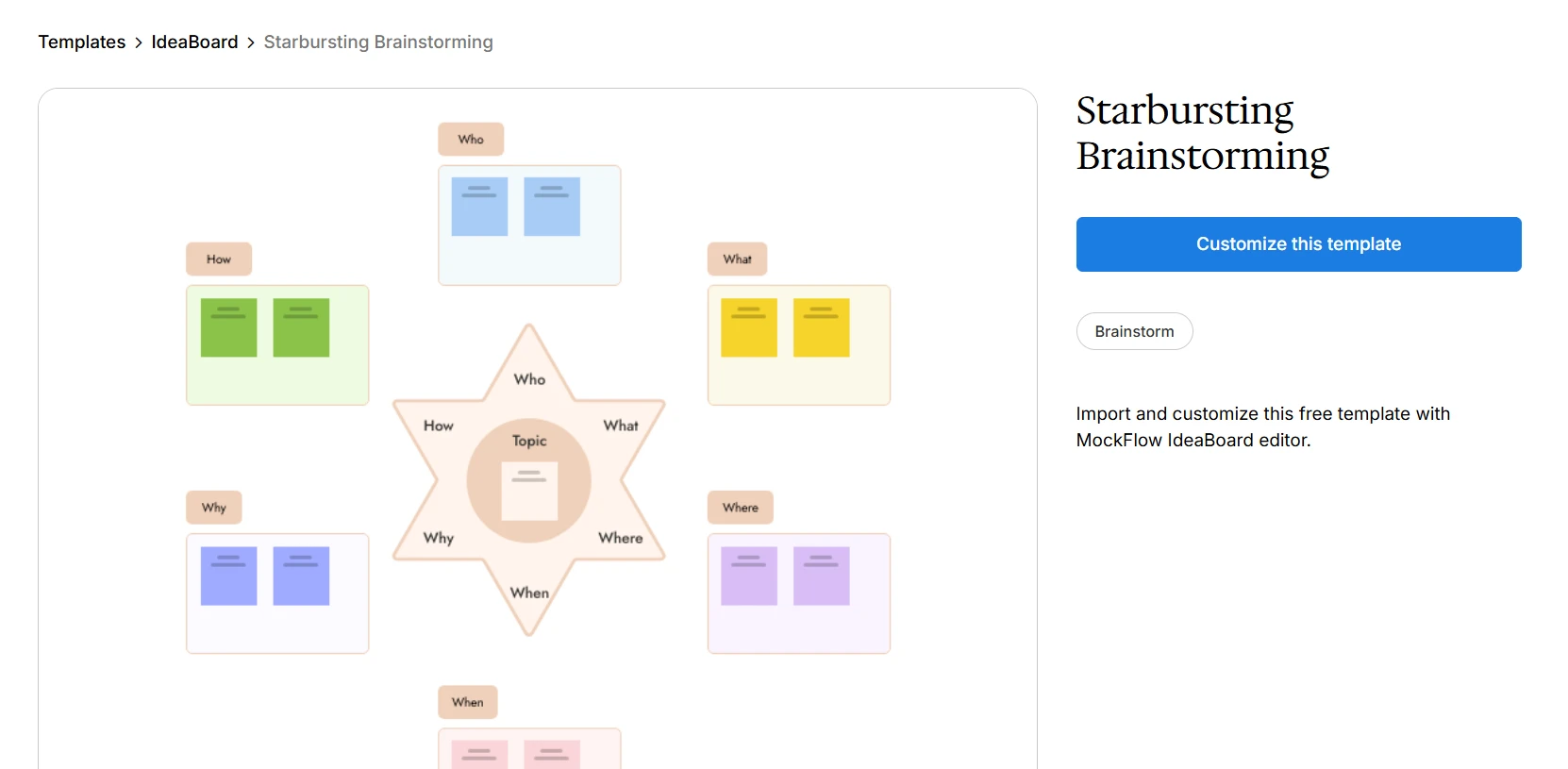
Click on the image and customize this starbursting template with IdeaBoard
How to use the starbursting technique for brainstorming
Using starbursting brainstorming effectively is less about artistic setup and more about creating the right conditions for questions to grow. The steps below focus on building a clear, flexible workspace and anchoring the exercise around a well-defined central idea before expanding outward.
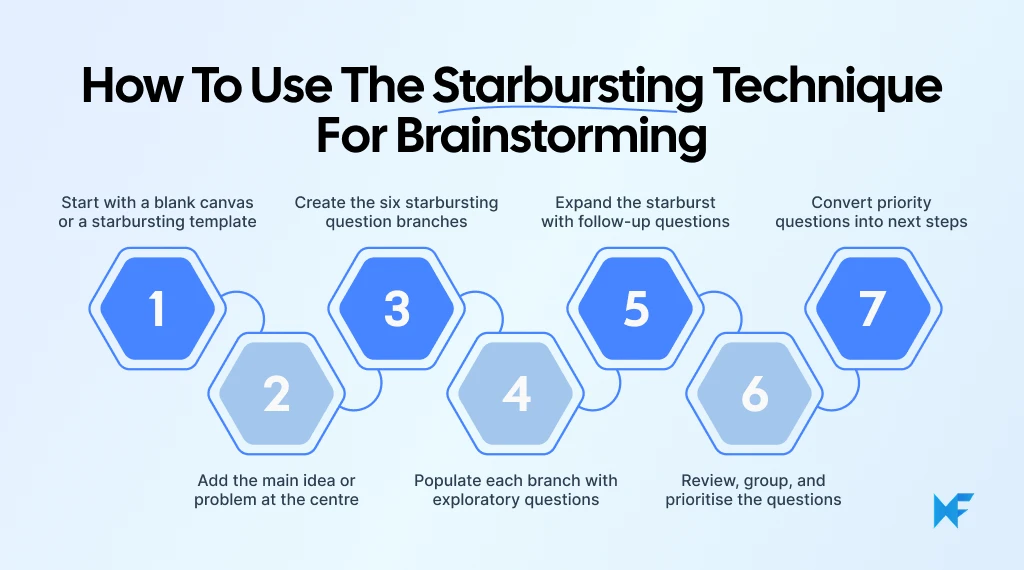
1. Start with a blank canvas or a starbursting template
The first step is opening a new board and deciding how much structure you want upfront. A blank canvas gives you maximum freedom to lay things out organically, while a ready-made starbursting template helps you move faster by removing setup friction.
What matters most is leaving enough open space for the idea to expand in multiple directions without feeling constrained.
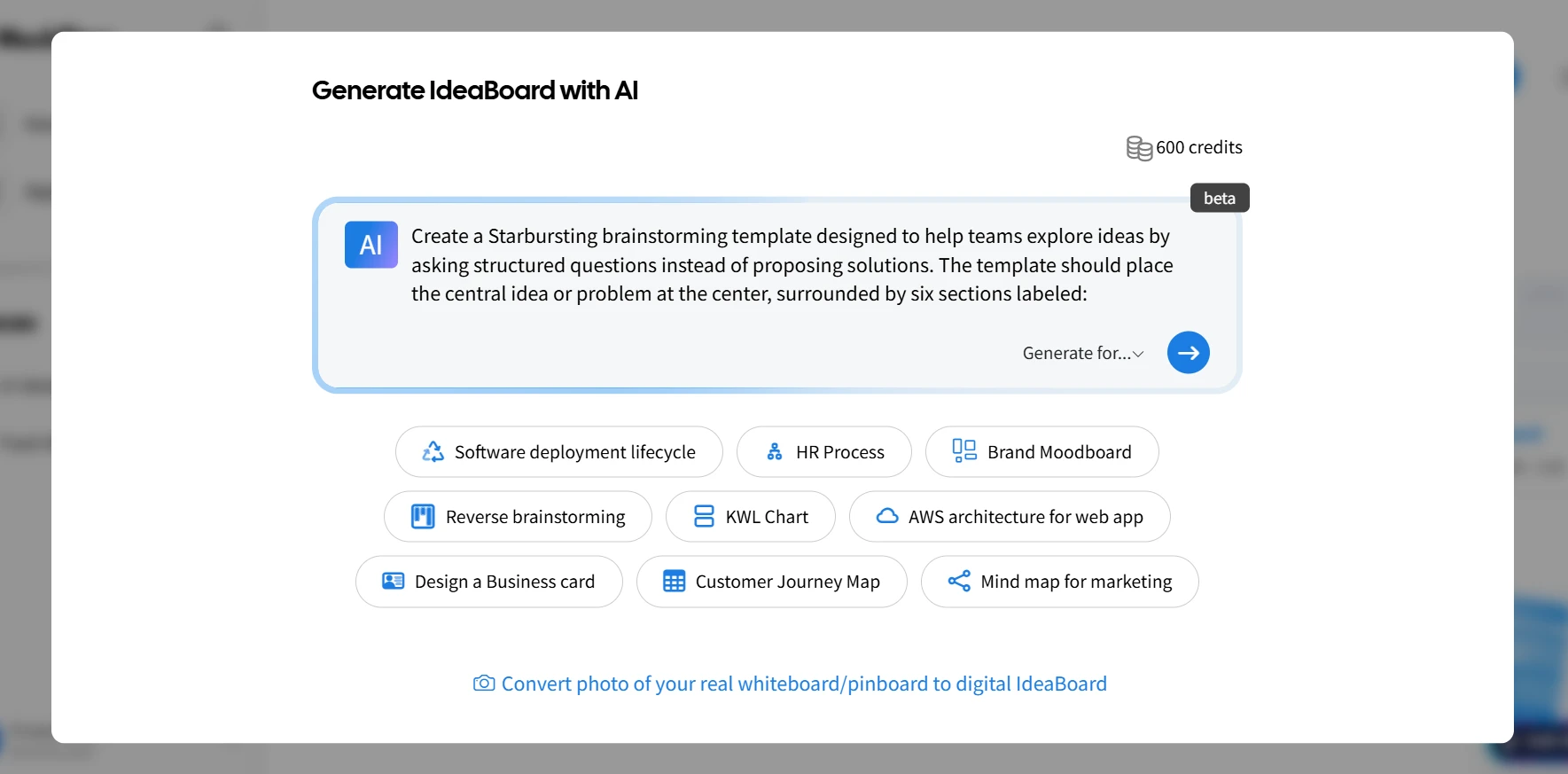
Visual collaboration tools like IdeaBoard make this easy by offering an infinite canvas, an intuitive drag-and-drop interface, and dedicated brainstorming templates. You can start from scratch, pick a customizable starbursting layout, or even generate a board quickly using AI prompts.
According to a DataIntelo market report, the remote collaboration tools market is growing at a double-digit rate, underscoring how teams increasingly rely on digital spaces to think together.
The goal at this stage is not perfection, but creating a workspace that invites exploration rather than limits it.
2. Add the main idea or problem at the center
Once the board is ready, place the core idea or problem at the center. This statement should be clear, specific, and singular. Avoid vague phrasing or combining multiple problems into one, as that weakens the quality of the questions that follow.
A strong central prompt acts as an anchor for the entire exercise. It ensures that every question branch stays connected to the same focus, making the starburst easier to navigate and far more useful when you review the output later.
3. Create the six starbursting question branches
With the central idea in place, the next step is to build out the six starbursting branches. These branches represent who, what, when, where, why, and how, and they should radiate outward evenly from the center. The goal is to give each question type equal space and importance, so no single lens dominates the conversation.
Label each branch clearly and keep the layout balanced. This visual symmetry matters more than it seems. When one branch feels larger or more prominent, teams naturally spend more time there and neglect the others. A clean, evenly weighted structure keeps attention distributed and reinforces the discipline of the technique.
4. Populate each branch with exploratory questions
Once the branches are set, start adding questions using sticky notes or cards. At this stage, volume matters more than precision. At the same time, structure keeps that volume useful.
Research published by Springer shows that clear frameworks in digital collaboration environments reduce cognitive overload and improve collective sense-making.
The aim is to generate as many relevant questions as possible before judging or refining them.
Keep the questions open-ended and exploratory. Avoid phrasing that implies a solution or assumes an answer. Encourage multiple angles within each branch, even if some questions feel repetitive or uncomfortable. Those moments often point to hidden assumptions or unresolved tension, which is exactly what starbursting brainstorming is designed to surface.
5. Expand the starburst with follow-up questions
After the first round of questions is on the board, use them as triggers for deeper exploration. Look at each question and ask what sits underneath it. This second layer often reveals assumptions, constraints, or dependencies that were not obvious at first.
Follow-up questions help move from surface-level curiosity to meaningful insight. They expose what the team is taking for granted, where information is missing, and which uncertainties could carry the most risk. This is where starbursting shifts from broad exploration to focused understanding.
6. Review, group, and prioritize the questions
Once the board feels full, step back and review it together. Start by visually clustering related questions to identify patterns and themes. Some areas will naturally feel heavier or more uncertain than others.
From there, highlight the critical unknowns. These are the questions that, if left unanswered, would block progress or lead to poor decisions. This step prepares the group for decision-making without jumping ahead prematurely.
7. Convert priority questions into next steps
The final step is turning the most important questions into action. This might mean assigning research tasks, planning experiments, scheduling stakeholder conversations, or validating assumptions with data.
The board should not disappear after the session ends. Treat it as a living reference that captures the thinking behind future decisions. Used this way, starbursting brainstorming becomes more than a workshop exercise. It becomes a foundation for informed, confident execution.
By the end of a starbursting session, you are not guessing what to do next. You have a clear map of the questions that matter most and the confidence to move forward with intent rather than assumptions.
Key takeaways
Here are the few key takeaways to note:
- Starbursting is a structured, question-based brainstorming technique that helps you explore an idea thoroughly by focusing on who, what, when, where, why, and how before jumping to answers.
- By prioritizing questions over solutions, starbursting reduces bias, surfaces assumptions early, and creates shared clarity across teams instead of fragmented opinions.
- It is most effective when ideas are still forming and understanding the problem space matters more than speed, prioritization, or execution.
- Start with a clear central idea, expand evenly across the six question branches, generate volume before filtering, and turn priority questions into concrete next steps.
Over time, question-led thinking becomes a habit. The more consistently you slow down to explore ideas this way, the stronger your decisions become.
If you want to try starbursting in your own sessions, you can run the exercise on MockFlow’s IdeaBoard using a ready-made starbursting template. It’s a simple way to move from scattered ideas to clear, actionable understanding.
Sign up for free and get started today!
FAQs about starbursting
1. What is starbursting brainstorming?
Starbursting is a structured brainstorming technique that helps teams explore an idea in depth by focusing on questions rather than solutions. The process starts with a single idea or problem placed at the center.
From there, the idea expands outward through systematic questioning. This approach encourages teams to slow down, examine all aspects of an idea, and uncover gaps or unknowns before committing to decisions.
2. Is starbursting a brainstorming technique or a visual framework?
Starbursting is primarily a brainstorming technique. The star-like layout is simply a supporting structure that helps organize thinking. The real value lies in the disciplined use of questions to explore an idea thoroughly. Even without a visual diagram, starbursting works as long as the questioning framework remains intact.
3. What is the difference between starbursting and mind mapping?
Starbursting and mind mapping serve different purposes. Starbursting focuses entirely on asking questions to understand an idea from every angle. Mind mapping, on the other hand, often combines ideas, associations, and potential solutions. Starbursting deliberately postpones answers, while mind mapping tends to move toward connections and outcomes more quickly.
4. How do we use starbursting for creative problem-solving?
We use starbursting by placing a clearly defined idea or problem at the center and expanding it using who, what, when, where, why, and how questions. Each question branch prompts deeper exploration and follow-up questions. This process helps teams identify assumptions, risks, constraints, and missing information before they move into solution mode.
5. Why is starbursting used across different teams and industries?
Starbursting is widely used because structured questioning applies to any problem or idea. Product teams, marketers, strategists, and innovation groups all rely on clear understanding before execution. Starbursting helps create shared clarity, reduces blind spots, and ensures ideas are explored thoroughly before resources are committed.
Mural vs Microsoft Whiteboard: Which Visual Tool Fits Your Team?
Mural and Microsoft Whiteboard both give teams a shared digital canvas, but they are built for different collaboration needs....
Affinity Diagram: A Practical Guide to Organizing Ideas and Insights
Introduction Brainstorming sessions often produce dozens of ideas in minutes, but it gets difficult to figure out which ideas...
5 Storyboard Examples for Film, UX, Animation, and Marketing Teams
TL;DR Storyboard examples show how an idea moves panel by panel before production or execution begins. This guide covers...
