Nominal Group Technique: A Practical Guide to Group Decisions
Introduction
The nominal group technique (NGT) is a structured group decision-making method used when teams need to choose between several possible solutions or decide what to prioritize.
NGT gives everyone an opportunity to contribute by allowing participants to develop ideas independently before sharing them in turns. Group discussion follows only after all suggestions have been collected, helping reduce the influence of dominant voices. Participants then vote individually to establish a ranking based on the group's preferences.
This guide explains when to use the nominal group technique and how to conduct its four stages effectively, with practical examples.
What is the nominal group technique?
The nominal group technique is a structured decision-making method that helps groups identify and prioritize ideas through individual input and voting. Each participant gets an opportunity to contribute before the group decides which options deserve the most attention.
Developed by André Delbecq, Andrew Van de Ven, and David Gustafson, the method is called nominal because participants initially work independently despite being part of a group.
The method follows four stages:
- Silent idea generation: Participants develop ideas independently.
- Round-robin sharing: Each participant contributes ideas in turn.
- Group clarification: Participants discuss suggestions to establish a shared understanding.
- Voting and ranking: Participants vote to identify the group's priorities.
The nominal group approach shares some similarities with brainstorming and the Delphi technique, although each serves a different purpose.
Aspect | Nominal group technique | Brainstorming | Delphi technique |
Primary goal | Select priorities from competing ideas | Generate a wide range of creative ideas | Develop expert consensus on complex questions |
How ideas are collected | Participants write ideas silently before sharing | Participants build on ideas through open discussion | Experts respond to questionnaires individually |
Group interaction | Facilitated discussion with equal turns | Flexible, spontaneous conversation | Usually no direct interaction between experts |
How decisions are made | Participants rank options through structured voting | Requires a separate evaluation process | Experts revise judgments across multiple rounds |
Typical format | One facilitated group session | Interactive group workshop | Multiple questionnaire rounds over time |
When should we use the nominal group technique?
We should use NGT when several people need to contribute to a decision, especially when discussions tend to favor more vocal participants or competing suggestions make prioritization difficult.
The nominal group method is particularly useful in situations where a group needs to evaluate different perspectives before agreeing on what to prioritize. A 2025 GAABS survey found that 45% of 105 professionals had no structured process for important workplace decisions, highlighting the value of a defined approach when a group needs to set priorities.
Situation | Why NGT is appropriate |
Prioritizing competing ideas | Ranks multiple options to identify the group's preferences |
Product or project planning | Helps stakeholders select features or initiatives for upcoming work |
Needs assessments | Identifies which problems or requirements need attention first |
Cross-functional meetings | Gives each department a structured opportunity to contribute |
Difficult group decisions | Keeps the discussion focused despite differing preferences |
For example, a product team choosing three improvements from fifteen customer requests can use NGT to gather suggestions and rank priorities. NGT works best with five to ten participants and a neutral facilitator. Larger groups may need breakout sessions or extra time to review everyone's contributions.
If the problem isn't clearly defined yet, MockFlow's Starbursting Brainstorming template offers a useful starting point. The team can place the problem at the center and explore questions about who is affected or why it occurs. Once the issue is clear, NGT can be used to prioritize potential solutions.
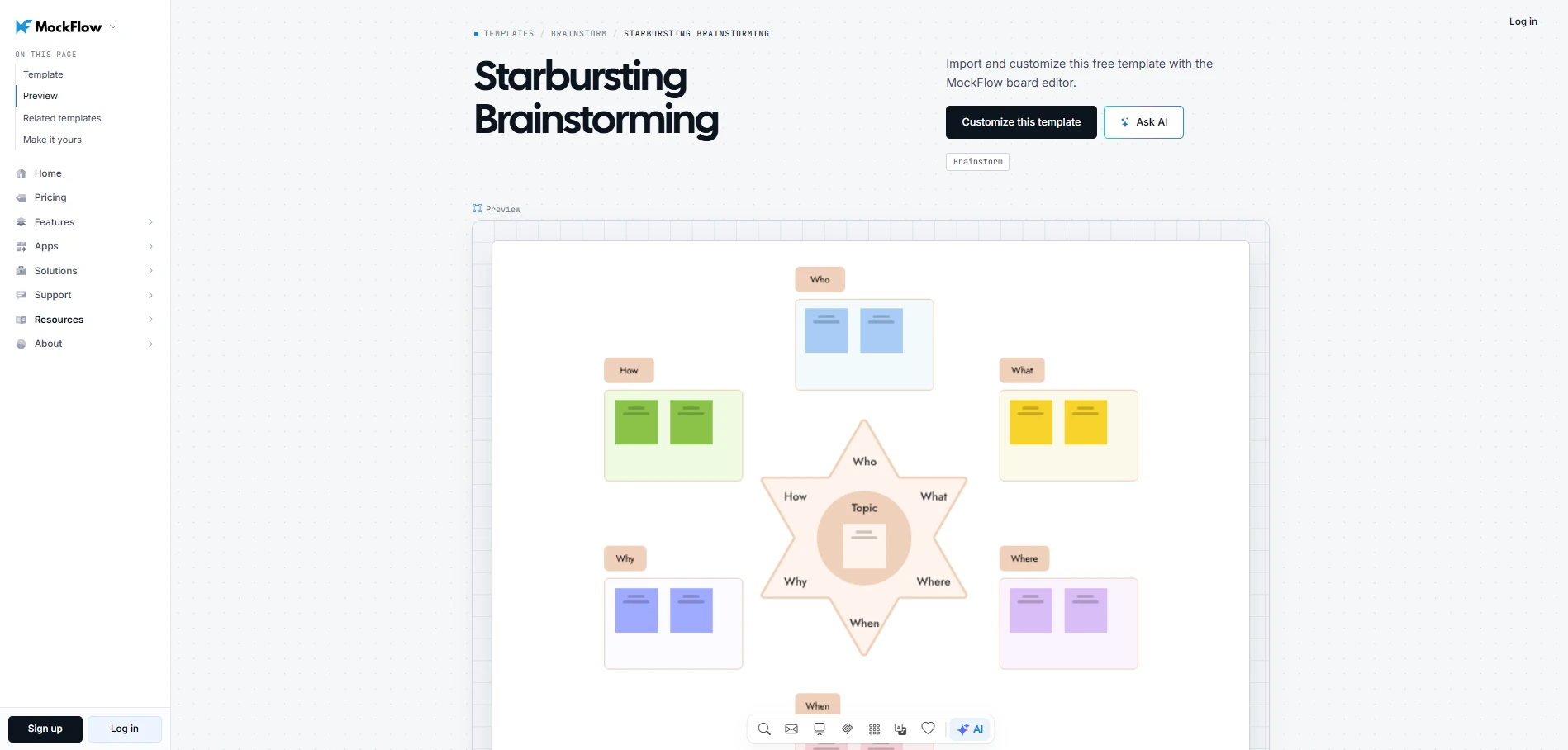
Customize this starbursting brainstorming template
How to conduct the nominal group technique with MockFlow
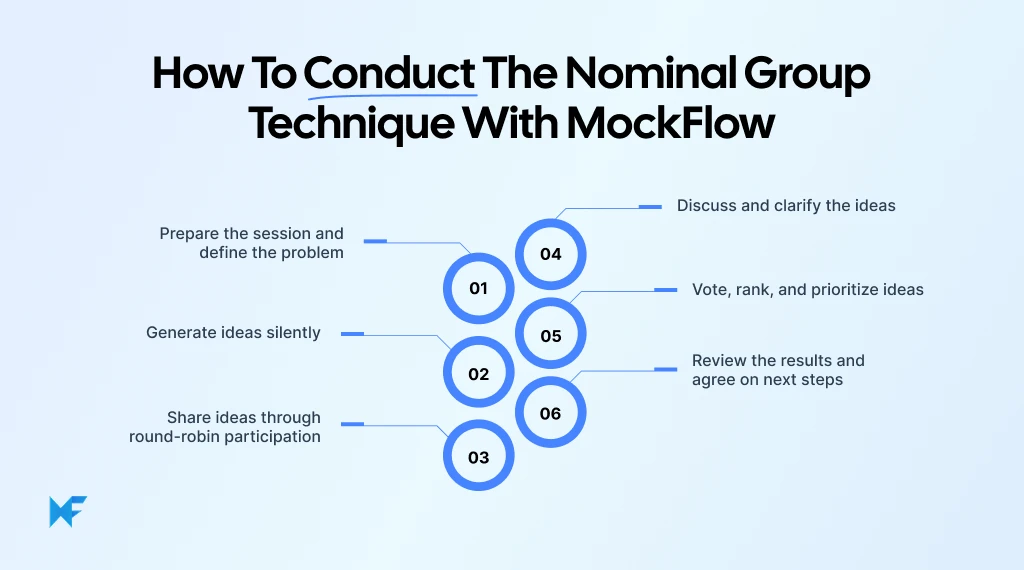
To conduct the nominal group technique, start by defining a clear decision question and preparing the session. The method then moves through four stages, beginning with independent idea generation and ending with voting to establish priorities.
Consider a seven-person product team planning its next release. There are several customer onboarding improvements worth considering, but the team needs to decide which ones to prioritize.
The steps below show how to conduct the four NGT stages using MockFlow, including what to prepare beforehand and how to document the results afterwards.
Before the session: Prepare and define the problem
Start with one question that participants can realistically answer and rank within a single session.
For the product team, that question could be:
"Which customer onboarding improvements should be prioritized for the next product release?"
Share the decision question with participants before the meeting, along with any relevant background. Giving everyone time to prepare their thoughts allows those who need longer to reflect to arrive with ideas ready, rather than developing everything under the meeting's time limit.
Before the meeting, the facilitator should:
- Select participants: Include people familiar with the onboarding experience who can offer different perspectives.
- Set the rules: Explain that participants will think independently before sharing ideas in turns. Clarification comes next, followed by voting.
- Choose the voting method: Decide how many ideas each participant can rank and how points will be assigned.
- Prepare the board: Use MockFlow's Nominal Group Technique template as a starting point. Add the decision question and prepare space for recording each contribution, so the group can focus on the ideas rather than arranging the board during the meeting.
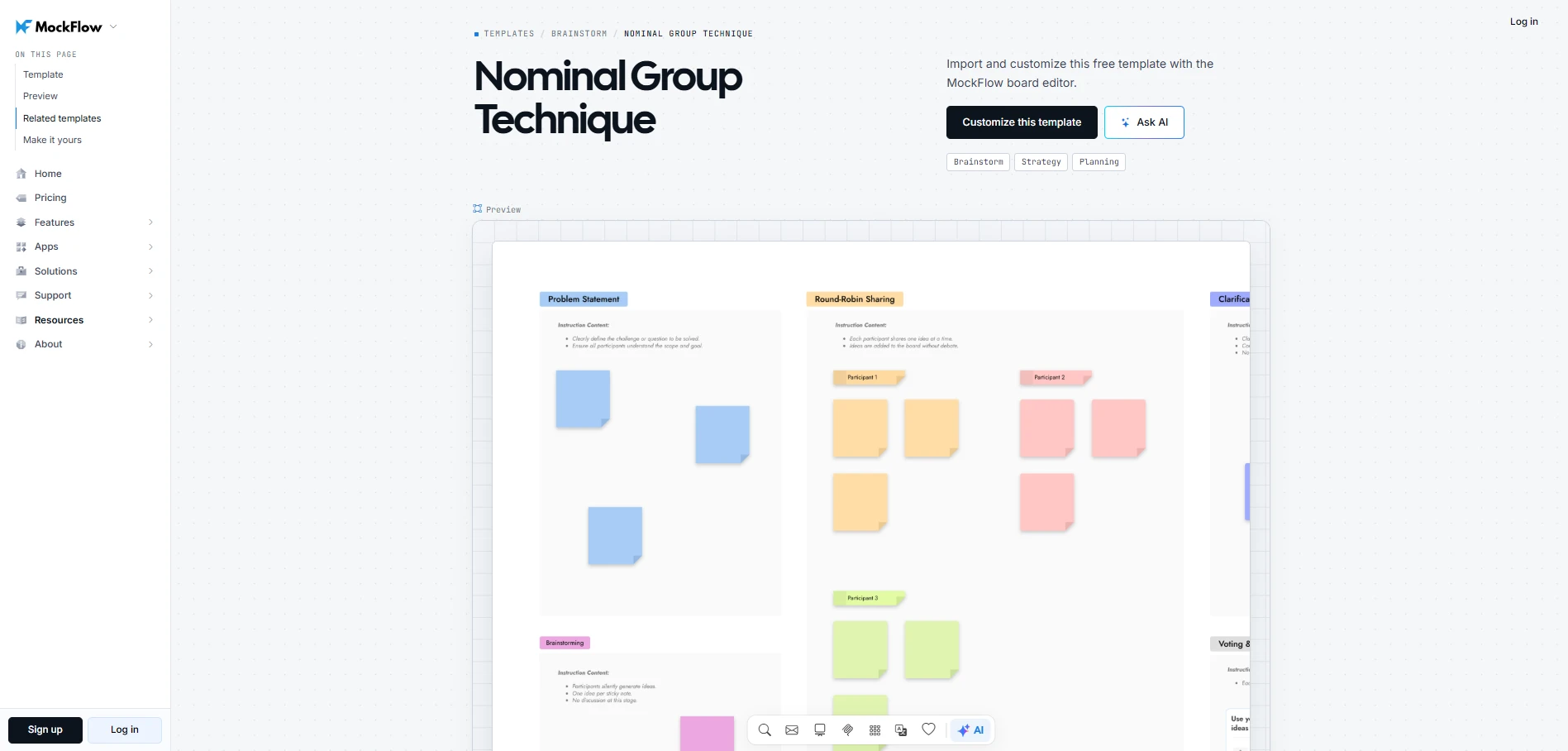
Customize this nominal group technique template
If the meeting is happening in Microsoft Teams, open MockFlow within Teams and bring up the prepared board. As participants share ideas, the facilitator can add them directly to the canvas for everyone to follow. The same board can remain accessible through a Teams channel after the session, avoiding the need to recreate the discussion in a separate document.
Step 1: Generate ideas silently
Give participants 5 to 10 minutes to develop ideas independently. Ask everyone to consider several possible improvements before discussing them with the group. Dale Carnegie’s 2026 organizational health report found that 68% of workers did not feel secure expressing ideas at work. Silent writing gives everyone time to form an idea before the group discussion.
During this stage:
- Write ideas privately in personal notes or a document.
- Keep each suggestion specific and easy to understand.
- Avoid discussing or evaluating ideas until everyone has finished.
One team member might suggest reducing registration fields to shorten sign-up. Another might propose an interactive checklist to guide new users through their first session.
The facilitator can use MockFlow's Brainwriting template to prepare separate spaces for participants' ideas.
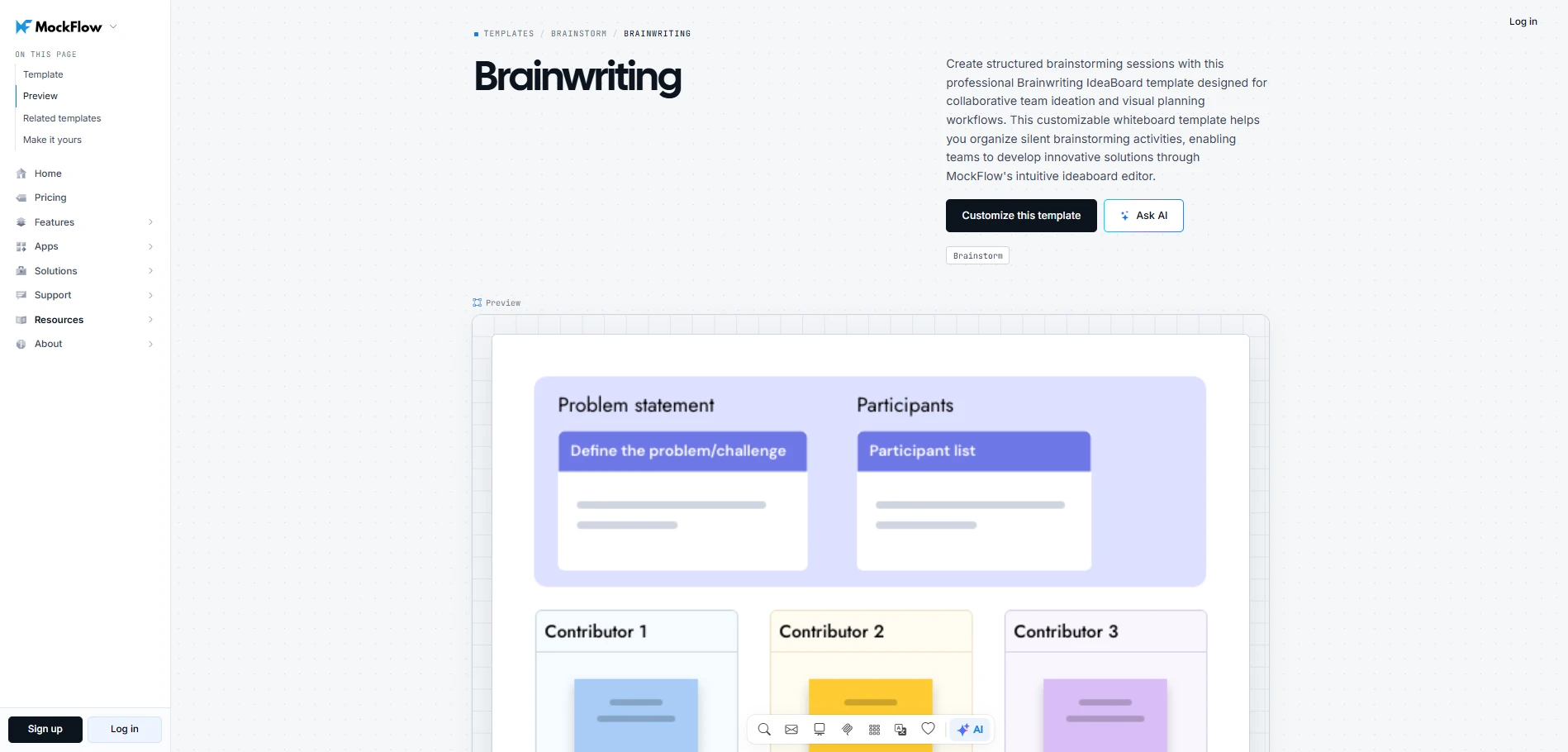
Once everyone finishes writing privately, their suggestions can be transferred to the board as individual notes, ready for round-robin sharing. Keep initial responses private, since a shared board does not automatically hide contributions.
Step 2: Share ideas through round-robin participation
Once everyone has their ideas ready, collect one suggestion per participant in a fixed order. As each person speaks, record their idea on MockFlow's visual canvas using a separate sticky note. The shared board gives participants a clear view of the suggestions already collected, so repeated ideas are easier to spot before the clarification stage.
Follow these steps to collect ideas fairly:
- Ask the first participant to share one idea.
- Record it on the shared board, preserving the participant's original meaning.
- Move to the next participant and repeat until all ideas are collected. Anyone without another suggestion can pass.
For example, one participant might suggest simplifying registration, while another might propose clearer onboarding instructions. Both ideas should be recorded separately. Record both separately, even if they seem related.
Using MockFlow's Round Robin Brainstorming template, the facilitator can assign each participant a section and record their ideas as sticky notes.
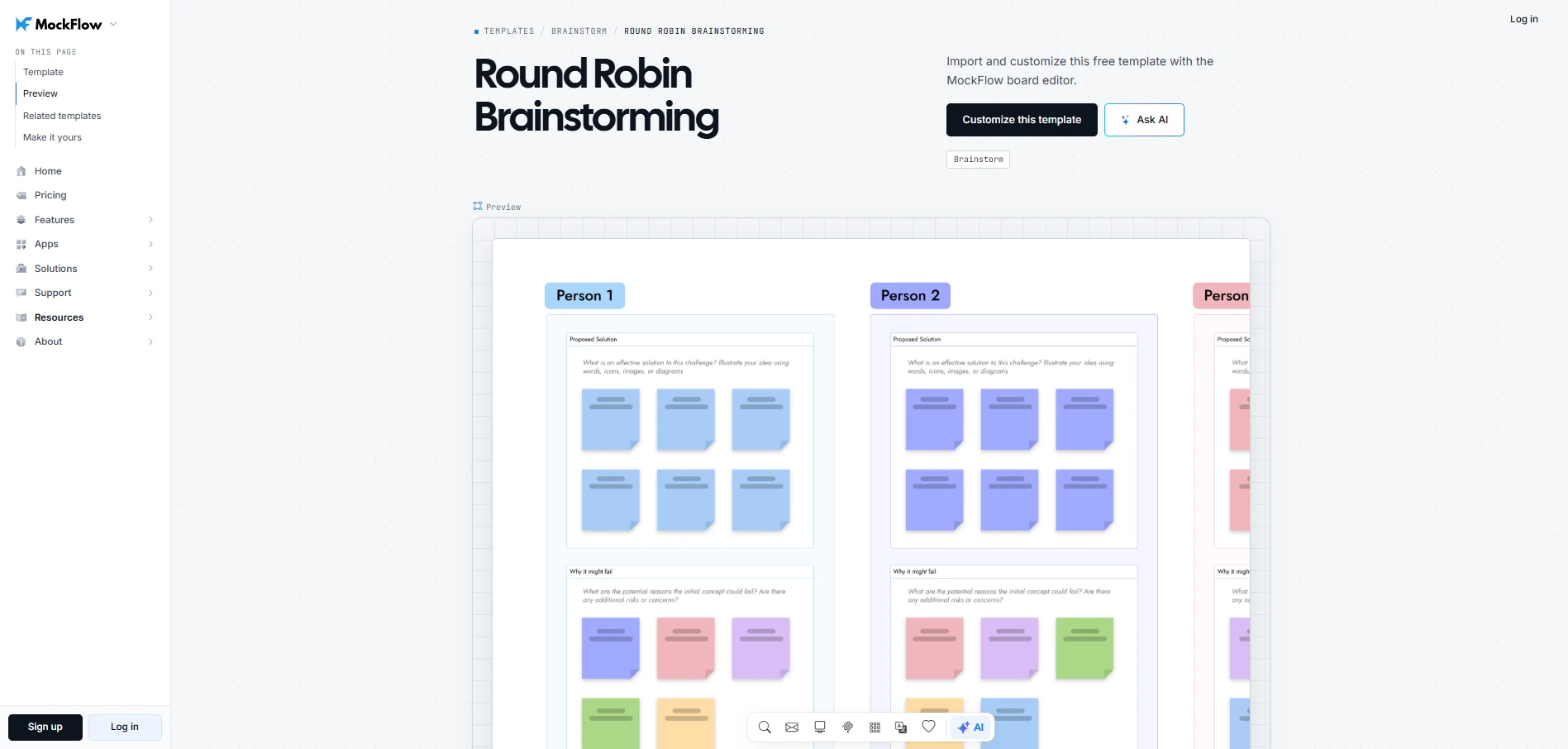
Customize this round robin brainstorming template
If the session is happening in Microsoft Teams, the facilitator can record contributions on the same board with Mockflow as participants take turns speaking. With each idea captured in its designated area, it's easier to track who has contributed and ensure no suggestions are missed.
Step 3: Discuss and clarify the ideas
Once all suggestions are recorded, review them one by one to ensure everyone understands what each idea means. The purpose is to clarify the options before voting, without debating which one is better.
During this stage:
- Ask participants to explain any unclear suggestions.
- Identify ideas that may overlap and confirm whether they mean the same thing.
- Combine suggestions only with the group's agreement. Keep distinct ideas separate, even when they sound similar.
If the board contains many suggestions, Mida, MockFlow's AI agent, can organize the existing notes into related themes and flag possible duplicates for review. This gives the facilitator a more manageable list without manually sorting every contribution.
A useful prompt is:
“Organize these NGT contributions into related themes. Keep all original ideas, flag possible duplicates for group review, and prepare a clear list for clarification before voting. Do not remove or rank any ideas.”
The group reviews Mida's suggestions and decides which ideas to combine before voting.
Step 4: Vote, rank, and prioritize ideas
Once the ideas are clarified, participants independently rank their preferred options. NGT typically uses ranked voting or point allocation.
Follow this sequence:
- Finalize the options: Confirm which suggestions will appear on the ballot.
- Set the scoring rules: For example, award 3 points to the first choice, 2 to the second, and 1 to the third.
- Collect votes independently: Each participant ranks their preferred options without consulting others.
- Tally the scores: Add the points and arrange the ideas from highest to lowest.
With seven participants ranking three options each, the results might look like this:
Onboarding improvement | Total points | Final rank |
Simplify registration | 17 | 1 |
Interactive onboarding checklist | 12 | 2 |
Improve welcome emails | 8 | 3 |
Expand help documentation | 5 | 4 |
To make preferences visible during an open vote, the facilitator can add MockFlow's Upvote Ideas component to the board. Participants vote on the listed proposals, and updated totals appear alongside the options, making it easier to compare support without counting votes manually.
After the session: Review results and agree on next steps
Before closing the session, review the final rankings and turn them into actionable next steps.
- Confirm the rankings: Check that votes are recorded correctly and address any unresolved disagreements.
- Identify next priorities: The onboarding team selects simplifying registration for feasibility assessment, while the next two ranked ideas remain under consideration for roadmap planning.
- Assign responsibilities: Designate someone to assess implementation effort. Mida can organize the meeting notes into a follow-up plan for the team to review.
- Share the outcomes: Keep the rankings and action items on the MockFlow board, then share the updated board through the Microsoft Teams channel for future reference.
The session should end with documented priorities and clear action owners. Rankings reflect group preferences, even when participants don't fully agree on every decision.
What are the benefits and limitations of the nominal group technique?
The main benefits of the nominal group technique are balanced participation and clear prioritization. Its limitations include the time needed to complete the process and the need for careful facilitation. NGT is particularly useful for identifying group preferences, although voting alone cannot establish whether an idea is practical to implement.
CIPD’s 2025 Good Work Index found that 51% of UK employees said their managers sought their views, while 37% said they could influence final decisions. This highlights the importance of showing employees how their input shapes final priorities, which NGT’s ranking step can make visible.
Here's a closer look at its advantages and potential drawbacks:
Benefits | Limitations |
Balanced participation: Silent writing and round-robin sharing give everyone an opportunity to contribute, including quieter participants. | Time-consuming: Collecting and clarifying individual contributions takes longer as the group grows. |
Reduced peer influence: Participants develop initial ideas independently, limiting the influence of early suggestions. | Limited spontaneity: The fixed sequence leaves less room for spontaneous discussion and building on others' ideas. |
Broader perspectives: Independent contributions allow participants to raise ideas that may otherwise go unheard. | Requires skilled facilitation: A neutral facilitator must manage participation and prevent discussions from drifting into debates. |
Clear prioritization: Voting produces a ranked list, making the group's preferred options easier to identify. | Limited evaluation depth: Rankings show preferences but don't necessarily account for feasibility or implementation constraints. |
Transparent decision-making: Recorded scores show how priorities were established, making the outcome easier to review. | No guaranteed consensus: Participants may accept the final ranking while still disagreeing with the preferred options. |
Ready to put NGT into practice?
The next time a team has several competing ideas on the table, put them through an NGT session before deciding what moves forward. Give everyone time to think independently, keep the discussion focused, and let the final ranking show where the group's priorities lie.
MockFlow makes it easier to run this process without juggling meeting notes and separate documents. Prepare the board before the session, capture ideas as participants share them, and keep the final priorities in one place. If the team works in Microsoft Teams, the same board can be used during the meeting.
Have a decision coming up? Try MockFlow for free and set up an NGT board for it.
FAQs
1. How do you use the nominal group technique?
Start by defining a specific decision question. Participants then generate ideas independently before sharing them in turns. The group clarifies suggestions to ensure everyone understands the options. Finally, participants vote or rank their preferred ideas to establish priorities for further evaluation.
2. What are three characteristics of the nominal group technique?
The three defining characteristics of NGT are:
- Independent idea generation: Participants develop suggestions before group discussion.
- Structured participation: Everyone contributes through an organized round-robin process.
- Formal ranking: Participants vote to determine which ideas receive the most support.
Together, these characteristics provide a consistent process for group decision-making.
3. What are the key differences between the Delphi technique and the nominal group technique?
NGT typically involves a facilitated group session where participants share and discuss ideas before voting. The Delphi technique collects expert opinions through multiple questionnaire rounds, usually with anonymous responses. NGT suits group decisions requiring immediate prioritization, while Delphi is useful for developing expert consensus over time.
4. How many people should participate in an NGT session?
An NGT session typically works well with five to ten participants. This group size allows everyone to contribute without making round-robin sharing too time-consuming. Larger groups can still use the method, but may need breakout sessions or additional time to review contributions.
5. Can the nominal group technique be conducted virtually?
Yes, NGT can be conducted virtually as long as participants generate ideas independently before group discussion. The facilitator must also preserve structured sharing and individual ranking. MockFlow within Microsoft Teams provides a shared board for recording contributions and displaying the group's priorities during the meeting.
6. Does the nominal group technique require everyone to agree?
No, NGT does not require unanimous agreement. Voting identifies which ideas receive the most support, but participants may still prefer different outcomes. The final ranking provides a basis for prioritization, while the facilitator can document unresolved disagreements for further consideration.
How an API Diagram Works and How to Create One Step by Step
API-based systems can be complex, but explaining them does not have to be. A clear visual can help teams understand how...

Wireframing Process: A 5-Stage Practical Workflow for Product Teams
A wireframe can either save a project weeks of rework or create the confusion that causes it. The outcome usually comes down to...
Process Mapping Explained: 7 Types, Examples, Uses, and Best Practices
An approval sits untouched because no one knows who owns it. A customer request moves between departments without resolution. A...
