Creative Problem Solving: The 4-Stage CPS Model and Techniques
Introduction
Traditional problem solving breaks down when challenges are complex, ambiguous, or cross-functional. It pushes quick answers and familiar thinking, which typically ends with 20 ideas and zero clear direction.
Creative problem solving fixes this gap. It combines structured frameworks with creative thinking to help teams generate better ideas, evaluate them effectively, and implement solutions that actually work.
In this guide, we’ll break down the creative problem solving process, explain how the CPS model works, and walk you through practical techniques teams use every day. You’ll also see how to apply these methods in real scenarios using tools like IdeaBoard.
What Is Creative Problem Solving?
Creative problem solving is a structured process that helps individuals and teams generate, evaluate, and implement innovative solutions to complex challenges. It combines divergent thinking to explore ideas and convergent thinking to select the most practical options. The process includes stages such as clarify, ideate, develop, and implement.
That sounds structured, and it is. In practice, it solves a very real problem most teams face: turning ideas into clear decisions and outcomes.
At a practical level, creative problem solving helps teams:
- Improve collaboration by giving everyone a clear way to contribute ideas
- Strengthen decision-making by evaluating options systematically
- Drive innovation by exploring multiple possibilities before choosing one
- Apply consistent thinking across business, education, and real-world scenarios
That relevance is growing, not shrinking. The WEF’s Future of Jobs Report 2025, representing 14 million workers, identified creative thinking as one of the skills that is already critical and continuing to rise in importance.
In short, traditional problem solving often jumps straight to answers, but creative problem solving slows that down just enough to explore better options first. That extra step leads to stronger ideas, better alignment, and more confident execution.
Key Principles of Creative Problem Solving
Creative problem solving works best when teams shift how they think, not just what they do. Techniques help, but the real impact comes from the mindset behind them. The way ideas are explored, challenged, and built determines the quality of outcomes.
Here are the core principles that make CPS work in practice:
- Balance divergence and convergence: Start by expanding ideas without constraints, and then narrow them down based on feasibility and impact. This balance ensures you do not settle too early or get stuck in endless ideation.
- Reframe the problem: The way you define the problem shapes the solution. Instead of asking, “Why are users dropping off?”, shift to “How might we improve onboarding?” A simple reframe can open up entirely new directions.
- Defer judgment: Most ideas fail because they are judged too early. Separate idea generation from evaluation, and give ideas space to develop before deciding whether they work.
- Think in “Yes, and…”: Good ideas rarely come fully formed, which is why you should build on what others suggest instead of shutting it down. This approach keeps momentum high and encourages collaboration across the team.
UX professionals describe how traditional brainstorming often favors faster thinkers or louder voices, while others struggle to contribute in time. This is exactly why techniques like brainwriting or structured ideation become critical, as they remove friction and create space for more diverse thinking.
When teams apply these principles consistently, ideas become more diverse, discussions become more productive, and decisions feel more grounded.
Benefits of Applying Creative Problem-Solving Principles
When teams consistently apply creative problem-solving principles, the difference shows up in how ideas evolve and how decisions get made. You start to see improvements across multiple areas:
- Stronger ideas from the start: Teams generate a wider range of options, which increases the chances of identifying solutions that are both creative and practical.
- Better participation across the team: Structured ideation creates space for every voice, not just the most vocal contributors. This leads to more balanced and inclusive discussions.
- More confident decision-making: Ideas are already explored and evaluated, so decisions feel less reactive and more grounded in logic and alignment.
- Faster movement from ideas to execution: When thinking is structured, teams spend less time debating and more time implementing solutions that have already been vetted.
Over time, this approach replaces scattered thinking with a more intentional way of working. Teams become better at navigating ambiguity, aligning on priorities, and moving forward with clarity.
This matters even more in AI-driven workplaces, where organizations often invest in technology faster than they invest in the human capabilities needed to use it well. In Deloitte’s 2024 Global Human Capital Trends research, 73% of respondents said it is important to keep human capabilities in step with technological innovation, but only 9% said their organizations are making progress on that balance.
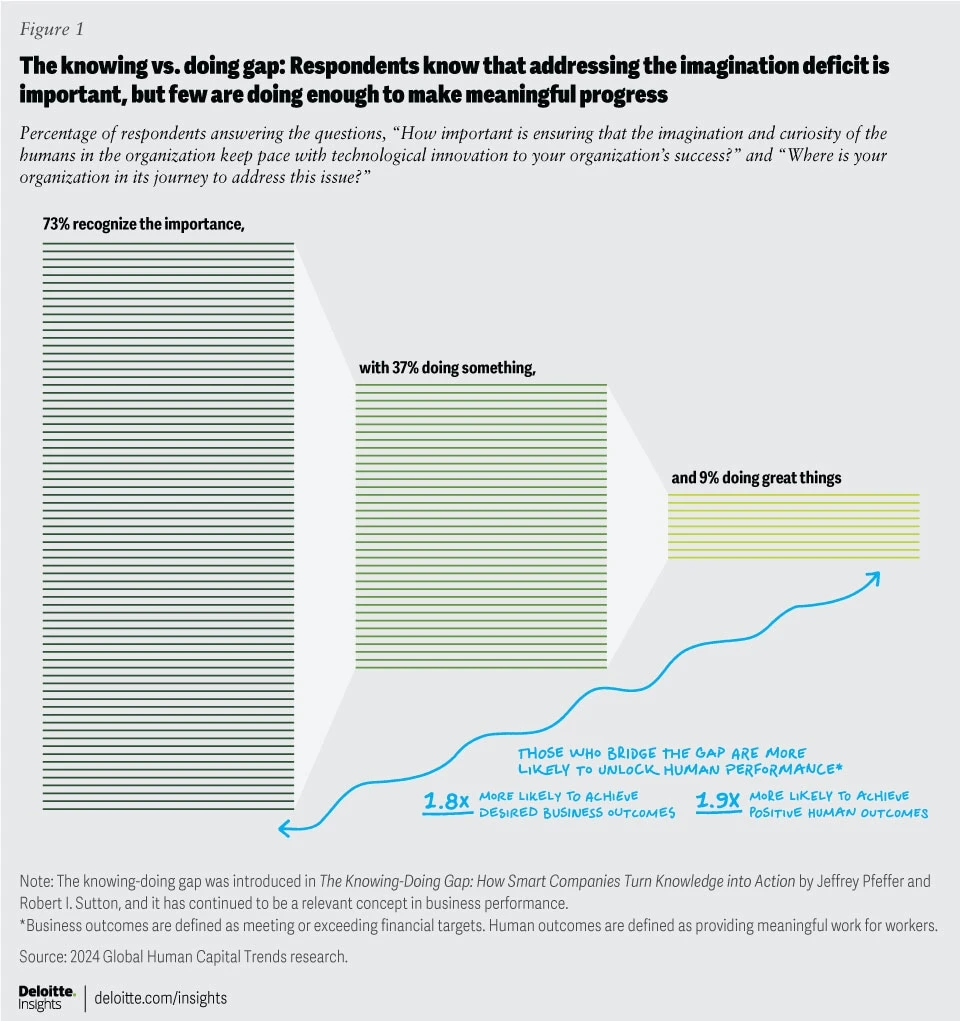
Image Source: Deloitte’s 2024 Global Human Capital Trends research
This is where creative problem solving starts to move beyond theory. Once the principles are in place, the next step is understanding how they translate into a repeatable process that teams can actually follow.
How Does the CPS Model Work? The 4-Stage Process
Creative problem solving was formalized by pioneers like Alex Osborn and Sidney Parnes, and later refined into frameworks such as CPS Version 6.1 by Treffinger and Isaksen. What makes the CPS model effective today is its ability to provide a clear, repeatable structure that teams can apply across different types of problems without overcomplicating the process.
The CPS model breaks down into four stages that guide how thinking evolves.
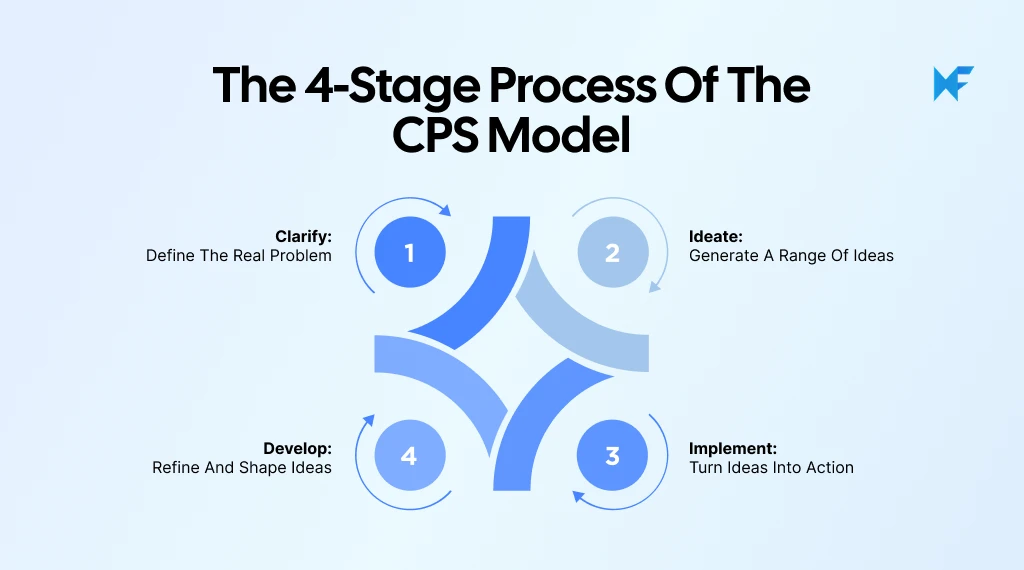
Stage 1: Clarify
The process begins with defining the real problem rather than reacting to surface-level symptoms. In many cases, teams focus on what is visible, which leads to solutions that do not address the underlying issue.
Reframing the problem helps shift the direction of thinking. By turning a challenge into a “How Might We” question, teams move from constraints to possibilities. For example, a problem like “low adoption” can be reframed as “How might we simplify onboarding?”, which opens up more actionable solution paths.
Stage 2: Ideate
Once the problem is clearly defined, the focus shifts to generating a wide range of ideas without aiming for perfection at this stage. Teams are encouraged to explore multiple directions, including those that may initially seem unconventional or impractical.
Divergent thinking plays a central role here, as it allows teams to expand the solution space before narrowing it down. Short, time-boxed ideation sprints often help maintain momentum and prevent over-analysis.
For example, a product team running a 7-minute ideation sprint generated ideas that ranged from guided onboarding tours to removing onboarding entirely, and that unexpected direction eventually led to a “learn by doing” experience that improved user engagement.
Stage 3: Develop
After generating a range of ideas, the focus shifts to refining and shaping them into viable solutions. Teams begin by clustering related ideas, identifying patterns, and combining concepts that strengthen the overall approach.
Convergent thinking becomes important at this stage, as ideas are evaluated based on feasibility, impact, and alignment with goals. The objective is not just to select an idea, but to develop it into something that can realistically be executed.
Stage 4: Implement
The final stage focuses on turning selected ideas into action through quick prototyping and validation. Rather than waiting for a perfect solution, teams test concepts early and gather feedback from users or stakeholders.
Implementation becomes an iterative process, where insights from testing are used to refine the solution further. This approach reduces risk and ensures that ideas evolve based on real-world input.
This implementation layer also matters because user-centered ideas only create value when teams can align around them and move them forward.
In fact, IBM’s 2024 AI in Action report found that 85% of leaders follow an AI roadmap and 72% have alignment between the C-suite and IT leadership, reinforcing the point that innovation depends as much on coordination and follow-through as it does on idea generation.
When teams follow this structure, problem solving becomes more intentional and less reactive, with ideas moving through a clear path instead of getting stuck in discussion. At this stage, it’s important to understand how teams apply the CPS model in day-to-day work using the right techniques and methods.
7 Creative Problem-Solving Techniques Teams Actually Use
Different situations call for different approaches, and the effectiveness of creative problem solving often depends on how well teams match the technique to the problem at hand.
Brainstorming
Brainstorming focuses on rapid idea generation through open discussion, where team members build on each other’s thoughts in real time. It works best in early-stage ideation when the goal is to generate as many ideas as possible without overthinking.
When to use: This technique is most effective when you need quick, collaborative input from a group that is comfortable sharing ideas openly.
Brainwriting
Brainwriting takes a more structured approach by allowing individuals to generate ideas silently before sharing them with the group. This reduces bias and ensures that quieter contributors have equal space to participate.
When to use: It works particularly well in diverse teams or situations where dominant voices might influence outcomes. Using a structured brainwriting template can help capture ideas independently and then organize them into themes without losing individual input.
Round Robin Brainstorming
Round robin brainstorming introduces structure into idea sharing by allowing each participant to contribute in turn. This ensures that everyone participates while also encouraging teams to build on previously shared ideas.
When to use: This approach is useful when you want balanced participation across the team, especially in larger groups. A round robin brainstorming template can guide the flow of ideas and make it easier to track how concepts evolve during the session.
Mind Mapping
Mind mapping is a visual technique that starts with a central idea and expands outward into related concepts. It helps teams uncover connections that may not be immediately obvious in linear discussions.
When to use: This method is particularly useful when dealing with complex or interconnected problems. A project plan mind map template can support this process by structuring ideas visually, making it easier to explore relationships and identify new directions.
SCAMPER Technique
The SCAMPER technique uses structured prompts to rethink existing ideas by asking how they can be substituted, combined, adapted, modified, or reversed. It encourages teams to build on what already exists rather than starting from scratch.
When to use: This technique works best when improving or iterating on an existing product, process, or strategy. IdeaBoard’s SCAMPER technique template can help teams systematically explore variations and uncover creative improvements.
How Might We Method
The “How Might We” method converts challenges into open-ended, opportunity-driven questions that encourage solution-focused thinking. It helps teams move away from problem-heavy language and toward exploration.
When to use: This approach is especially useful when the problem feels unclear or too broad, as it creates a starting point for ideation and aligns the team around a shared direction.
Design Thinking Framework
Design thinking brings an empathy-driven approach to creative problem solving by focusing on user needs, prototyping solutions, and testing them in real scenarios. It combines creativity with structured experimentation.
When to use: This framework is ideal for solving user-centric or experience-driven problems, where understanding behavior and feedback plays a critical role in shaping the final solution.
Each of these techniques supports a different part of the creative problem solving process, and the real impact comes from knowing when and how to use them. When applied in the right context, they help teams move from abstract ideas to structured solutions with far greater clarity.
How to Apply CPS Techniques in Real Scenarios with IdeaBoard
Creative problem solving becomes more effective when teams apply it to real business scenarios rather than abstract exercises. The following examples show how structured techniques and visual collaboration help teams turn ideas into actionable solutions.
Example 1: Improving Product Onboarding Experience
A common challenge product teams face is user drop-off during onboarding. Metrics highlight the issue, but the root cause often remains unclear. Instead of jumping to quick fixes, teams can use the brainwriting technique to explore a wider range of possibilities.
For instance, IdeaBoard’s Brainwriting 6-3-5 template can help teams generate and build on ideas in a time-bound format while keeping contributions organized.
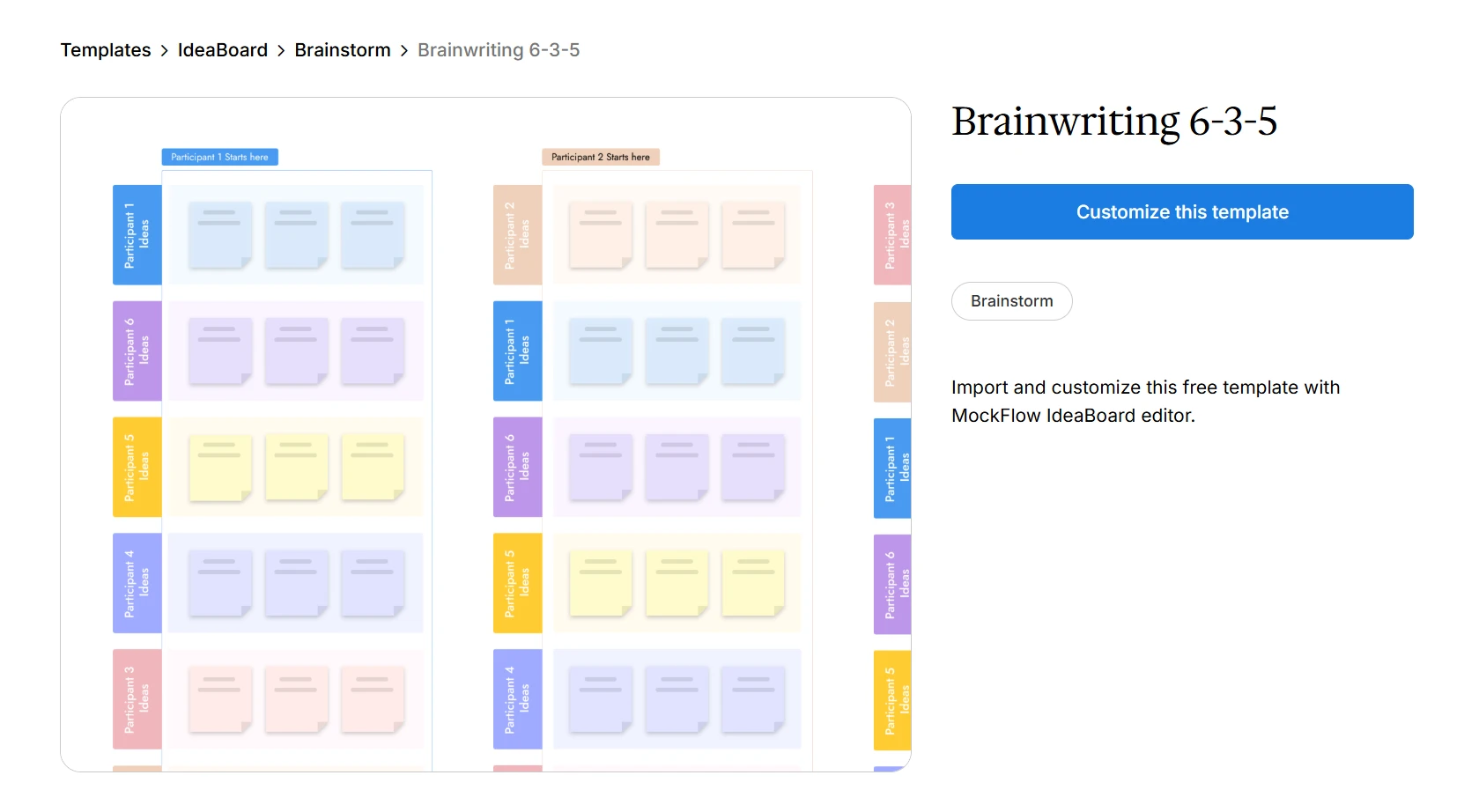
Click on the image to customize the Brainwriting 6-3-5 template
Here’s how you can customize the template for this solution:
- Define the core problem at the top, such as reducing onboarding drop-off
- Ask each participant to add 3 onboarding ideas within a fixed time block
- Rotate ideas across participants so each person builds on existing inputs
- Use sections in the template to group ideas into themes like guided flows or self-serve experiences
- Mark high-impact ideas for quick validation or A/B testing
This approach often surfaces ideas that would not emerge in a traditional discussion. What begins as an idea for guided onboarding can evolve into a “learn by doing” experience that removes onboarding friction entirely.
Example 2: Redesigning a Marketing Campaign Strategy
Marketing teams often see campaign performance drop when ideas start to repeat across channels and audiences. Engagement declines not because execution is poor, but because the strategy lacks fresh direction. In such cases, mind mapping works well as a creative problem solving technique to expand thinking and uncover new campaign possibilities.
A structured way to do this is by using IdeaBoard’s Business Planning Mind Map template, which helps teams organize campaign elements visually and explore multiple directions in one place.
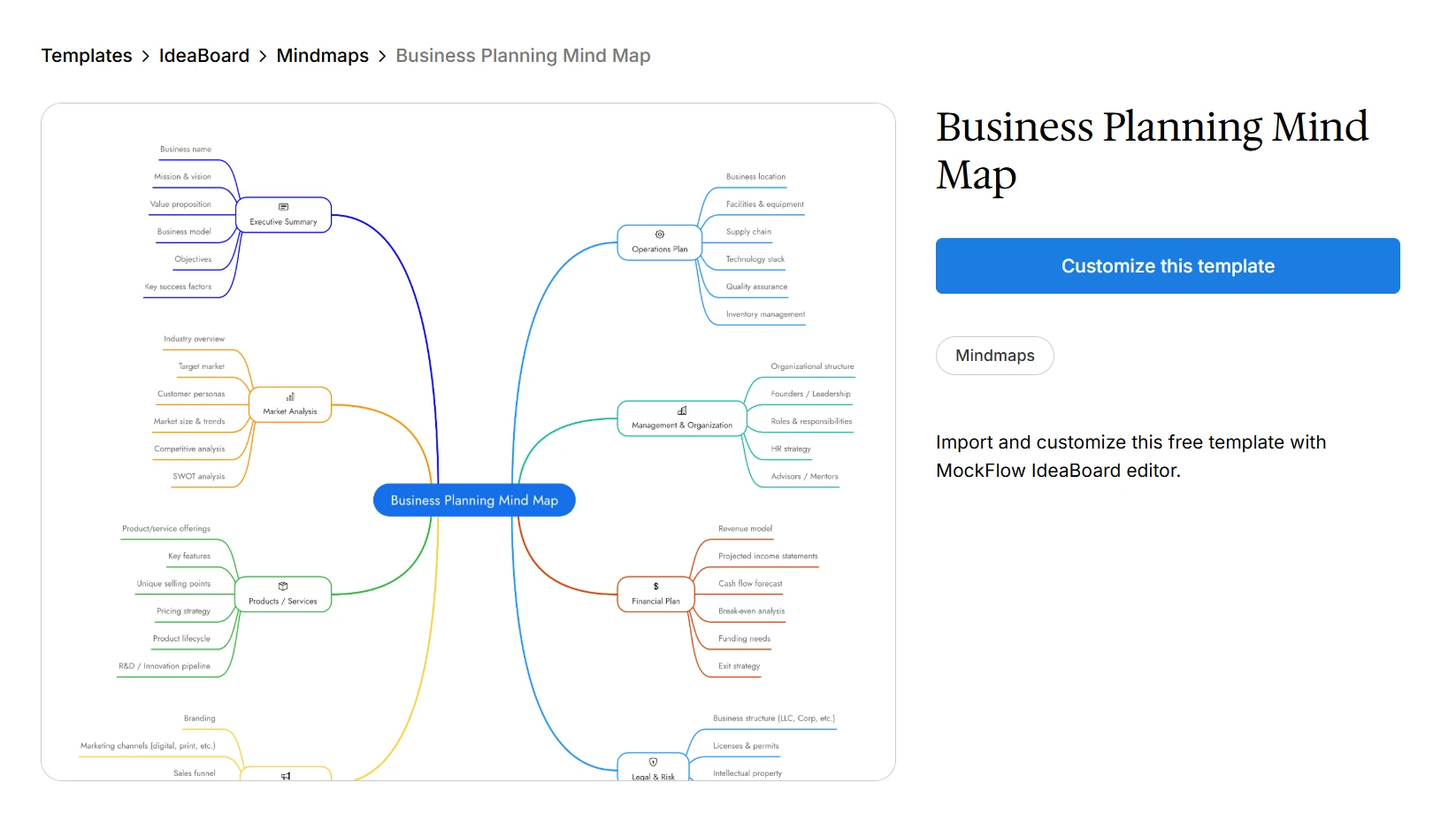
Test the Business Planning Mind Map template on IdeaBoard
To apply this template effectively:
- Start with the campaign objective clearly defined at the center
- Create branches for audience segments, channels, messaging themes, and formats
- Add variations within each branch to explore new campaign ideas
- Identify connections across branches to uncover unique campaign opportunities
- Prioritize ideas that align with goals and are ready for testing
This method helps teams move from incremental tweaks to more strategic shifts. What begins as a simple exploration of channels can lead to entirely new campaign approaches driven by better audience insight and creative alignment.
How IdeaBoard Supports Creative Problem Solving
Creative problem solving becomes far more effective when teams can think, collaborate, and organize ideas in one place. In most teams, ideas are scattered across documents, chats, and presentations, which slows down both ideation and decision-making. Visual collaboration tools change this dynamic by bringing structure to creativity without limiting exploration.
IdeaBoard is designed to support this exact workflow. It combines a flexible canvas with structured frameworks, allowing teams to move seamlessly from idea generation to evaluation and execution. Instead of switching between tools, teams can capture, refine, and act on ideas within a single shared space.
What makes this especially useful for creative problem solving is how its features align with each stage of the CPS process:
- Infinite canvas: Provides a flexible space to explore ideas freely without constraints during divergent thinking.
- AI-assisted brainstorming: Allows teams to generate visual storyboards and structured starting points quickly using prompts.
- Template library: Offers pre-built templates and layouts for brainwriting, mind mapping, and strategy planning to speed up sessions.
- Visual clustering: Helps teams group, organize, and refine ideas during convergent thinking.
- Multimedia comments: Allows teams to add voice and video feedback directly on ideas for clearer context and insights.
- Real-time collaboration: Enables teams to brainstorm visually via Google Meet during live discussions without switching tools.
These capabilities reduce the friction that often slows down creative sessions. Teams no longer spend time setting up tools or consolidating inputs. Instead, they can focus entirely on generating ideas, building on them, and refining them into actionable solutions.
Over time, this shift changes how teams approach problem-solving. Ideas become easier to explore, decisions become more structured, and execution becomes more aligned across stakeholders.
Conclusion
When teams struggle because there are too many ideas and not enough clarity, creative problem-solving steps in to close that gap. It gives teams a clear way to move from scattered thinking to structured execution.
The next step is to put this into practice:
- Start by identifying one real problem your team is facing
- Apply the CPS model to reframe it
- Use a structured technique to explore solutions
- Move quickly into testing what works
The goal is to build a repeatable way of thinking and working. This is where a visual collaboration tool like MockFlow’s IdeaBoard becomes useful. It helps bring structure to your process, keeps ideas organized in one place, and enables teams to move faster from ideation to execution without losing context. Instead of managing tools, your team can focus on solving the problem.
If you want to make creative problem solving a consistent part of how your team works, sign up for a free IdeaBoard demo today.
FAQs
1. What is creative problem solving?
Creative problem solving is a structured approach to generate, evaluate, and implement innovative solutions. It combines idea generation with practical decision-making. The process typically includes stages like clarify, ideate, develop, and implement. It helps individuals and teams solve complex problems with both creativity and logic.
2. How does creative problem solving work step by step?
Creative problem solving follows a clear process. First, clarify the problem and define goals. Next, ideate by generating multiple ideas using techniques like brainstorming. Then, develop by evaluating and refining the best options. Finally, implement the selected solution and measure results. This structured flow balances creativity with execution.
3. What are the best creative problem solving techniques?
Common creative problem solving techniques include brainstorming, brainwriting, mind mapping, SCAMPER, round robin brainstorming, and the “How Might We” method. These techniques help teams generate diverse ideas, build on others’ input, and explore new perspectives before narrowing down to practical solutions.
4. How is creative problem solving different from critical thinking?
Creative problem solving focuses on generating new ideas and exploring possibilities. Critical thinking focuses on analyzing, evaluating, and validating those ideas. Creative problem solving uses divergent thinking to expand options, while critical thinking uses convergent thinking to select the best solution. Both work together in decision-making.
5. What are examples of creative problem solving at work?
Creative problem solving at work includes improving product onboarding, redesigning marketing strategies, or solving customer experience issues. Teams use structured techniques to generate ideas, test solutions, and implement changes. This approach helps improve collaboration, innovation, and business outcomes.
6. How can managers improve creative problem solving in the workplace?
Managers can improve creative problem solving by encouraging open idea sharing, using structured techniques, and creating a safe environment for experimentation. They can run workshops, promote collaboration, and use tools to organize ideas. Clear goals and feedback loops also help teams move from ideas to execution.

Design Thinking Process Steps: 5 Stages Explained with Examples
Introduction If you’ve ever worked on a product, feature, or even a simple redesign, you’ve probably hit that moment where...
Rapid Ideation: How to Generate, Refine, and Act on Ideas Faster
Quick Answer: Rapid ideation is a structured brainstorming approach that helps generate a large volume of ideas quickly...

Wireframe vs Mockup vs Prototype: What’s the Difference?
Wireframes, mockups, and prototypes are three stages of the product design process. Wireframes define layout and structure,...
