
What Is Brainstorming? Techniques, Templates & Steps to Run a Session
Introduction
When we talk about brainstorming, most people think of presenting ideas or filling a board with sticky notes. But there’s more to it than that.
At its core, brainstorming is about how we think, how we connect ideas, and how we turn scattered thoughts into something meaningful.
It’s been around for decades, evolving from simple group discussions to structured methods used in product teams, classrooms, and design thinking processes. Today, it’s not just about creativity. It’s about creating clarity, direction, and shared understanding.
In this guide, we’ll break down what is brainstorming, effective brainstorming techniques you can use, templates, and steps to run sessions that actually lead to outcomes.
What is Brainstorming?
Brainstorming is a creative problem-solving technique where individuals or teams generate ideas freely to explore solutions without immediate evaluation. It uses divergent thinking to produce many ideas before selecting the best ones.
The process starts with a clear problem, followed by idea generation, organization, and prioritization.
Brainstorming supports collaboration, creativity, and structured thinking. Teams often use techniques like mind mapping or brainwriting to improve results. This method helps turn unclear ideas into actionable solutions across projects, design thinking, and planning workflows.
Types of Brainstorming Techniques (with Templates)
The brainstorming technique you choose shapes how ideas are generated, how people participate, and how useful the outcome is. Some methods are better for exploring ideas freely, while others bring structure or help you dig deeper.
Below are the most practical types of brainstorming techniques, along with how to actually use them and where brainstorming templates help.
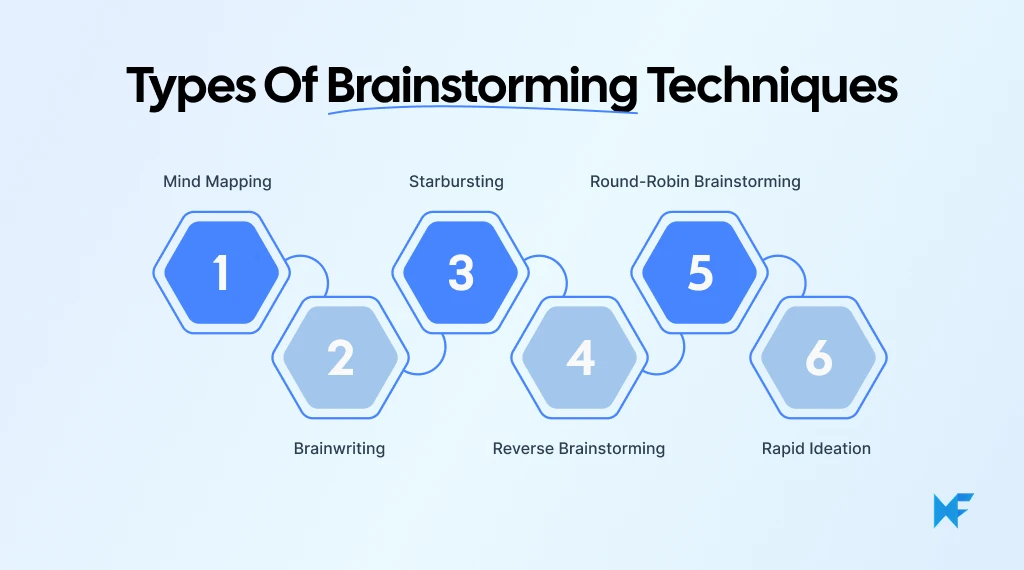
1. Mind Mapping
Mind mapping is a visual brainstorming technique where you start with a central idea and expand outward into related thoughts.
It works well when you’re dealing with a broad topic and need to explore different directions without overthinking structure.
How to use it:
- Start with a central topic in the middle
- Add branches for key ideas
- Expand each branch with related sub-ideas
- Keep building connections as new thoughts emerge
This approach helps you see relationships between ideas instead of listing them in isolation.
Teams often use a structured board like a Sticky Note Mind Map template to quickly map ideas without setting everything up from scratch.
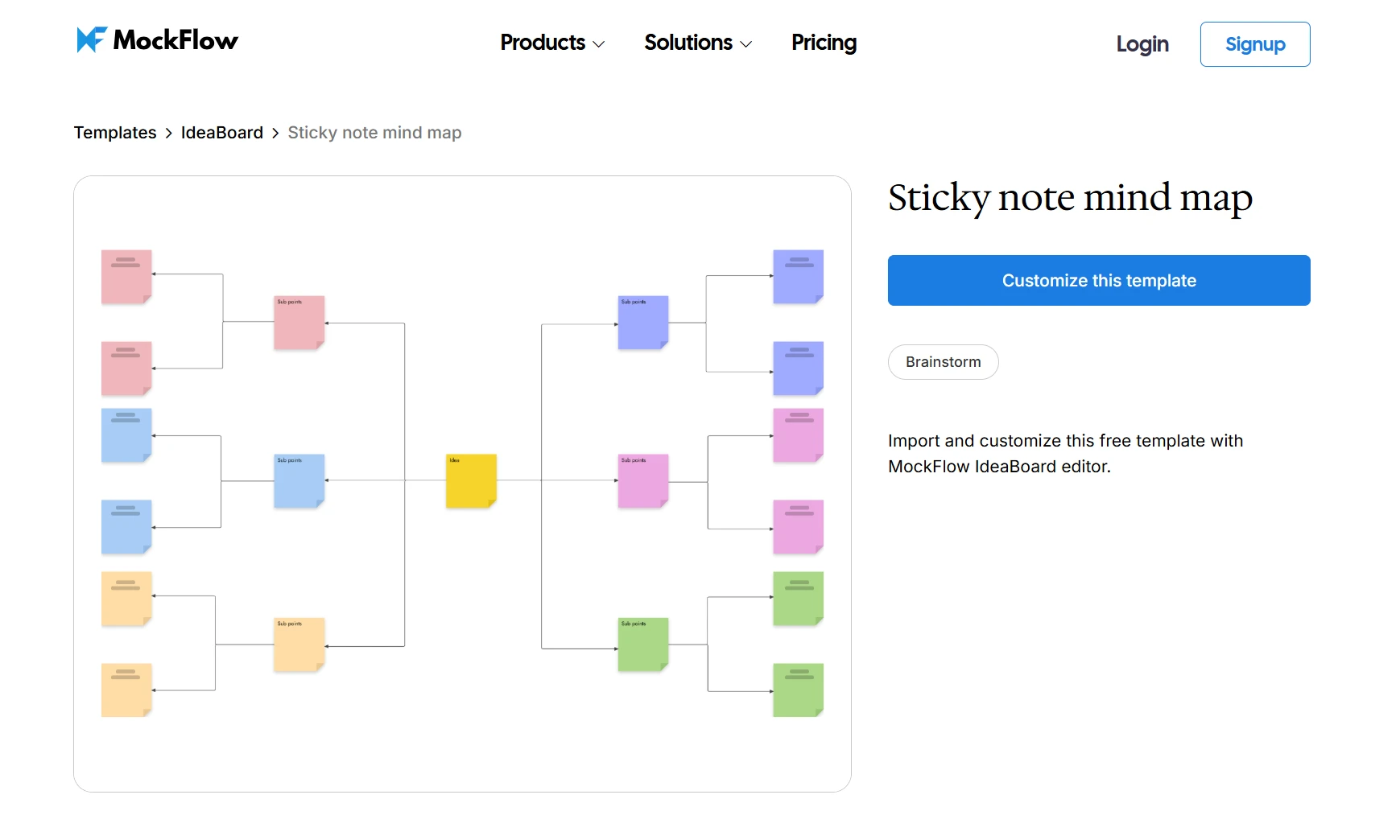
Customize this sticky note mind map template
2. Brainwriting
Brainwriting is a quieter, more structured version of brainstorming where participants write ideas instead of speaking them out loud.
It’s especially useful when you want to avoid bias or ensure everyone contributes equally.
How to use it:
- Give everyone a fixed time to write ideas individually
- Pass ideas to the next person for expansion
- Repeat the process for multiple rounds
- Review all ideas together at the end
This method reduces interruptions and often leads to more diverse thinking. According to a Gartner innovation strategy guide, structured ideation methods such as brainwriting are among the best practices for generating high-quality ideas in R&D and innovation teams.
Teams can use a brainwriting template to organize rounds and track idea flow clearly.
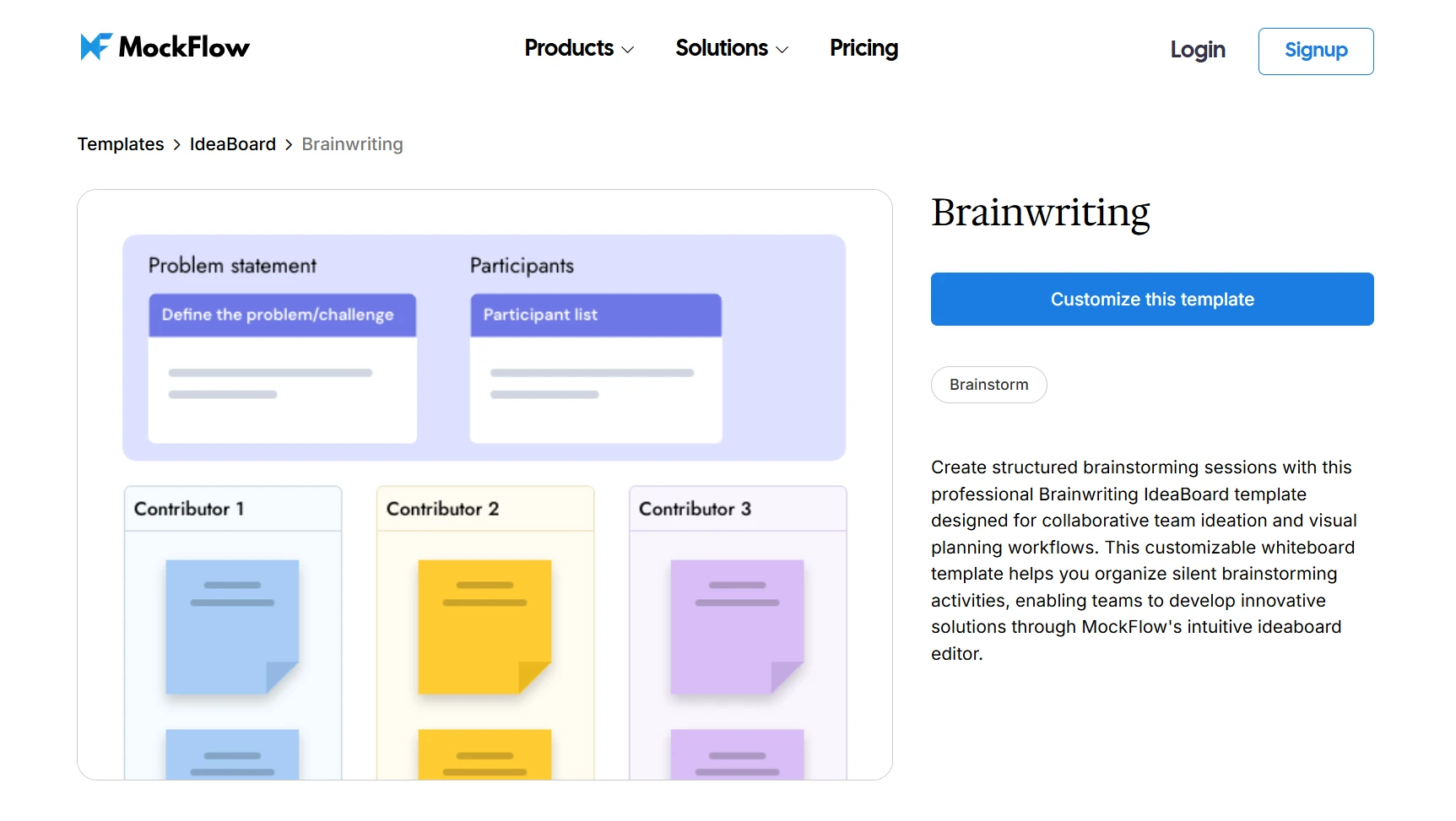
Customize this brainwriting template for your next brainstorming session
3. Starbursting
Starbursting focuses on asking questions instead of generating direct answers. It pushes you to explore an idea from multiple angles before acting on it.
This is helpful when an idea seems promising but hasn’t been fully thought through.
How to use it:
- Place the main idea at the center
- Build questions around it using who, what, when, where, why, and how
- Expand each question with follow-ups
- Identify gaps or unknowns
It helps teams uncover assumptions early and avoid rushing into execution.
A structured layout like a starbursting brainstorming template makes it easier to organize questions systematically.
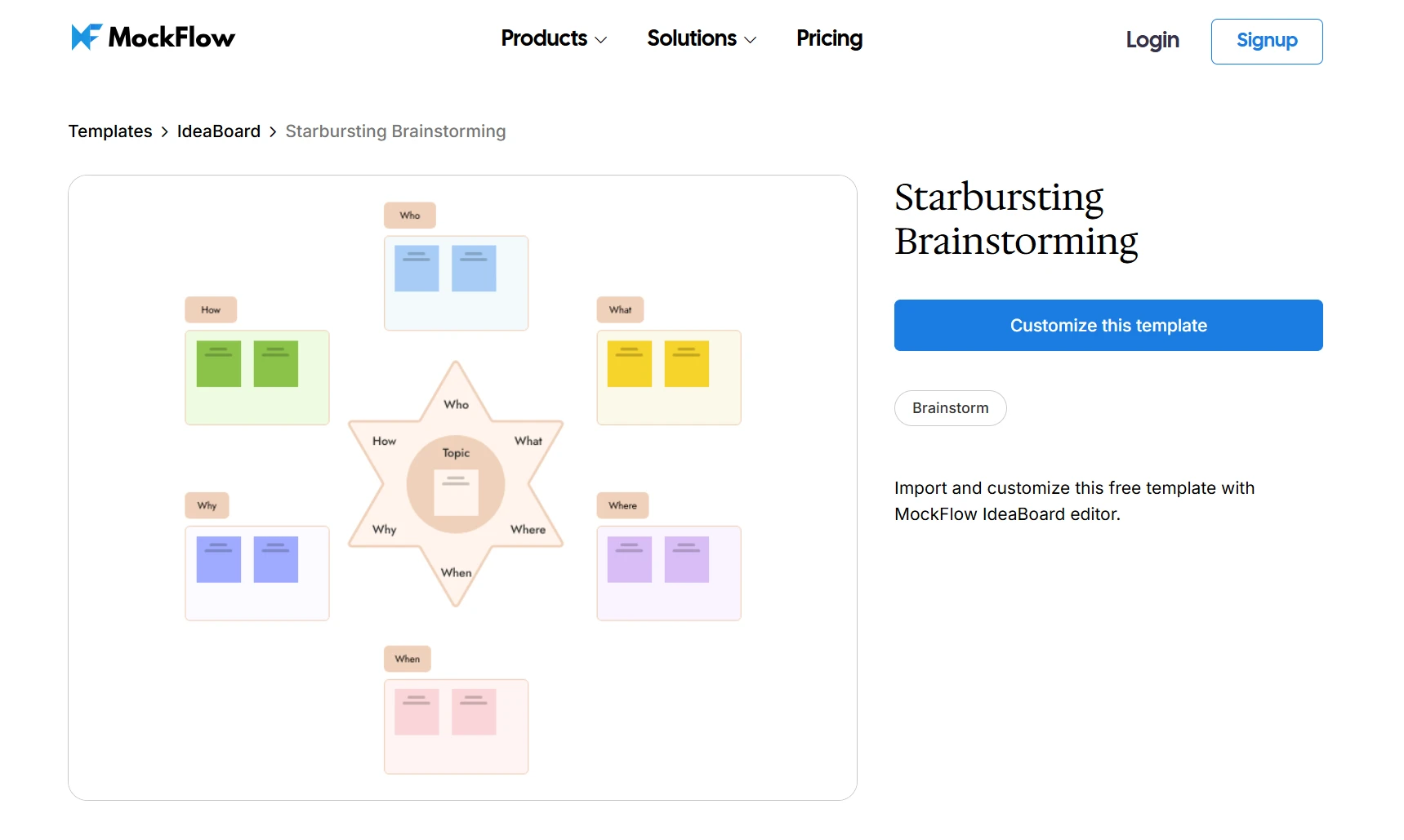
Customize this starbursting template for your next brainstorming session
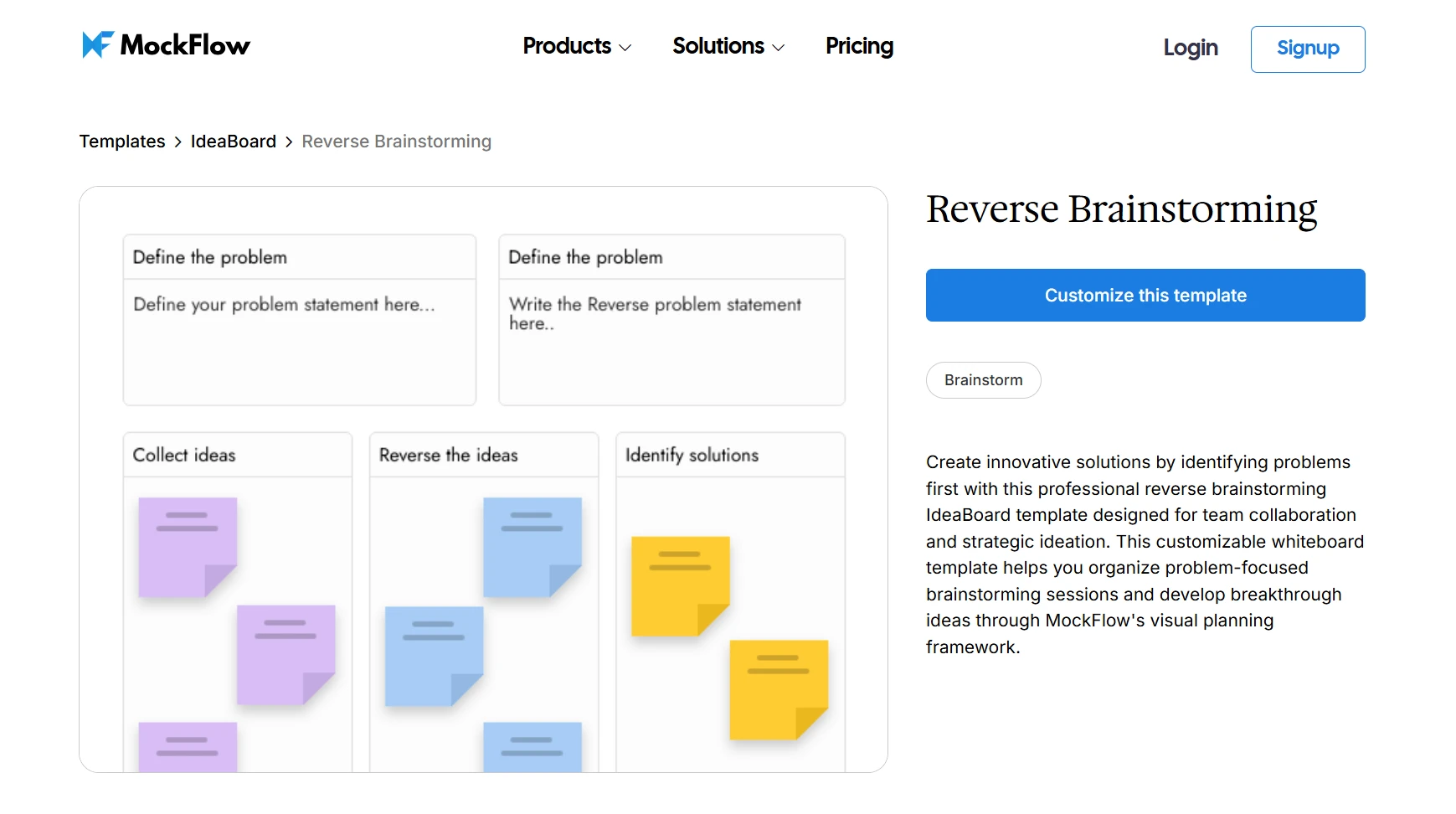
4. Reverse Brainstorming
Reverse brainstorming flips the problem. Instead of asking how to solve it, you ask how to create or worsen it.
That shift often surfaces risks and blind spots that regular brainstorming misses.
How to use it:
- Define the problem clearly
- Ask: “How could we make this worse?”
- List all negative ideas
- Reverse those ideas into solutions
This method is especially useful for identifying failure points and improving processes.
Teams often use a guided board like a Reverse brainstorming template to structure both the negative and reversed ideas.
Customize this reverse brainstorming template on IdeaBoard
5. Round-Robin Brainstorming
Round-robin brainstorming introduces structure by giving each participant a turn to contribute ideas one by one.
It prevents dominant voices from taking over and keeps participation balanced.
How to use it:
- Define the problem
- Go around the group in order
- Each person shares one idea per turn
- Continue until ideas slow down
This method works well for smaller teams where you want consistent input from everyone.
A simple structured board with sections for each participant can help keep contributions organized.
6. Rapid Ideation
Rapid ideation is a fast-paced brainstorming method focused on generating as many ideas as possible within a short time.
The goal is to remove overthinking and push creative output.
How to use it:
- Set a strict time limit (5–10 minutes)
- Ask participants to write as many ideas as possible
- Avoid any discussion during the session
- Review and refine ideas afterward
This technique works well when teams feel stuck or need quick momentum.
Using a time-boxed ideation board with predefined sections helps teams stay focused and capture ideas quickly.
How to Run a Brainstorming Session (Step-by-Step)
Running a good brainstorming session isn’t about being creative on the spot. It’s about following a simple process that helps ideas flow and then turns them into something useful.
Here’s a step-by-step way to run a brainstorming session that actually works.
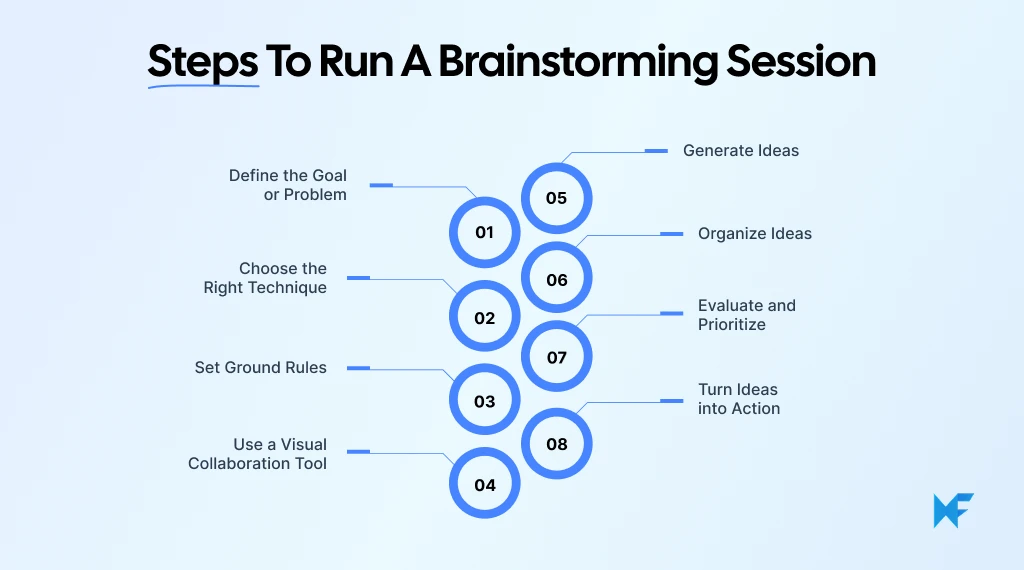
Step 1: Define the Goal or Problem
Every brainstorming session needs a clear starting point. If the problem is vague, the ideas will be too.
Start by framing a specific question or objective. For example, instead of saying “improve the product,” define it as “how can we improve onboarding for new users?”
Clarity at this stage keeps the session focused and prevents ideas from drifting.
Step 2: Choose the Right Technique
Once the goal is clear, the next step is selecting the right brainstorming method.
If you need broad exploration, mind mapping works well. If you want equal participation, brainwriting is better. If you’re analyzing risks, reverse brainstorming is more effective.
Matching the technique to the goal makes the session more structured and productive.
Step 3: Set Ground Rules
Before starting, align everyone on how the session will run.
A few simple brainstorming rules make a big difference:
- No judging ideas during the generation phase
- Encourage building on others’ ideas
- Focus on quantity first, not quality
- Give everyone a chance to contribute
These rules help avoid groupthink and create a space where ideas can flow freely.
Step 4: Use a Visual Collaboration Tool
Capturing ideas clearly is just as important as generating them. Without structure, ideas get lost or become hard to follow.
Using a visual collaboration platform like IdeaBoard helps teams:
- Capture ideas in real time
- Organize thoughts visually
- Collaborate across remote or hybrid teams
Instead of scattered notes, everything stays in one place and evolves as the session progresses. According to Zoom’s 2025 workplace survey, 75% of business leaders say teams using digital collaboration tools work together more effectively.
Step 5: Generate Ideas (Divergent Thinking)
This is where the actual brainstorming happens.
The focus here is on divergent thinking, generating as many ideas as possible without filtering.
Encourage participants to think freely, share unfinished ideas, and build on others’ inputs. The goal is volume, not perfection.
Step 6: Organize Ideas (Clustering)
Once ideas are generated, the next step is to bring structure.
Group similar ideas together, identify patterns, and remove duplicates. This process, often called idea clustering, helps make sense of large volumes of input.
It also reveals themes that may not be obvious at first.
Step 7: Evaluate and Prioritize
After organizing ideas, shift to convergent thinking.
Review the ideas and select the most relevant ones based on criteria like feasibility, impact, or alignment with the goal.
Teams often use simple methods like voting, scoring, or ranking to make decisions.
Step 8: Turn Ideas into Action
A brainstorming session is only valuable if it leads to action.
Take the shortlisted ideas and define next steps:
- Assign ownership
- Set timelines
- Outline what needs to be done
This step ensures that ideas don’t just stay on the board but move forward into execution.
Practical Brainstorming Tips for Better Results
Over time, teams that run frequent brainstorming sessions tend to notice small patterns in what actually works. These are practical advice shared by people who regularly facilitate ideation sessions. When applied consistently, they make brainstorming more focused and productive.
- Start with a slightly narrowed prompt: Open-ended questions can lead to scattered thinking. Defining a clear direction helps participants go deeper instead of just listing ideas.
- Write before you speak: Giving everyone a few minutes to think and note ideas individually leads to more original inputs. Teams that start with silent idea generation first tend to avoid repetition and surface better ideas.
- Focus on building ideas, not replacing them: Instead of jumping to new ideas every time, expand what’s already there. Strong sessions often improve ideas by layering on top of them rather than discarding them early.
- Separate idea generation from evaluation: Trying to judge ideas while generating them slows everything down. Keeping these stages separate allows ideas to develop fully before filtering.
- Use short, time-boxed bursts: Long sessions often lose energy. Short, focused rounds help maintain momentum and push quicker thinking without over-analysis.
- Switch formats when stuck: If ideas slow down, change the approach. Moving from discussion to writing or from lists to visual mapping can help unlock new directions. Many teams improve creativity by changing how ideas are explored mid-session.
- Start small and expand gradually: Instead of trying to solve everything at once, begin with a simple idea and build outward. This makes it easier to create depth without getting overwhelmed.
These small shifts help turn brainstorming techniques into consistent, repeatable outcomes rather than one-off sessions.
Using the Right Brainstorming Tools to Run Better Sessions
When we brainstorm, we’re not just coming up with ideas, we’re trying to build on them, connect them, and make sense of them as we go. Doing that in your head or across random notes doesn’t really work.
Using a shared space makes this easier. Everyone can see what’s being added, react to it, and build on it in real time. It keeps the conversation moving and makes sure ideas don’t just disappear as the session goes on.
A study published on ResearchGate found that 87% of professionals reported improved productivity and 92% reported better collaboration when using digital communication tools.
IdeaBoard is one visual brainstorming tool that gives teams a shared space to think, organize, and move ideas forward without breaking the flow of the session.
- Teams can expand ideas freely in an open canvas, group them, and rearrange them as the session evolves.
- Pre-built templates for techniques like brainwriting or mind mapping help teams start faster without setting up structure manually.
- Participants can add ideas, connect them, and organize them without needing any setup or training.
- Everyone can contribute at the same time, which keeps the session active and aligned, especially for remote teams.
- With AI-assisted brainstorming support, teams can generate structured boards or prompts quickly, making it easier to start sessions and maintain momentum.
The outcome is straightforward. Ideas are easier to capture, easier to organize, and easier to act on. Instead of spending time managing the session, teams can focus on thinking and decision-making.
Conclusion
Brainstorming is a practical skill we can build and improve over time. When we use the right brainstorming tools and techniques, follow a simple process, and create space for open thinking, ideas become easier to generate and refine.
The key is to stay consistent. Start with a clear goal, explore ideas without overthinking, and then bring structure to what you’ve created. Over time, this turns brainstorming into something reliable, not something we struggle with.
If you want to make your sessions more structured and easier to run, you can start using IdeaBoard for free and try it in your next brainstorming session.
FAQs about what is brainstorming
1. What are the key benefits of brainstorming?
Brainstorming helps generate a large number of ideas quickly, improves team collaboration, and encourages creative thinking. It allows participants to explore multiple perspectives, uncover new solutions, and move from unclear problems to structured ideas that can be refined and executed.
2. What is the difference between divergent and convergent thinking in brainstorming?
Divergent thinking focuses on generating many ideas without judgment, while convergent thinking focuses on evaluating and selecting the best ideas. Brainstorming starts with divergent thinking to maximize idea volume and then shifts to convergent thinking to refine and prioritize solutions.
3. Can brainstorming be done asynchronously?
Yes, brainstorming can be done asynchronously using digital tools. Participants contribute ideas at different times instead of in a live session. This approach allows more thoughtful input, reduces pressure, and works well for remote or distributed teams.
4. What are common mistakes to avoid in brainstorming sessions?
Common mistakes include judging ideas too early, focusing on quality instead of quantity, allowing a few people to dominate the discussion, lacking a clear goal, and failing to organize or follow up on ideas. These issues reduce participation and limit the effectiveness of the session.
5. How long should a brainstorming session last?
A typical brainstorming session lasts between 15 and 60 minutes. Short sessions maintain focus and energy, while longer sessions can lead to fatigue and reduced creativity. Time-boxing helps teams generate ideas efficiently and stay productive.
6. What is the difference between group brainstorming and individual brainstorming?
Group brainstorming involves multiple participants sharing and building on ideas together, which improves collaboration and idea diversity. Individual brainstorming allows focused thinking without interruptions, which can lead to deeper insights.

Quarterly Business Review: How to Plan, Structure & Run a QBR Meeting
Introduction Every quarter, we pause and ask ourselves a familiar question: are we actually moving the business forward, or are...

How to Use the Starbursting Technique for Brainstorming in 2026
Introduction Some ideas feel “done” the minute we say them out loud. A new feature. A campaign hook. A process change. Everyone...

Storyboard vs Wireframe: When to Use Each in UX Design
TL;DR A storyboard breaks the experience into scenes: who the user is, what triggers the need, what steps they take, where...
