Round Robin Brainstorming: Steps, Benefits, and Use Cases
Introduction
Brainstorming sessions that don't lead to clear, actionable ideas typically have a structure problem, not a lack of creativity.
Round robin brainstorming fixes this by introducing a simple, turn-based approach where everyone contributes, and ideas build on each other instead of competing. It brings balance to the room and turns discussions into something teams can actually use.
A 2024 LSE study found that 35% of business meetings are considered unproductive, and that inclusive meeting behaviors could reduce that number to 15%.
In this guide, we’ll walk you through how the round robin brainstorming technique works, when to use it, and how to run a session step by step. You’ll also see how using pre-made templates or a tool like IdeaBoard can help you run more structured and effective ideation sessions.
What is Round Robin Brainstorming?
Round robin brainstorming is a structured brainstorming method where participants take turns sharing ideas in a fixed sequence to ensure equal contribution. Teams use it to generate ideas, improve collaboration, and reduce dominance by a few voices.
The process follows clear steps, supports idea building, and works in in-person, remote, or hybrid sessions. Facilitators use prompts, time limits, and templates to guide discussion and improve outcomes.
At its core, this method introduces structure into what is usually an unstructured activity. Instead of people jumping in randomly, ideas move in a sequence. Each participant contributes, then builds on what came before. That small shift changes how teams think, collaborate, and move from ideas to outcomes.
In a 2025 Elsevier study, structured brainstorming improved both idea originality and idea quality, which is exactly why turn-based formats tend to produce stronger outcomes than open-ended discussions.
What makes the round robin brainstorming technique practical is its flexibility. You can run it verbally in a workshop, use index cards for silent brainstorming, or move the entire process to a digital board. The structure stays the same, but the format adapts to your team.
Here’s what defines the method:
- Turn-based participation
- Equal contribution across all participants
- Can be run silently or verbally
- Works for in-person, remote, and hybrid teams
If you’re looking at it from a quick evaluation lens, this is how it breaks down:
Element | Description |
Structure | Turn-based participation |
Goal | Equal contribution |
Format | Written or verbal |
Best For | Team ideation sessions |
Benefits of Round Robin Brainstorming for Teams
Round robin brainstorming gives teams a repeatable way to generate ideas without the chaos that usually comes with open discussions.
Here’s what makes the brainstorming technique effective in real team settings:
- Ensures equal participation: Everyone contributes in turns, which naturally balances the conversation. It reduces reliance on dominant voices and brings quieter perspectives into the mix, especially in cross-functional teams.
- Reduces groupthink early in the process: Since participants start with individual idea generation, they are less influenced by others’ opinions upfront. This leads to more diverse and original thinking.
- Improves idea quality through iteration: Ideas don’t stay static. One person introduces a concept, another expands it, and someone else refines it. This layered approach often results in more actionable and well-thought-out outcomes.
- Creates structured, usable outputs: Ideas are already documented as part of the process. This makes it easier to cluster them into themes, identify patterns, and move directly into prioritization without losing context.
- Works well for remote and hybrid teams: With tools like IdeaBoard, teams can manage idea rotation, track contributions, and organize outputs without constant facilitation. The structure translates smoothly across distributed environments.
This matters even more in distributed settings, where quieter contributors can disappear into the background. PwC’s 2025 Global Workforce Hopes and Fears Survey found that workers with the highest levels of psychological safety are 72% more motivated, yet only 56% say it is safe to try new approaches at work, which is one reason structured participation formats can be so useful.
Once you see these benefits in action, the difference is hard to ignore. The session feels more balanced, and the output is far easier to work with. What really makes it work, though, is how you run the process step by step.
How Round Robin Brainstorming Works: A Step-by-Step Process
This is where the round robin method really starts to show its value. When you move from an open discussion to a structured flow, the session naturally shifts from scattered inputs to something far more organized and actionable.
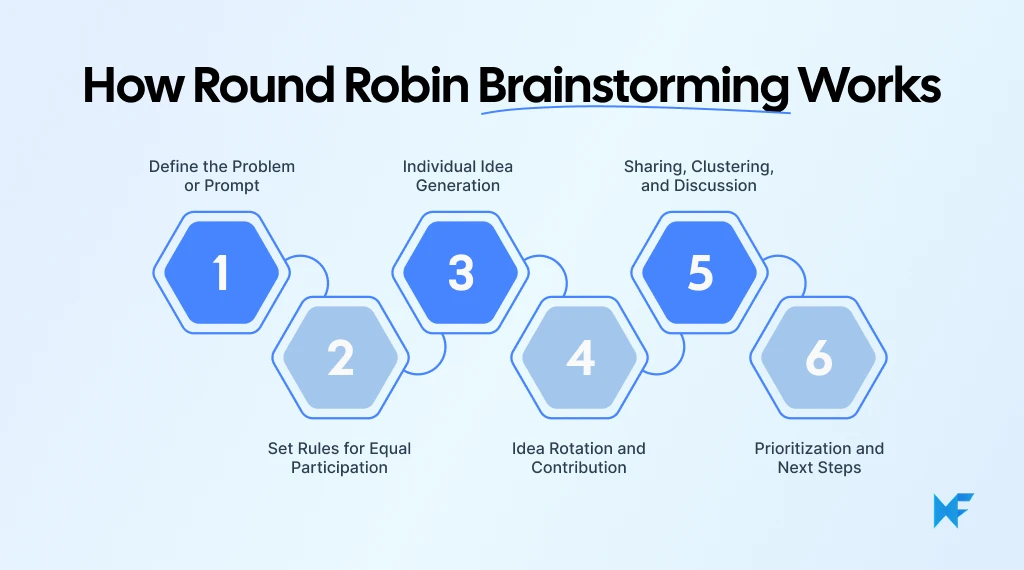
Step 1: Define the Problem or Prompt
Running a brainstorming session should always start with the right question. If the prompt is too broad, the ideas will be too. A clear, focused question gives the session direction and makes it easier for participants to contribute meaningfully.
For example, asking “How can we improve our product?” often leads to generic ideas. But reframing it as “How might we improve the onboarding experience for new users?” immediately narrows the thinking and makes the discussion more productive.
Step 2: Set Rules for Equal Participation
Before the session begins, it helps to establish a few simple brainstorming ground rules. These don’t need to be complicated, but they do need to be clear.
Each participant contributes one idea per turn, and there are no interruptions or critiques during the ideation phase. Time limits for each round keep things moving without rushing the thinking.
These small constraints create a space where everyone knows how to participate, which makes the session feel more balanced and inclusive.
Step 3: Individual Idea Generation
Instead of jumping straight into group discussion, participants begin by generating ideas on their own. This can happen on index cards, worksheets, or a shared digital board.
This silent phase plays a bigger role than most teams expect. It gives people the space to think independently, without being influenced by early suggestions from others. As a result, the ideas that emerge tend to be more original and varied.
This quiet thinking phase is often underestimated. Product management teams consistently point out that giving people space to think independently leads to more original contributions compared to jumping straight into group discussion, where early ideas tend to anchor the conversation.
Step 4: Idea Rotation and Contribution
Once the initial ideas are captured, the session moves into rotation. Each participant passes their ideas to someone else, who then builds on them.
At this stage, ideas start to evolve. One person might expand on a concept, another might refine it, and someone else might suggest a different angle altogether. This is where collaborative ideation really compounds.
When you’re using a tool like IdeaBoard, this process becomes much easier to manage. Ideas can be assigned, tracked, and iterated on without losing context, which keeps the flow smooth and focused.
Step 5: Sharing, Clustering, and Discussion
After a few rounds of rotation, it’s time to bring everything together. All ideas are collected and grouped into themes.
This step helps the team move from individual inputs to shared understanding. Patterns start to emerge, overlaps become visible, and stronger directions begin to stand out. It’s often the moment when the conversation shifts from “What ideas do we have?” to “What do these ideas tell us?”
Step 6: Prioritization and Next Steps
The final step is where decisions take shape. Instead of leaving with a long list of ideas, the team narrows down what matters most.
This can be done through voting, scoring, or using an impact-effort matrix. The goal is to identify ideas that are both valuable and feasible.
Once priorities are clear, assigning ownership or defining next steps ensures the session leads to action. With tools like IdeaBoard, teams can move from ideation to prioritization within the same workspace, which removes the usual friction between thinking and execution.
By the end of this process, the difference is clear. Ideas are no longer scattered, and the team has something concrete to work with. What really brings this method to life, though, is how it fits into real-world scenarios where structure makes all the difference.
Best Use Cases for Round Robin Brainstorming
Round robin brainstorming becomes most effective in situations where structure, clarity, and equal input are non-negotiable. It’s not just about generating ideas, but making sure those ideas are balanced, diverse, and actually usable.
In fact, a more direct round robin result supports that pattern. In a 2025 study of 42 first-year university students, the method increased average writing scores from 68 to 79 and collaboration scores from 67 to 79, suggesting that turn-based contribution can improve both output quality and teamwork.
Here’s where this method works particularly well:
- Product and feature ideation: When teams need to explore multiple solution paths before narrowing down, this method helps surface a wider range of ideas. It ensures early concepts are not dismissed too quickly and get a chance to evolve.
- UX and customer experience workshops: Understanding user pain points requires diverse perspectives. Round robin allows designers, researchers, and stakeholders to contribute without bias or interruption, leading to more well-rounded insights.
- Cross-functional team collaboration: When marketing, product, and engineering teams come together, differences in communication styles can limit participation. This method creates a level playing field where everyone contributes equally.
- Remote or distributed teams: For teams working across time zones or locations, structured ideation reduces coordination challenges. Everyone knows when and how to contribute, especially when supported by a shared digital workspace.
- Problem-solving sessions with diverse stakeholders: In environments where hierarchy exists, round robin ensures that every voice is heard. It removes the pressure of speaking up in a free-flow discussion and creates space for more thoughtful input.
Structured ideation becomes a challenge in distributed environments where engagement is already fragile. Gallup reported in January 2025 that only 31% of U.S. employees were engaged in 2024, while global engagement fell to 21%, which is one reason structured collaboration formats matter more than ever for remote teams.
What makes these use cases stand out is not just the method itself, but how consistently it delivers structured outcomes across very different team settings.
Example: Running a Product Ideation Session Using a Template
Let’s say your product team is exploring new onboarding features. Instead of starting with a blank board, you can use IdeaBoard’s Round Robin Brainstorming template to guide the entire session.
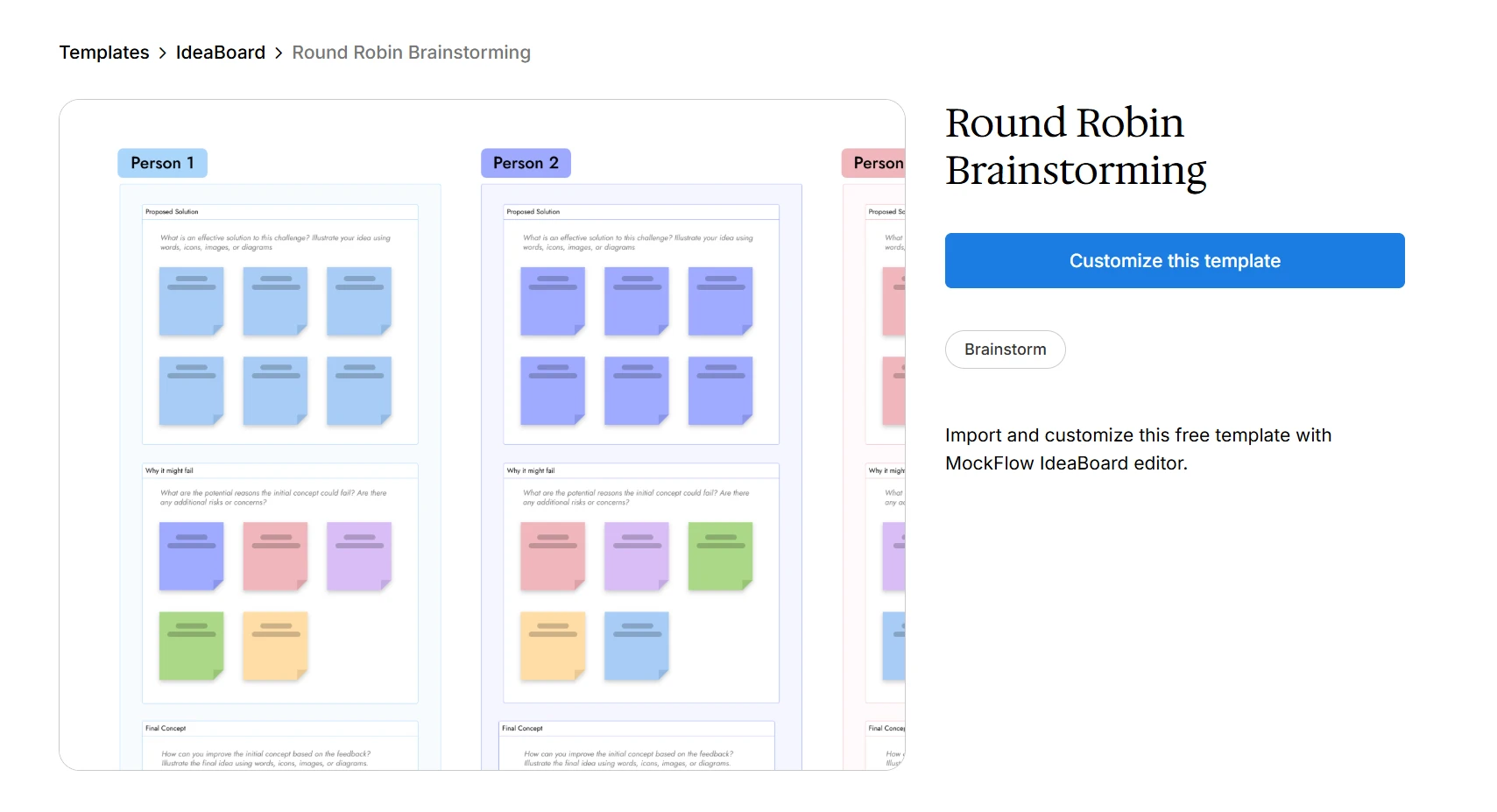
Edit this template on IdeaBoard
The template gives you a structured layout from the start. You have a clear space for the central prompt, dedicated sections for each participant, and a built-in flow for idea rotation and clustering. It removes the need to manually organize the session, so the team can focus on thinking instead of managing the process.
Here’s how you can run the session using the template:
- Set up the board and define your prompt: Add a clear, focused question at the top of the board. IdeaBoard’s infinite canvas makes it easy to structure your space without worrying about layout constraints, so your prompt stays visible and central throughout the session.
- Assign sections to each participant: Divide the board so each person has their own space to add ideas. With drag-and-drop components and sticky notes, participants can quickly start contributing without any learning curve.
- Start with individual idea generation: Ask each participant to add two to three ideas independently. This silent phase works especially well on a shared board where everyone can contribute simultaneously without interruption, thanks to real-time collaboration.
- Enable idea rotation: Assign participants to review another section. They build on existing ideas by adding improvements or variations. IdeaBoard keeps every contribution visible and connected, so ideas evolve without getting lost in the process.
- Repeat the rotation for a few rounds: After two or three cycles, ideas start to take shape. You’ll notice that initial thoughts become more refined as different perspectives layer onto them.
- Cluster and organize ideas: Use sticky notes, grouping, or visual elements to cluster similar ideas. The visual nature of the board makes patterns easier to spot and discuss as a team.
- Prioritize the best ideas: Run a quick voting or scoring exercise directly on the board. With everything in one place, your team can add comments, voice notes, and move from ideation to decision-making without switching tools.
By the end of the session, you’re not left with scattered thoughts. You have a structured set of refined ideas that are ready to move forward.
If you want to try this without committing to a full setup, MockFlow now offers a free, no-signup whiteboard demo. You can test the flow, experiment with templates, and run a quick session here.
This kind of setup removes the friction from brainstorming and keeps the team focused on what actually matters. When the method and the environment work together, the difference shows up immediately in both participation and outcomes.
Conclusion
When conversations are unstructured, ideas compete instead of building on each other, and the best ones rarely make it through. That’s exactly the gap structured ideation is designed to solve.
With a method like round robin brainstorming and a tool like IdeaBoard, you don’t just run a session, you create a system. MockFlow’s IdeaBoard helps you structure the entire flow, from capturing ideas to rotating inputs and prioritizing outcomes, all in one place without the usual coordination overhead.
If you’re looking to run more effective, outcome-driven ideation sessions, it’s worth trying it out in practice.
Sign up for a demo of IdeaBoard and see how structured brainstorming can change the way your team generates and acts on ideas.
FAQs
1. What is round robin brainstorming?
Round robin brainstorming is a structured ideation method where participants take turns sharing ideas in a fixed sequence. This approach ensures equal participation, reduces dominance by a few voices, and helps teams generate ideas collaboratively in a controlled and repeatable format.
2. How does round robin brainstorming work?
Round robin brainstorming works by guiding participants through a turn-based process. Each person contributes one idea at a time, often building on previous inputs. A facilitator sets a prompt, defines rules, and manages timing to keep the session structured and productive.
3. What are the benefits of round robin brainstorming?
Round robin brainstorming improves participation by giving everyone equal airtime. It encourages diverse ideas, reduces bias, and creates a more inclusive environment. The structured format also helps teams stay focused and generate higher-quality ideas.
4. What are the steps in round robin brainstorming?
The process typically includes defining a clear problem, setting participation rules, generating ideas individually, rotating ideas among participants, discussing and grouping ideas, and prioritizing the best solutions for next steps.
5. When should I use round robin brainstorming?
Use round robin brainstorming when you need balanced participation, especially in larger groups or diverse teams. It works well for structured workshops, problem-solving sessions, product ideation, and situations where quieter participants need equal opportunity to contribute.
6. How is round robin brainstorming different from traditional brainstorming?
Round robin brainstorming follows a structured, turn-based format, while traditional brainstorming is more open and unstructured. This structure helps ensure equal contribution and reduces interruptions, making it more effective for inclusive and focused idea generation.
Affinity Diagram: A Practical Guide to Organizing Ideas and Insights
Introduction Brainstorming sessions often produce dozens of ideas in minutes, but it gets difficult to figure out which ideas...

What is a Swimlane Diagram? Definition, Examples, & When to Use It
Introduction Have you ever sat in a meeting where everyone agrees the process is “clear,” but somehow work still gets stuck?...
Team Planning Process Guide: Steps & Best Practices in 2026
Team planning often starts when the team already feels the pressure. A new quarter is approaching. A major project is about to...
