Collaboration Skills: How to Improve Team Performance and ROI
Introduction
Smart teams fail more often than we admit.
Deadlines slip when communication breaks down, projects stall when ownership feels unclear, and meetings drag on when no one truly listens. These issues are not created by skill gaps, but collaboration gaps.
Collaboration skills are the abilities that help people work effectively toward shared goals. They combine communication, active listening, conflict resolution, accountability, and cross-functional coordination. In fast-moving workplaces, these skills determine whether teams operate in silos or move as a unit.
In this guide, we’ll break down what collaboration skills really mean in the workplace, why they directly impact performance, and how you can improve them using practical, structured approaches.
Why Are Collaboration Skills Important in the Workplace?
Collaboration skills are the abilities that help employees work effectively with others to achieve shared goals. These skills include clear communication, active listening, conflict resolution, trust-building, accountability, and cross-functional teamwork.
Strong collaboration skills improve team performance, productivity, and decision-making in the workplace. Organizations use collaboration skills to drive alignment, innovation, and measurable business results.
Remote and hybrid teams rely on structured communication and shared tools to strengthen collaboration. Effective collaboration skills create high-performing teams and support long-term organizational success.
Benefits of Collaboration in a Professional Workplace
Deloitte’s 2024 global research, surveying 14,000 respondents across 95 countries, found that only 3% of organizations say they are “extremely effective” at capturing the value created by workers. It revealed that the gap between effort and outcome often comes down to alignment, clarity, and collaboration systems.
Collaboration skills directly impact:
- Faster problem-solving through collective intelligence
- Reduced workplace conflict
- Improved team performance and productivity
- Higher employee engagement and morale
- Better cross-functional alignment
- Stronger innovation outcomes
- Clear accountability and reduced duplication of work
When teams collaborate visually and transparently, they reduce back-and-forth confusion and improve execution clarity. Workflow-driven and tooling-supported environments also play a huge role in this.
A Microsoft global survey found that 75% of knowledge workers already use AI at work. Out of those, 90% say it helps them save time, 85% say it helps them focus on important work, and 84% say it boosts creativity. This shows that modern collaboration is about clarity, coordination, and the systems teams use to work smarter together.
Key Collaboration Skills Every Professional Needs
Collaboration skills go far beyond simply “working well with others.” They combine teamwork skills, interpersonal awareness, and structured coordination that help teams move from discussion to execution without unnecessary friction. When these collaborative skills are strong, teams align faster, solve problems more efficiently, and deliver better outcomes.
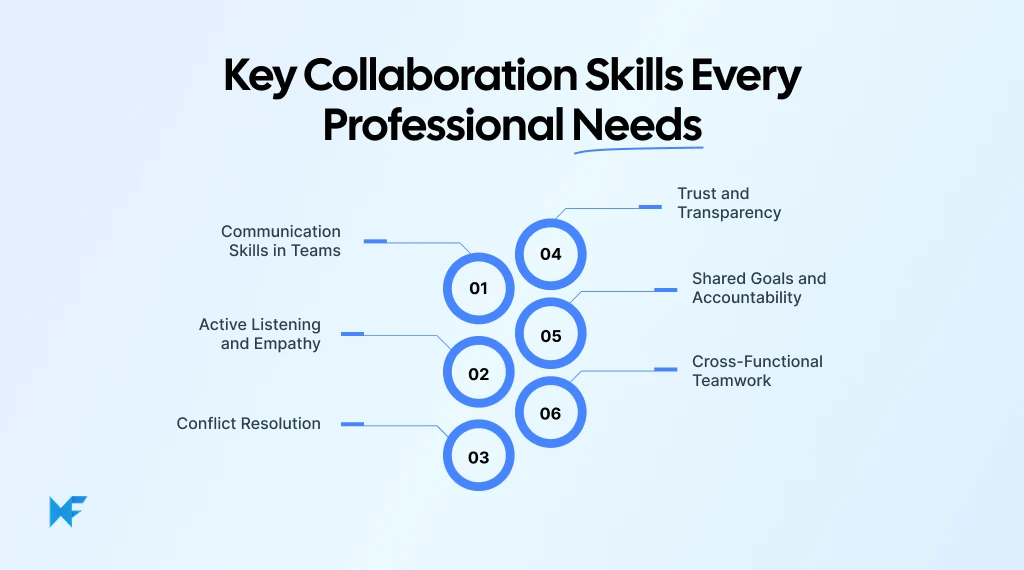
1. Communication Skills in Teams
Effective communication in teams is not just about speaking clearly. It’s about making sure the message actually lands. In cross-functional environments, that often means translating complex ideas into shared understanding so that marketing, product, and engineering stay aligned.
Clear goals prevent misalignment before it starts. Structured updates reduce rework and eliminate the endless back-and-forth that drains momentum. When communication is intentional and visible, collaboration skills become a performance multiplier rather than a daily struggle.
2. Active Listening and Empathy
Active listening means paying attention to understand, not waiting for your turn to speak. It shifts conversations from reactive to thoughtful. Teams that practice active listening create space for diverse viewpoints, which strengthens problem-solving in groups.
A study published in PLOS ONE found that team psychological safety significantly improves innovative performance, with communication behavior acting as a key mediator. In simple terms, when teams feel safe to speak and share information openly, innovation improves.
Empathy also plays a critical role in cooperative working. When team members acknowledge different constraints, priorities, and pressures, discussions become solution-focused instead of defensive. That shift alone can dramatically improve team collaboration skills.
3. Conflict Resolution
Conflict is not a red flag. In fact, high-performing teams often disagree more frequently because they care deeply about outcomes. The difference lies in how they handle those disagreements.
Strong collaboration skills separate ideas from individuals. Teams address the issue without attacking the person. Structured conversations keep debates constructive and focused on finding the best path forward. Over time, this reduces long-term friction and builds trust.
4. Trust and Transparency
Trust does not emerge by accident. It develops when information flows openly, and progress remains visible. Transparency reduces assumptions, which are often the silent driver of workplace tension.
When teams track work visibly and share updates consistently, accountability becomes clearer. People understand who owns what, what stage a project is in, and where support is needed. Shared visual environments often strengthen collaboration skills because expectations stop living in people’s heads and start living in shared systems.
5. Shared Goals and Accountability
If you’ve ever felt like meetings generate work that vanishes, you’re not alone. Professionals often point to the same root cause: action items die when no one assigns a clear owner and follow-up cadence.
Clear milestones and defined responsibilities align individual contributions with team objectives. Accountability frameworks prevent duplication of effort and eliminate the “I thought someone else was handling that” problem. When success metrics are shared and visible, teams move faster and with more confidence.
6. Cross-Functional Teamwork
Modern workplaces depend on cross-functional teamwork. Marketing cannot operate in isolation from product, engineering cannot build without understanding customer context, and design cannot finalize without stakeholder alignment.
A 2024 peer-reviewed study analyzing 377 virtual teams found that groups with diverse levels of expertise showed greater performance gains from virtual collaboration compared to more uniform teams. Collaboration skills become even more critical when teams are cross-functional or unevenly experienced.
When teams co-create plans, workflows, or brainstorm early in the process, alignment strengthens before execution begins. Visual collaboration tools like MockFlow can support this by making ideas tangible and shared, reducing ambiguity and increasing clarity across departments.
Strong collaboration skills are not abstract qualities. They show up in everyday interactions, decisions, and workflows. Once you start noticing them in action, it becomes much easier to see where they are missing and where they can be strengthened.
Collaboration Skills Examples in the Workplace
Collaboration skills start to make real sense when you see them in action.
Take a product and design team working on a new feature. Instead of jumping straight into execution, they use a shared visual space to map ideas, brainstorm flows, test diagrams, and outline assumptions together.
Designers clarify user intent, product managers align on scope, and engineers review feasibility in the same collaborative view. That early, visible alignment reduces rework later and prevents costly misunderstandings once development begins.
In fact, you see the same pattern in revenue teams. When marketing and sales align on campaign messaging and targets before launch, customer communication becomes consistent, sales understands the positioning, and marketing understands the objections.
Other collaboration skills examples in the workplace include:
- Engineers resolving technical disagreements through structured discussions, where the focus stays on the problem instead of personal preferences.
- Managers clarify ownership using defined roles and responsibilities, which eliminates duplication and confusion.
- Remote teams use shared boards to track progress, making accountability visible rather than assumed.
- Cross-functional teams map workflows together before execution, so dependencies are clear from the start.
What stands out in all these scenarios is not just teamwork, but structured coordination. People communicate clearly, listen actively, align on shared goals, and make progress visible. That combination strengthens team collaboration skills and improves overall team performance skills.
Once you begin recognizing these patterns, it becomes easier to identify where collaboration breaks down in your own environment. The next step is not just spotting the gaps, but deliberately strengthening the habits that close them.
How to Improve Collaboration Skills in a Workplace
Strong collaboration skills improve when teams introduce structure, clarity, and consistent habits that support cooperative working. If collaboration feels inconsistent in your organization, the solution is a better framework that allows more effective brainstorming for teams.
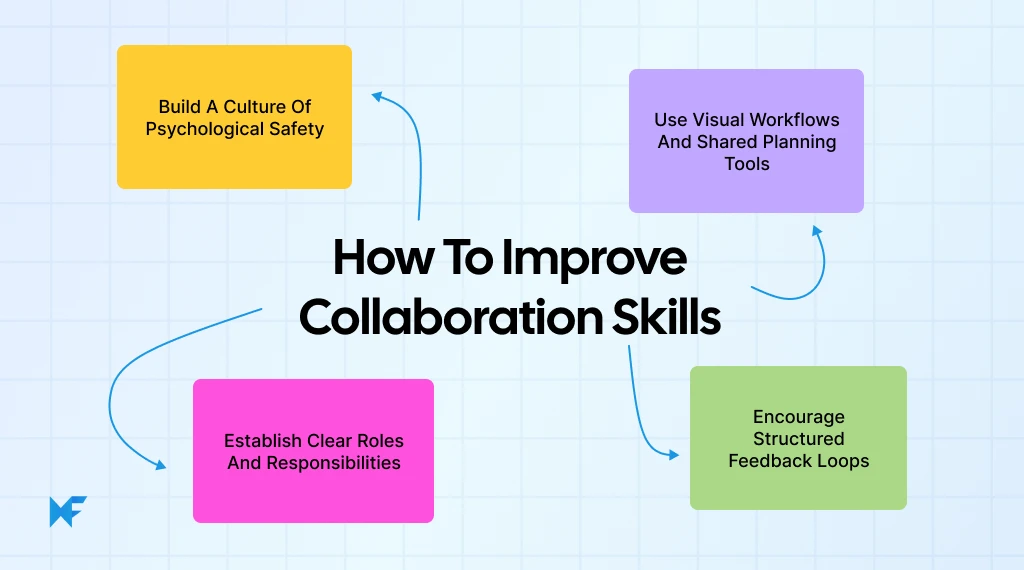
Build a Culture of Psychological Safety
Psychological safety creates the foundation for effective communication in teams. When people feel safe to share ideas, raise concerns, or challenge assumptions, discussions become more honest and productive.
Leaders play a critical role here. They can normalize respectful disagreement, invite input from quieter team members, and recognize team-based achievements instead of spotlighting individual heroics. Over time, this builds trust and transparency, which are essential for sustainable collaboration skills in the workplace.
In case mistakes get repeated often or a lack of ownership is visible in the team, professionals explain that leaders can start by examining the system when things go wrong, while still holding people accountable when patterns repeat.
Establish Clear Roles and Responsibilities
Many collaboration breakdowns happen because ownership feels vague. When responsibilities overlap or remain undefined, confusion spreads quickly.
Clear accountability reduces that friction. Defining who leads, who supports, and who decides ensures that everyone understands their role in achieving shared goals. Structured clarity prevents duplication of work and improves overall team performance skills.
Use Visual Workflows and Shared Planning Tools
Collaboration improves when ideas and progress are visible. Shared whiteboards and workflow diagrams allow teams to align early rather than discover misalignment late.
When teams design processes or map workflows together in a shared visual environment, conversations become more structured.
Collaborative platforms like IdeaBoard strengthen this process by offering ready-made templates designed specifically for structured team thinking.
For instance, the Brainwriting 6-3-5 template allows multiple team members to contribute ideas simultaneously in a balanced way, encouraging equal participation and reducing dominance bias in discussions.
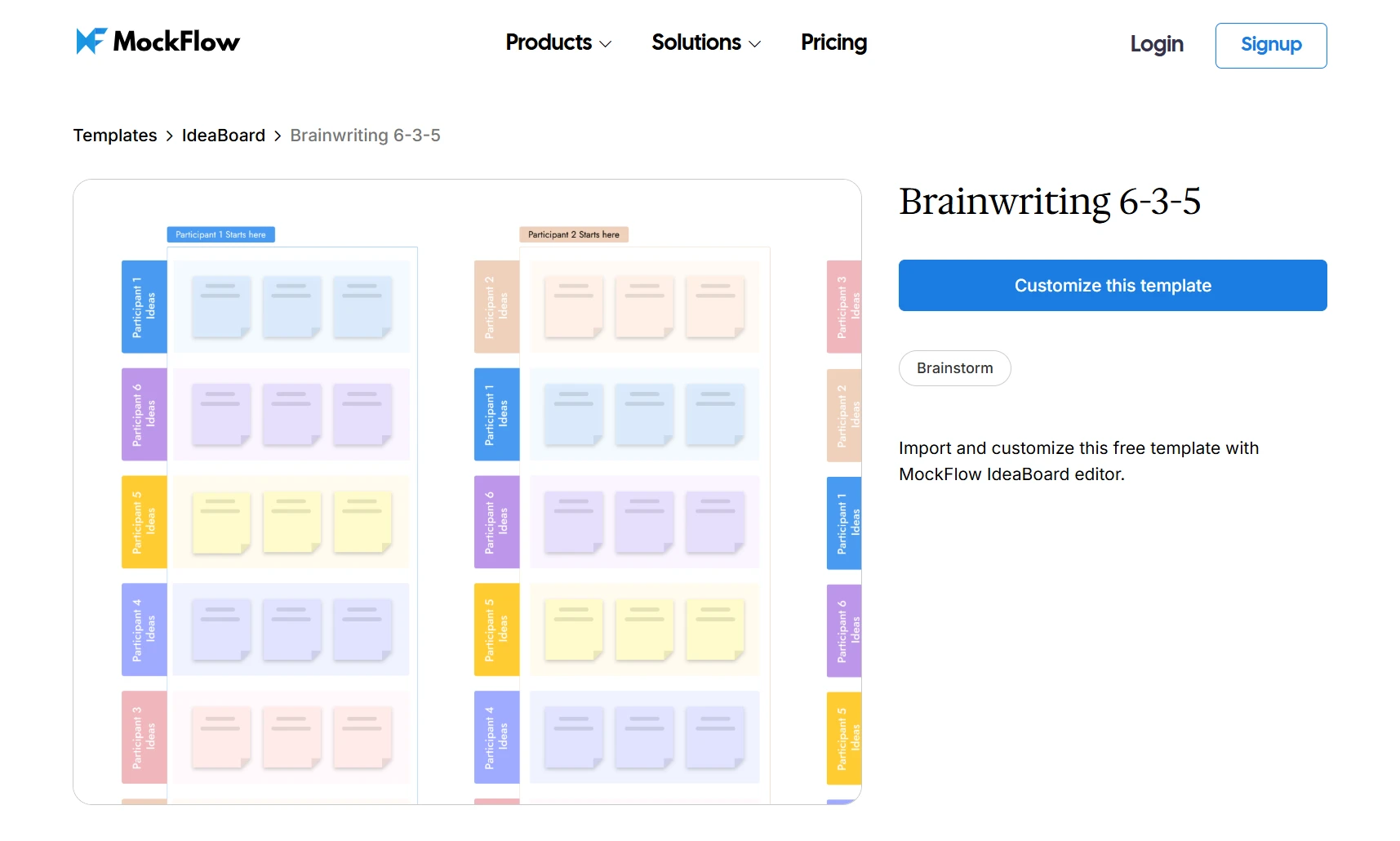
Image Source: IdeaBoard Brainwriting 6-3-5 template
Encourage Structured Feedback Loops
Collaboration strengthens when teams regularly reflect on how they work together. Weekly retrospectives, sprint reviews, and cross-functional sync meetings create space to refine processes and improve communication patterns.
Structured feedback encourages continuous improvement. Teams identify what worked, what created friction, and how they can collaborate more effectively next time. Over time, these small adjustments compound into stronger collaborative skills.
As teams become more distributed, feedback also needs to travel beyond live meetings. Tools that support asynchronous collaboration through voice notes, video comments, and contextual responses make feedback richer and clearer than text alone.
IdeaBoard, for instance, allows teams to add video and voice comments directly within shared boards, helping contributors explain context, tone, and intent more effectively during async collaboration.
Improving collaboration is less about personality and more about systems. When psychological safety, clarity, visibility, and feedback become part of everyday work, team dynamics start to shift. The real impact becomes visible when these improved habits begin influencing productivity, innovation, and measurable business outcomes.
The ROI of Collaboration Skills in the Workplace
Collaboration skills are often labeled as “soft,” but their impact is anything but soft. They shape how quickly teams move, how effectively they solve problems, and how consistently they deliver results. When collaboration improves, performance metrics tend to follow.
Let’s break down how that return on investment actually shows up.
Productivity gains often appear first. When communication becomes clear and roles are well defined, teams spend less time clarifying misunderstandings and more time executing. The results typically include:
- Reduced duplication of work
- Faster decision-making cycles
- Shorter project turnaround times
- Fewer revision loops
Instead of circling back to fix avoidable mistakes, teams move forward with confidence.
Reduced operational friction is another measurable outcome. BCG reports that 48% of workers globally are grappling with burnout symptoms. Excess meetings, unclear ownership, and constant coordination overhead contribute to this fatigue, making structured collaboration not just a productivity issue, but a well-being one.
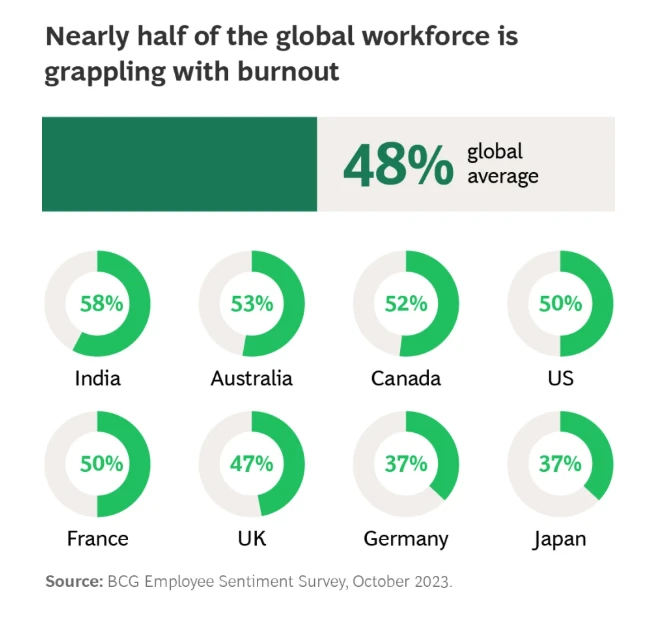
Image source: BCG Research
When collaboration skills improve, teams experience:
- Fewer escalated conflicts
- Lower stress caused by unclear expectations
- Smoother handoffs between departments
- Greater transparency across workflows
Clarity reduces friction, transparency reduces tension, and the day-to-day work feels more coordinated and less reactive.
Innovation and revenue impact also benefit from strong cross-functional teamwork. When product, marketing, engineering, and sales exchange ideas openly and early, innovation accelerates. Execution becomes consistent across functions, which directly influences revenue performance.
One last thing, employee retention and engagement should not be overlooked. BCG’s 2024 research shows that 12% of employees with low psychological safety say they are likely to quit within a year, compared to just 3% when psychological safety is high. Trust, candor, and structured collaboration directly influence retention risk.
Clear expectations reduce burnout, and trust improves morale. Teams that collaborate effectively often report stronger engagement because people understand how their work contributes to shared goals.
At the end of the day, collaboration skills are not optional cultural add-ons. They are performance multipliers that influence productivity, innovation, and retention in measurable ways.
Conclusion
MockFlow’s collaborative platform helps teams turn communication into visible alignment. Instead of relying on scattered conversations and assumptions, teams co-create, clarify, and execute together.
With MockFlow’s IdeaBoard, your team can:
- Co-create diagrams and workflows before execution begins
- Map responsibilities clearly to avoid duplication
- Visualize processes so everyone understands dependencies
- Align cross-functional teams early in the project lifecycle
- Reduce back-and-forth revisions caused by miscommunication
Instead of relying on scattered documents and endless threads, teams collaborate in one structured, transparent space. That clarity strengthens collaboration skills in the workplace and improves execution confidence.
If your team feels busy but not aligned, it may be time to rethink how you collaborate. Sign up with IdeaBoard for free and see how structured visual collaboration can help your team move faster, align earlier, and deliver better results.
FAQs
1. What are collaboration skills?
Collaboration skills are the abilities that help employees work effectively with others toward shared goals. These skills include clear communication, active listening, conflict resolution, trust-building, accountability, and cross-functional teamwork. Strong collaboration skills improve alignment, decision-making, and overall team performance in the workplace.
2. Why are collaboration skills important in the workplace?
Collaboration skills drive productivity, innovation, and engagement. They help teams align around shared goals, reduce conflict, and improve communication. Organizations that strengthen collaboration create high-performing teams and achieve better business outcomes across departments and projects.
3. What are examples of collaboration skills in the workplace?
Examples of collaboration skills include active listening, transparent communication, constructive feedback, conflict resolution, accountability, empathy, and cross-functional coordination. These skills help teams work efficiently, build trust, and achieve measurable performance results.
4. How can I improve my collaboration skills?
You can improve collaboration skills by building psychological safety, clarifying roles and responsibilities, using shared planning tools, and encouraging structured feedback loops. Consistent practice of communication and accountability strengthens teamwork and improves performance outcomes.
5. How do collaboration skills impact productivity and ROI?
Collaboration skills improve productivity by reducing misunderstandings, aligning team priorities, and accelerating decision-making. Strong collaboration increases engagement, improves project delivery, and supports measurable business results such as efficiency, retention, and innovation.
6. How can organizations measure collaboration effectiveness?
Organizations measure collaboration effectiveness through engagement scores, project outcomes, delivery timelines, cross-team performance, and feedback quality. Clear metrics help leaders evaluate alignment, accountability, and overall team effectiveness.
7. How can I highlight collaboration skills on my resume or in a job interview?
List specific outcomes rather than the skill itself. Instead of writing "strong collaborator," describe a situation where you aligned a cross-functional team, resolved a conflict, or kept a project moving through clear communication. In interviews, use the same approach: walk through a real example where your communication, active listening, or accountability directly changed the outcome of a project. Hiring managers look for evidence, not adjectives, so concrete examples of the skills covered in this guide (communication, conflict resolution, cross-functional teamwork) carry far more weight than simply claiming to be a "team player.
Miro vs Visio: Side-by-Side Comparison of Features, Reviews & Pricing
Introduction Every team has its own rhythm when it comes to visual collaboration. Some think best when ideas spread loosely...
Quarterly Business Review: How to Plan, Structure & Run a QBR Meeting
Introduction Every quarter, we pause and ask ourselves a familiar question: are we actually moving the business forward, or are...
How to Implement Cross Functional Collaboration in Modern Teams
Introduction If you have ever been in a meeting where everyone agrees collaboration matters, but no one is quite sure how it...
