
30+ Brainstorming Questions for Better Sessions and Ideas
Quick Answer:
Brainstorming questions are open-ended prompts that help teams generate ideas, explore possibilities, and solve problems. These questions focus on idea generation, not final answers. They encourage creative thinking, challenge assumptions, and uncover new perspectives. Teams use brainstorming questions in workshops, meetings, and ideation sessions to improve collaboration and innovation. Common examples include:
- What are different ways we can approach this?
- What assumptions are we making?
- What ideas have we not explored yet?
Introduction
Many brainstorming sessions feel productive on the surface, but they often lack depth because the right questions are not being asked. Instead of exploring ideas fully, teams tend to move toward answers too quickly, leaving gaps in understanding and missed opportunities.
That is where effective brainstorming questions make a difference. By using the right prompts, we can guide discussions, uncover new perspectives, and generate more thoughtful ideas.
In this guide, we will explore how to ask better questions and share ready-to-use prompts that you can apply across different scenarios, including strategy, product thinking, team collaboration, and learning.
30 Brainstorming Questions to Ask in a Session
The effectiveness of a session often depends on asking the right type of questions for the situation. Below, we’ve grouped some questions for brainstorming based on real-world use cases so we can guide discussions with more clarity and intent.
Brainstorming Questions for Strategy & Business
When we’re working on strategy or business planning, the goal is to uncover opportunities, identify risks, and challenge assumptions. These questions help us think beyond surface-level decisions and bring clarity to long-term direction.
Questions to ask:
- What opportunities are we currently overlooking?
- What risks could impact our plans the most?
- What assumptions are we making about our market?
- Where are we losing efficiency in our current approach, and what is causing it?
- What can we do differently to stay competitive in a changing market?
- What would success realistically look like in the next six months, and how would we measure it?
- What external factors could disrupt our strategy, and how prepared are we for them?
Brainstorming Questions for UX & User Research
In UX brainstorming, the focus shifts to understanding user behavior, pain points, and experience gaps. These user research questions help us move beyond assumptions and design experiences that align with real user needs.
Questions to ask:
- What problems are users trying to solve?
- Where do users face the most friction?
- What feedback are we missing from our users?
- How do users currently experience this process from start to finish?
- What would make this experience more intuitive and effortless?
- What patterns are emerging from our UX brainstorming sessions?
Brainstorming Questions for Product & Innovation
For product and innovation, the goal is to explore possibilities and rethink how things work today. These questions encourage deeper ideation and help us uncover ways to differentiate and improve.
Questions to ask:
- What if we removed this feature entirely?
- What new features could significantly improve user value?
- How can we simplify this experience without losing functionality?
- What would a competitor do differently to solve this problem?
- What if we designed this solution from scratch with no constraints?
- How can we make this solution more scalable over time?
- What unmet user needs are we not addressing yet?
Brainstorming Questions for Students & Learning
In learning environments, brainstorming is about exploration and building understanding. These questions encourage curiosity and help break down complex ideas into simpler concepts.
Questions to ask:
- What are different ways to understand this topic?
- What questions have we not asked yet?
- How does this concept apply in real life?
- What are the key ideas behind this topic?
- How can we explain this in a simpler way?
- What connections can we make with other subjects?
Fun & Icebreaker Brainstorming Questions
Sometimes, the goal is to get people comfortable and thinking freely. These questions help create a relaxed environment and encourage participation from everyone.
Questions to ask:
- What is the most unexpected solution we can think of?
- What would we do if there were no limits?
- How would a beginner approach this problem?
- What is the simplest possible solution?
- What would make this idea more exciting?
- What is one completely different direction we can explore?
The right brainstorming questions shape the direction of the entire discussion. By choosing questions that match your goal, we can move from scattered thoughts to more focused, meaningful outcomes.
Tips to Ask Better Brainstorming Questions
The way a brainstorming question is structured can either limit thinking or expand it. By making a few deliberate shifts in how we ask questions, we can guide discussions toward deeper insights and more meaningful ideas.
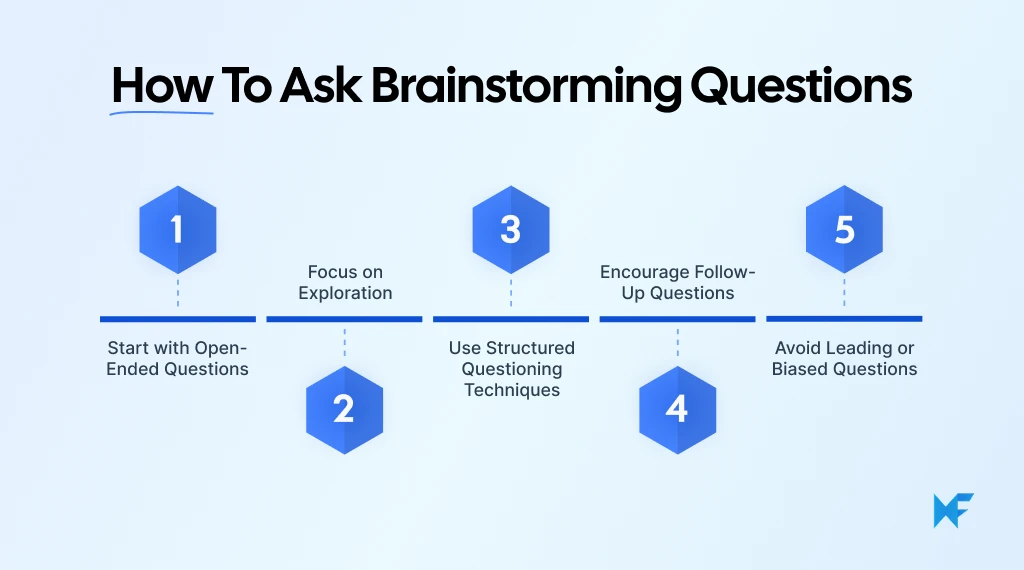
1. Start with Open-Ended Questions
Closed questions tend to produce short, predictable answers, which can limit idea generation. For example, asking “Is this a good idea?” usually leads to a simple yes or no. In contrast, asking “What makes this idea valuable?” encourages explanation, discussion, and multiple perspectives.
To make this shift clearer:
- Closed questions lead to limited answers
- Open-ended questions encourage deeper thinking
- Open-ended questions keep discussions going instead of stopping them early
2. Focus on Exploration
A common mistake in brainstorming is moving too quickly toward solutions. Strong questions are meant to expand thinking, not narrow it. When we focus on exploration, we allow ideas to develop without immediate judgment.
This approach helps because:
- It encourages divergent thinking
- It allows multiple perspectives to emerge
- It prevents early rejection of ideas
3. Use Structured Questioning Techniques
Using simple frameworks can make it easier to ask better questions.
One effective method is starbursting, which is a question-first technique that explores an idea using who, what, when, where, why, and how. It ensures all aspects of an idea are covered before moving to solutions.
For example:
- Who is this idea for?
- What problem does it solve?
- Why does this matter now?
- How can this be implemented?
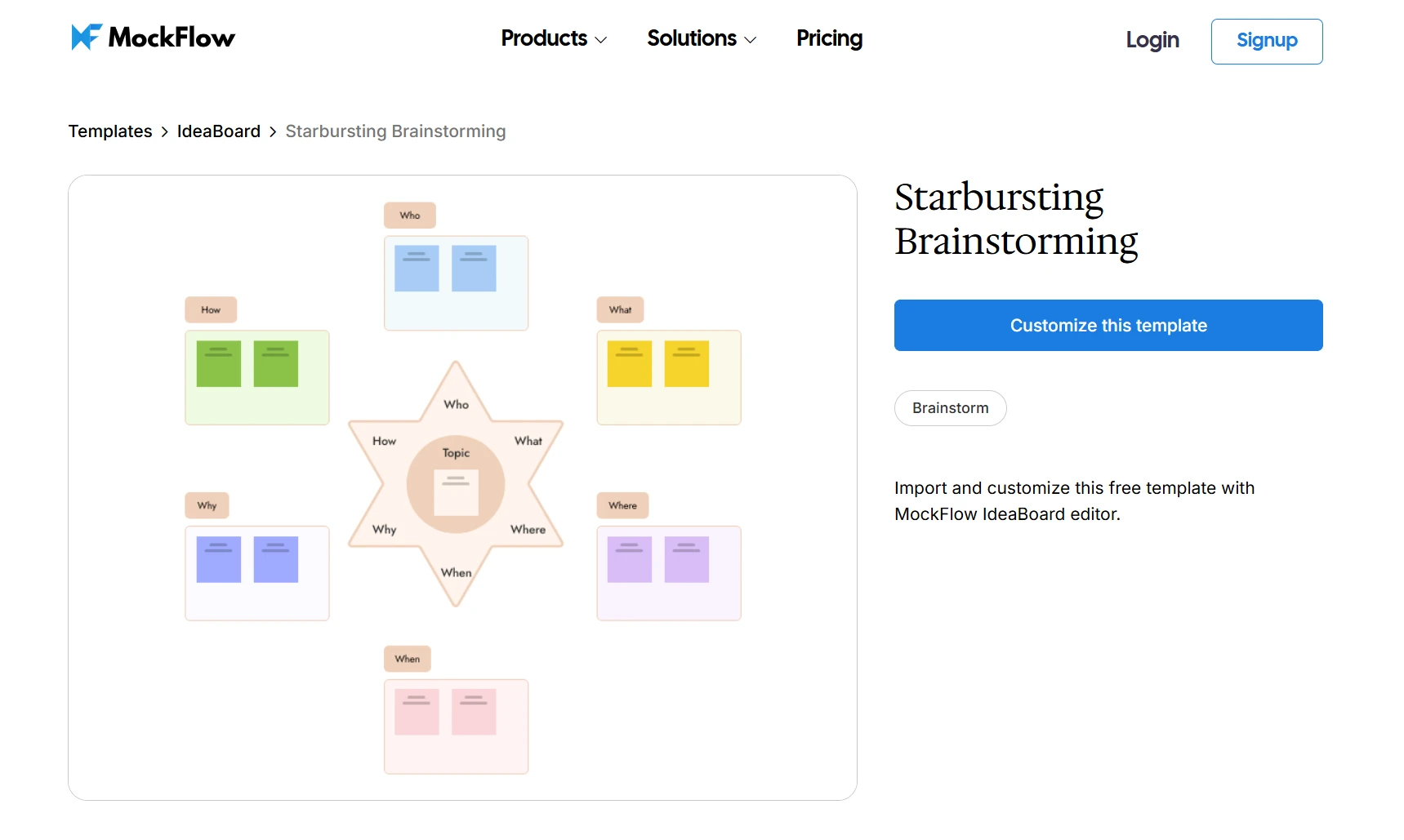
Customize this starbursting template on IdeaBoard
Another useful approach is brainwriting, where participants write down their ideas or questions individually before sharing them with the group. This reduces bias, encourages participation from everyone, and leads to more thoughtful inputs.
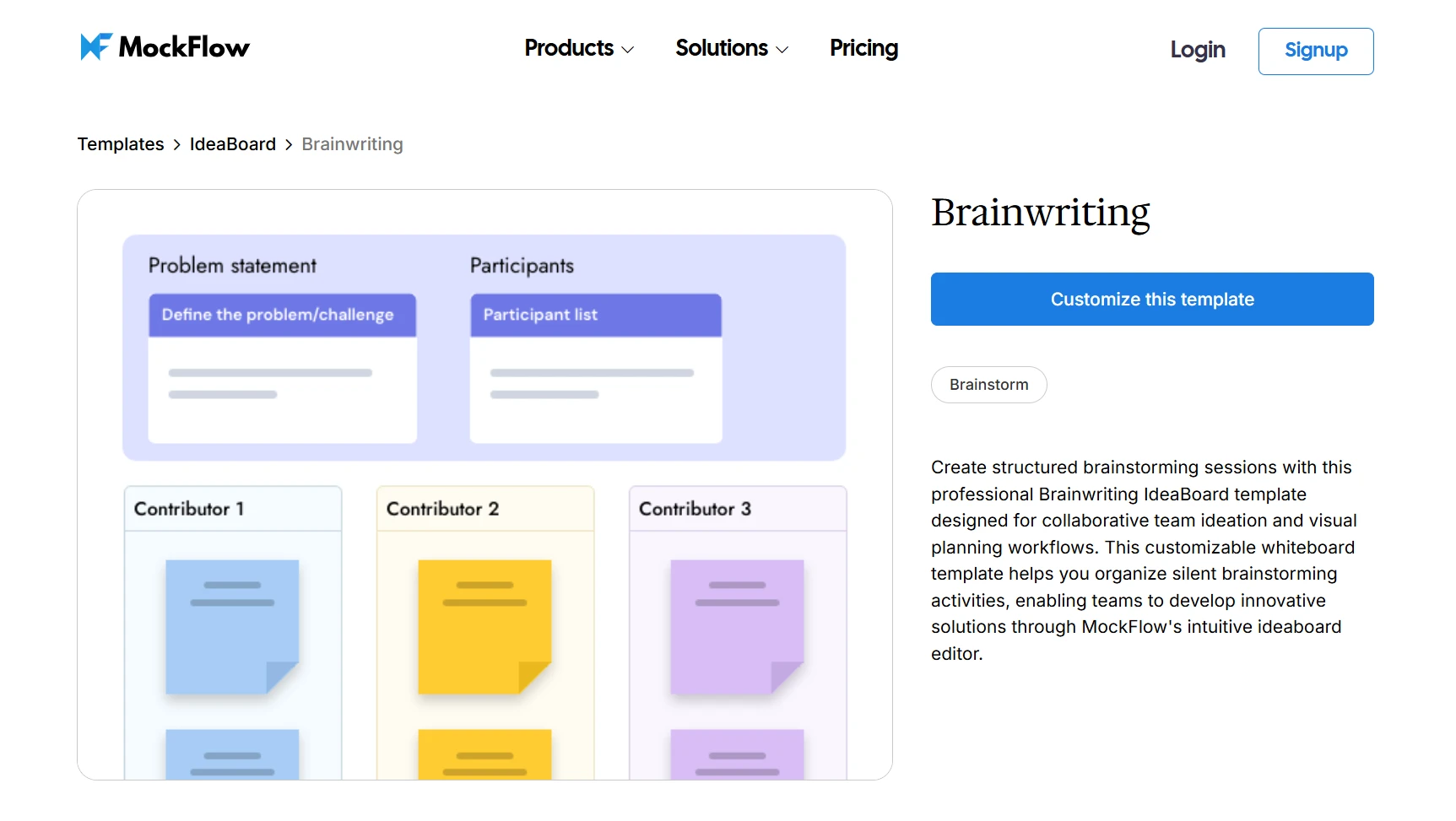
Customize this brainwriting template on IdeaBoard
According to Gartner’s 2025 innovation strategy guide, structured ideation methods such as brainwriting are among the best practices for generating high-quality ideas in R&D and innovation teams. This reduces bias, encourages participation from everyone, and leads to more thoughtful inputs.
Using these brainstorming techniques helps:
- Break down complex ideas
- Identify blind spots
- Keep brainstorming sessions structured without limiting creativity
4. Encourage Follow-Up Questions
The first question rarely uncovers meaningful insights. Real value comes from asking follow-up questions that build on earlier responses.
A simple progression looks like:
- Why is this happening?
- What is causing it?
- What if we change this part?
This helps us move from surface-level observations to deeper understanding.
5. Avoid Leading or Biased Questions
The way a question is framed can influence the answers we receive. Leading or biased questions push people toward a specific viewpoint, which limits creativity.
For example:
- “Don’t you think this is the best approach?”
- “Why is this strategy failing?”
A better approach is to keep questions neutral:
- “What are the strengths and weaknesses of this approach?”
Neutral phrasing allows for more balanced and honest input, which leads to better outcomes in brainstorming sessions.
Run Brainstorming Sessions on a Visual Collaboration Tool
Traditional brainstorming often becomes unstructured, making it hard to track ideas or move toward decisions. Even strong brainstorming questions lose impact without a clear system.
A Zoom survey highlights that both employees and executives increasingly expect flexible ways of working, making it essential for teams to collaborate effectively across locations.
Visual collaboration tools solve this by bringing structure and clarity:
- Capture all ideas in one place
- Enable real-time collaboration
- Help identify patterns and connections
- Support remote and hybrid teams
According to a Gallup workplace report, hybrid work has become the dominant model for many organizations, increasing the need for tools that support real-time collaboration across distributed teams.
More importantly, these tools help us move from asking questions to building structured insights. A typical flow becomes much easier to manage:
Questions → Ideas → Clusters → Insights
This is where brainstorming tools like IdeaBoard help turn brainstorming questions into structured, actionable sessions.
How IdeaBoard Facilitates Brainstorming Sessions
IdeaBoard provides a visual space that structures a session so that ideas lead to outcomes. Here’s a quick guide to get started with the brainstorming process.
- Start with a structured board instead of a blank canvas: You can begin by selecting a ready-made template or using the AI toolbox to generate a board from a simple prompt. You can even turn a prompt, document, or image into a structured visual board with Mida AI, which helps teams move from idea to layout instantly.
- Capture ideas in real time as questions turn into inputs: As you ask brainstorming questions, teams can add ideas directly onto the board using sticky notes or text blocks. This ensures every input is visible and documented.
- Organize ideas into clusters and patterns: Once ideas build up, you can group related inputs visually. This makes it easier to identify themes, overlaps, and gaps without switching tools.
- Collaborate without interruptions or delays: Teams can contribute simultaneously on the same board. Comments and multimedia feedback help add context, especially in remote or hybrid setups.
- Refine ideas into clear next steps: After clustering, you can highlight key insights, prioritize ideas, and define action items directly on the board.
- Present and share outcomes with stakeholders: The board itself becomes the output. You can present it, export it, or share secure links without recreating the work elsewhere.
- Extend brainstorming into execution workflows: Teams can connect IdeaBoard with their existing tools or workflows through MCP integration, making it easier to carry ideas forward into execution.
- Continue working without constraints: Teams can work offline, store boards locally, or integrate with tools like Trello to keep brainstorming aligned with ongoing work.
By structuring brainstorming this way, teams can move from scattered discussions to clear, actionable outcomes in one place.
If you want to try this approach, set up your next session on IdeaBoard using a template or generate a board instantly. You can sign up for free and get started or try it instantly without signup.
FAQs about brainstorming questions
1. What are brainstorming questions?
Brainstorming questions are open-ended prompts used to generate ideas, explore possibilities, and guide discussions. Instead of looking for direct answers, they help teams think more broadly and uncover new perspectives.
2. How do you write effective questions for brainstorming?
Effective questions for brainstorming should be open-ended, neutral, and focused on exploration. Instead of asking yes or no questions, it is better to ask questions that encourage explanation, such as “What are different ways to approach this?” or “What factors are influencing this problem?”
3. What is the difference between brainstorming and question storming?
Brainstorming focuses on generating ideas, while question storming focuses on generating questions. In question storming, the goal is to explore a topic deeply by asking as many relevant questions as possible before moving toward solutions.
4. When should teams use brainstorming questions?
Teams should use brainstorm questions at the early stages of problem-solving, planning, or ideation. They are especially useful when exploring new ideas, identifying gaps, or aligning team understanding before making decisions.
5. How can tools improve brainstorming sessions?
Visual collaboration tools like IdeaBoard help organize ideas, improve participation, and make it easier to move from discussion to action. They allow teams to capture inputs in real time, group ideas, and turn insights into structured outcomes.

What is a Kanban board? How It Works and How to Use One
TL;DR A Kanban board is a visual workflow management tool that helps you track work from start to finish. It uses cards to...
Miro vs Milanote: Full Comparison of Features, Pricing & Workflows
Introduction When teams compare Miro and Milanote, the discussion usually isn’t just about features - it’s about how each tool...

Importance of Wireframing in Product Design Process
Introduction Skipping wireframes can feel like saving time until the team starts debating layout, user flow, content, and...
