Gap Analysis Example for Business, Projects, and Team Planning
Quick Answer:
A gap analysis example shows how to compare a current state with a desired future state, identify performance or skill gaps, and define actions to close them. It uses clear steps, measurable KPIs, and structured templates to map gaps and root causes. Teams apply gap analysis examples across business, projects, and workforce planning to improve outcomes and align strategy.
Introduction
Let’s talk about gap analysis the way it actually shows up in real work.
It comes up when something feels off. The results aren’t matching expectations, a plan isn’t translating into outcomes, or a team is working hard but with no result. That’s when you need a clear way to step back, assess where things stand, and figure out what needs to change.
This is exactly where gap analysis becomes useful. It helps you compare your current state with your desired future state, understand what’s missing, and define a practical path forward.
In this guide, we’ll walk through real gap analysis examples, show how to do a gap analysis, and share a ready-to-use gap analysis template so you can apply it directly to your own project or team.
Why Teams Need Gap Analysis in Real Projects
Gap analysis becomes relevant when effort and outcomes don’t line up clearly. Teams are active, but priorities, performance, or results feel scattered.
What gap analysis does in practice is bring structure to that confusion. It helps teams:
- Clarify the current state using actual data instead of assumptions
- Define a clear target so everyone aligns on what success looks like
- Make gaps visible between where things are and where they need to be
- Translate gaps into actions with clear ownership and next steps
You’ll see this across use cases like business gap analysis, performance gap analysis, and skills gap analysis, but the goal stays the same. It gives teams a clear path from observation to execution.
Gap Analysis Examples by Use Case
Different teams use gap analysis in different ways, depending on what they are trying to improve. The following gap analysis examples show how this framework applies across multiple business use cases.
1. Business Gap Analysis Example
A company is scaling its growth efforts and expanding its pipeline, yet revenue growth remains inconsistent.
- Current state: Strong lead generation, inconsistent revenue outcomes
- Desired future state: Predictable revenue growth aligned with pipeline size
- Gap identified: Conversion inefficiencies and disconnect between pipeline quality and sales execution
As teams review the funnel, they often see variation in how leads are qualified, nurtured, and closed. The gap becomes visible in how demand moves through each stage.
For example, a 2025 McKinsey report on AI in the workplace highlights that while 78% of organizations have adopted AI, only 1% report full maturity, reflecting a clear gap between strategy and execution outcomes.
Action plan:
- Redefine ICP and qualification criteria
- Align marketing messaging with sales conversations
- Introduce better tracking of conversion KPIs
This is a classic strategic gap analysis where the issue is alignment.
2. Performance Gap Analysis Example
A customer support team is struggling with long resolution times and declining satisfaction scores.
- Current state: Average resolution time of 48 hours
- Desired future state: Resolution within 24 hours
- Gap identified: Inefficient workflows and lack of automation
According to a McKinsey report on performance transformation, organizations that systematically measure and act on performance gaps are significantly more likely to sustain long-term improvements. This highlights why structured analysis matters, not just identifying problems, but operationalizing solutions.
Action plan:
- Implement workflow automation
- Redesign escalation processes
- Track resolution KPIs more closely
Here, the focus is on process improvement and operational efficiency.
3. Skills Gap Analysis Example
A product team is expected to roll out new AI-driven features, but progress remains slow and dependent on a few individuals.
- Current state: Limited expertise in AI and data-related capabilities
- Desired future state: A team that can independently build and maintain AI features
- Gap identified: Lack of required technical skills across the broader team
The challenge becomes clearer when responsibilities are mapped. A small group carries most of the workload, while others are unable to contribute effectively.
Action plan:
- Upskill team members through focused training programs
- Hire for specific technical roles where needed
- Create internal documentation and knowledge-sharing systems
This is a skill gap scenario where capability development directly impacts execution speed. 72% of workers and 73% of executives say organizations need to do more to build workforce skills and experience, based on Deloitte Human Capital Trends (2025).
4. Process Gap Analysis Example
A team is consistently missing deadlines despite having the right resources in place.
- Current state: Delays caused by repeated handoffs and manual steps
- Desired future state: A streamlined workflow with predictable timelines
- Gap identified: Inefficient processes and lack of standardization
When mapped visually, the workflow shows multiple unnecessary steps and unclear ownership at certain stages.
Deloitte report on AI and tech investment (2025) highlights that enterprise value often gets “stranded in the gaps” between processes, leadership alignment, and execution, especially in digital transformation initiatives.
Action plan:
- Redesign the workflow to remove redundant steps
- Define clear ownership for each stage
- Introduce automation for repetitive tasks
Here, the focus is on improving execution through better process design.
5. Strategic Gap Analysis Example
An organization sets ambitious growth targets for the next few years but sees limited progress over time.
- Current state: Existing capabilities, resources, and performance levels
- Desired future state: Defined growth targets and market positioning
- Gap identified: Misalignment between strategy, resource allocation, and priorities
As teams review their roadmap, they find that efforts are spread across too many initiatives without clear prioritization.
A 2025 peer-reviewed study by ResearchGate found an 80% gap in strategic alignment between organizational strategy and execution, reinforcing how common this challenge is.
Action plan:
- Reprioritize initiatives based on business impact
- Align resource allocation with strategic goals
- Define measurable milestones to track progress
This example highlights how gap analysis supports strategic planning by connecting vision with execution.
6. Market Gap Analysis Example
A company launches a product with strong internal validation, but adoption in the target market remains low.
- Current state: Low adoption despite product readiness
- Desired future state: Strong uptake within the target audience
- Gap identified: Misalignment between product positioning and customer priorities
When teams review customer feedback and behavior, they often find that the product solves a problem, but not the one customers are actively looking to address.
Action plan:
- Conduct deeper customer research and needs analysis
- Refine positioning based on real user pain points
- Adjust features or messaging to better match demand
This example highlights how gaps can emerge between internal assumptions and market reality.
7. Product Gap Analysis Example
A product sees steady sign-ups, but user engagement drops after initial use.
- Current state: High sign-ups, low retention
- Desired future state: Consistent usage and stronger engagement
- Gap identified: Friction in the user journey and unclear value beyond onboarding
When mapped step by step, the user journey often shows drop-offs at specific points where users lose clarity or momentum.
Action plan:
- Analyze user behavior across key touchpoints
- Improve onboarding and in-product guidance
- Prioritize feature improvements based on usage patterns
This example focuses on improving how users experience and continue using the product.
8. Compliance Gap Analysis Example
An organization is working toward meeting regulatory or internal standards but struggles with consistency.
- Current state: Partial adherence to policies and inconsistent documentation
- Desired future state: Full compliance with clear audit readiness
- Gap identified: Missing processes, unclear ownership, and gaps in documentation
A closer look often shows that policies exist, but implementation varies across teams.
Action plan:
- Standardize processes and documentation
- Assign clear ownership for compliance tracking
- Introduce regular audits and monitoring
This example shows how gaps often appear in execution rather than planning.
9. Technology Gap Analysis Example
A team invests in new tools to improve productivity, but overall efficiency does not improve as expected.
- Current state: Multiple tools in place, inconsistent usage across teams
- Desired future state: Streamlined workflows with effective tool adoption
- Gap identified: Low adoption, poor integration, and lack of standardized usage
When reviewed closely, teams often find that tools are implemented, but processes around them are unclear, leading to fragmented workflows.
Action plan:
- Standardize how tools are used across teams
- Provide training and clear usage guidelines
- Integrate tools into existing workflows instead of adding parallel systems
This example shows how gaps can emerge between tool adoption and actual productivity.
10. Customer Experience Gap Analysis Example
A company receives steady customer traffic, but satisfaction scores and retention remain low.
- Current state: High interaction volume, inconsistent customer experience
- Desired future state: Smooth, consistent experience across all touchpoints
- Gap identified: Breaks in the customer journey and inconsistent service quality
When teams map the full journey, they often uncover friction points between channels, delays in response, or lack of continuity in interactions.
Action plan:
- Map the end-to-end customer journey
- Identify and fix friction points across touchpoints
- Standardize response processes and service quality
This example focuses on improving how customers experience the product or service across the entire journey.
How to Do a Gap Analysis for Your Project with IdeaBoard
A gap analysis brainstorming session becomes useful when it moves from thinking to execution. The steps below show how to actually run one using a structured, visual approach so your team can see, discuss, and act on it together.
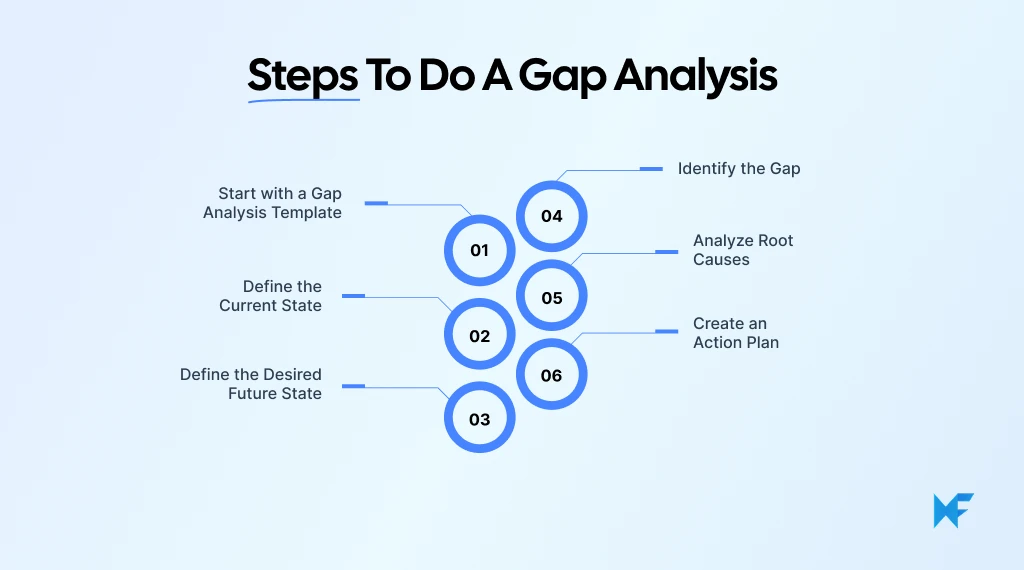
Step 1: Start with a Gap Analysis Template
The fastest way to begin is with a predefined structure. Instead of building everything from scratch, teams can use a ready gap analysis template. It gives clear sections for current state, desired state, gaps, and actions, so teams can focus on inputs rather than format.
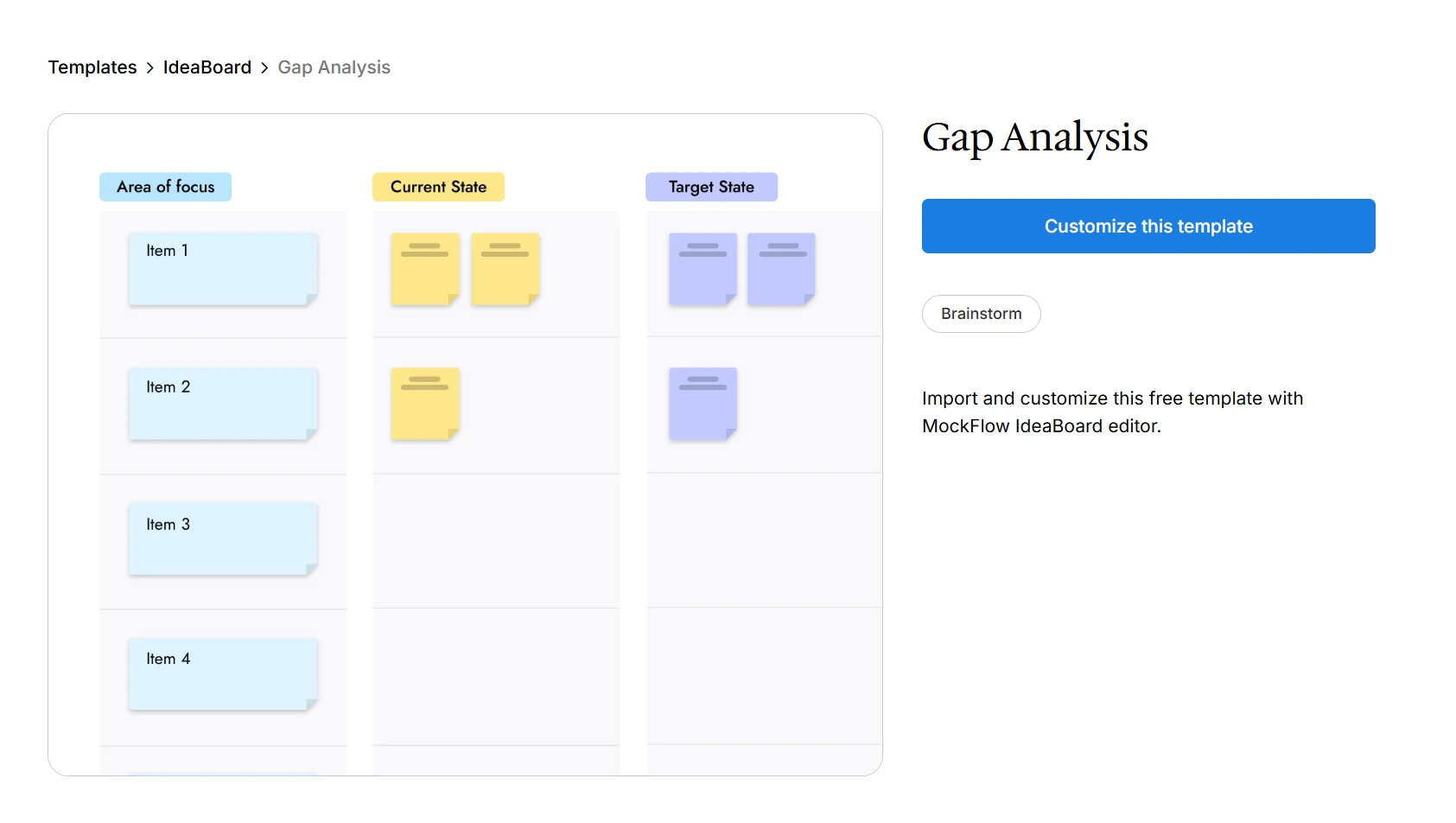
Edit this gap analysis template as per your use case
If your use case is more specific, teams can also generate a custom structure using IdeaBoard’s AI toolbox using simple text prompts. This is especially useful when different teams want slightly different views of the same analysis.
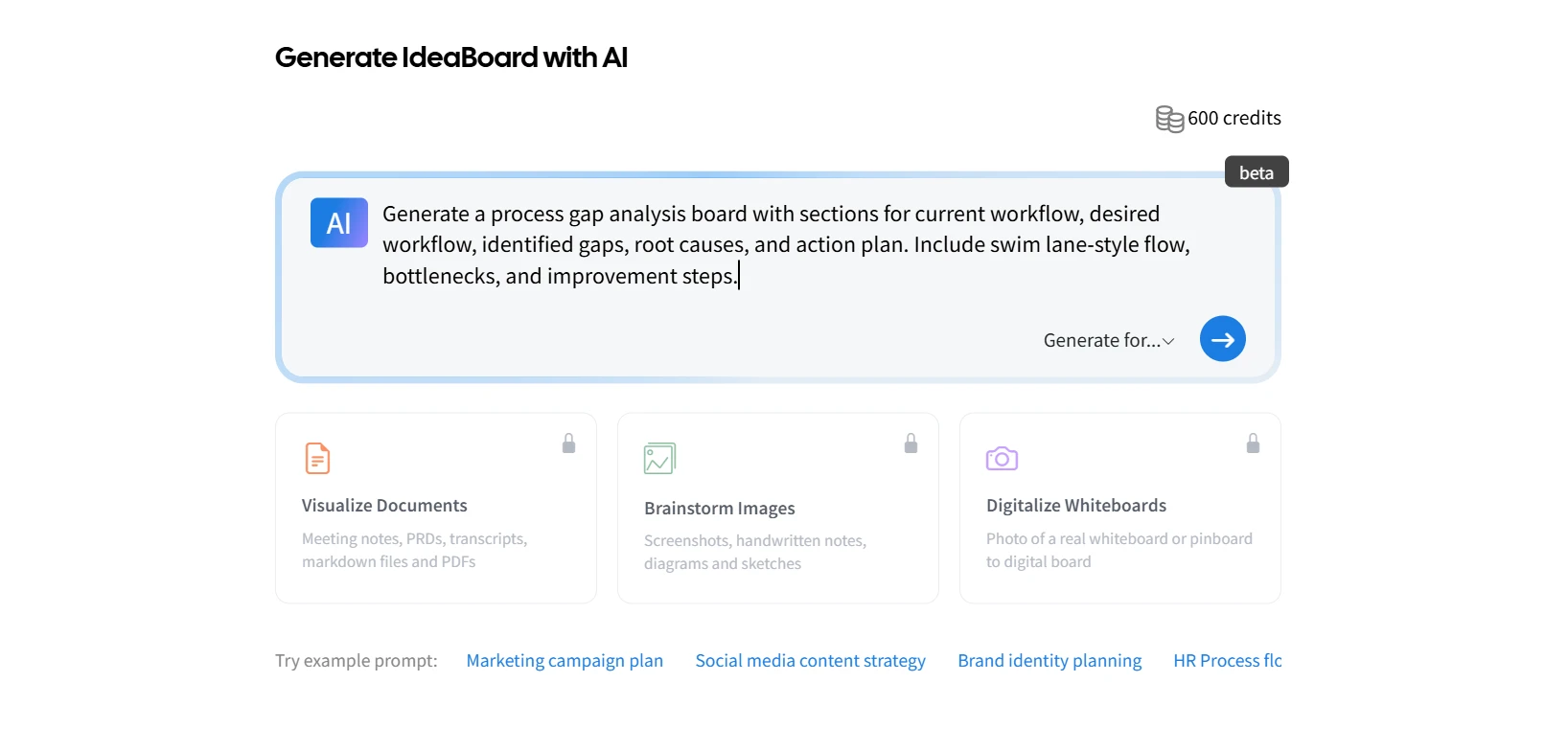
Generate custom layouts with AI for gap analysis
Working on a visual whiteboard helps here. Instead of scattered notes or documents, everything sits in one place, making it easier for remote and hybrid teams to contribute and align early.
Step 2: Define the Current State
This is the step where you capture what’s actually happening today using real data and observations.
Focus on:
- Key metrics (conversion rates, cycle time, output, etc.)
- Process observations (delays, bottlenecks, dependencies)
- Team inputs (what’s working, what’s slowing things down)
On a board, this step becomes easier to structure. You can group inputs by themes, add context, and make patterns visible quickly. It also helps teams align on a shared understanding before jumping to solutions.
Quick tip → Breaking down the current state into smaller, process-level steps helps teams identify hidden inefficiencies that don’t show up in high-level metrics. This level of detail often reveals where delays, dependencies, or ownership gaps are actually occurring.
Step 3: Define the Desired Future State
Once the current state is clear, the next step is to define where you want to go. This needs to be specific and measurable.
Instead of broad goals, focus on:
- Target metrics (for example, reducing turnaround time or increasing conversion rates)
- Expected outcomes (faster delivery, better quality, improved efficiency)
- Clear benchmarks or success criteria
When this is visualized alongside the current state, the difference becomes easier to understand. Teams can see the direction clearly and align on what success actually looks like.
Step 4: Identify the Gap
With both states defined, the gap becomes visible. This is where you compare the two side by side.
Look at:
- Differences in metrics
- Missing capabilities or resources
- Breakpoints in processes or workflows
On a visual board, this step is straightforward. You can map current vs future directly and highlight where the biggest gaps exist. This makes prioritization easier, especially when multiple gaps show up at once.
Step 5: Analyze Root Causes
Once the gap is identified, the next step is understanding why it exists. This prevents surface-level fixes and leads to more effective actions.
You can approach this by:
- Breaking down each gap into contributing factors
- Looking at dependencies across teams or processes
- Identifying recurring patterns or blockers
Collaborating on this step is important. Different team members bring different perspectives, and capturing them in one place helps build a more accurate picture.
Quick tip → Root cause analysis becomes more effective when teams ask multiple layers of “why” for each gap instead of stopping at the first explanation. This approach helps uncover deeper systemic issues rather than surface-level symptoms.
Step 6: Create an Action Plan
The final step is turning insights into execution. Every identified gap should lead to a clear set of actions.
Define:
- Specific tasks or initiatives
- Owners responsible for each action
- Timelines and milestones
- Metrics to track progress
Keeping this on the same board ensures continuity. Teams can move from analysis to execution without switching tools or losing context.
Across all these steps, the key advantage is visibility. When everything from current state to action plan is mapped in one place, teams collaborate more effectively and move faster from insight to execution.
Use Visual Tools to Simplify Gap Analysis
Gap analysis often starts scattered across spreadsheets, docs, and disconnected conversations. That makes it harder to see relationships, identify gaps clearly, and get everyone aligned on what needs to change.
A visual collaboration and brainstorming tool like IdeaBoard fixes this.
IdeaBoard brings structure to gap analysis by turning scattered inputs into a single visual workspace. Teams can use ready templates on an infinite canvas to map current and future states clearly, while real-time collaboration with multimedia feedback keeps discussions contextual and aligned without switching tools.
It also reduces setup time with AI-driven workflows. Using AI and a pre-built prompt library for quick layouts, teams can generate structured boards instantly, extend ideas with Mida AI, and connect workflows through MCP integration in MCP-compatible AI assistants like Claude and Cursor for deeper, continuous analysis.
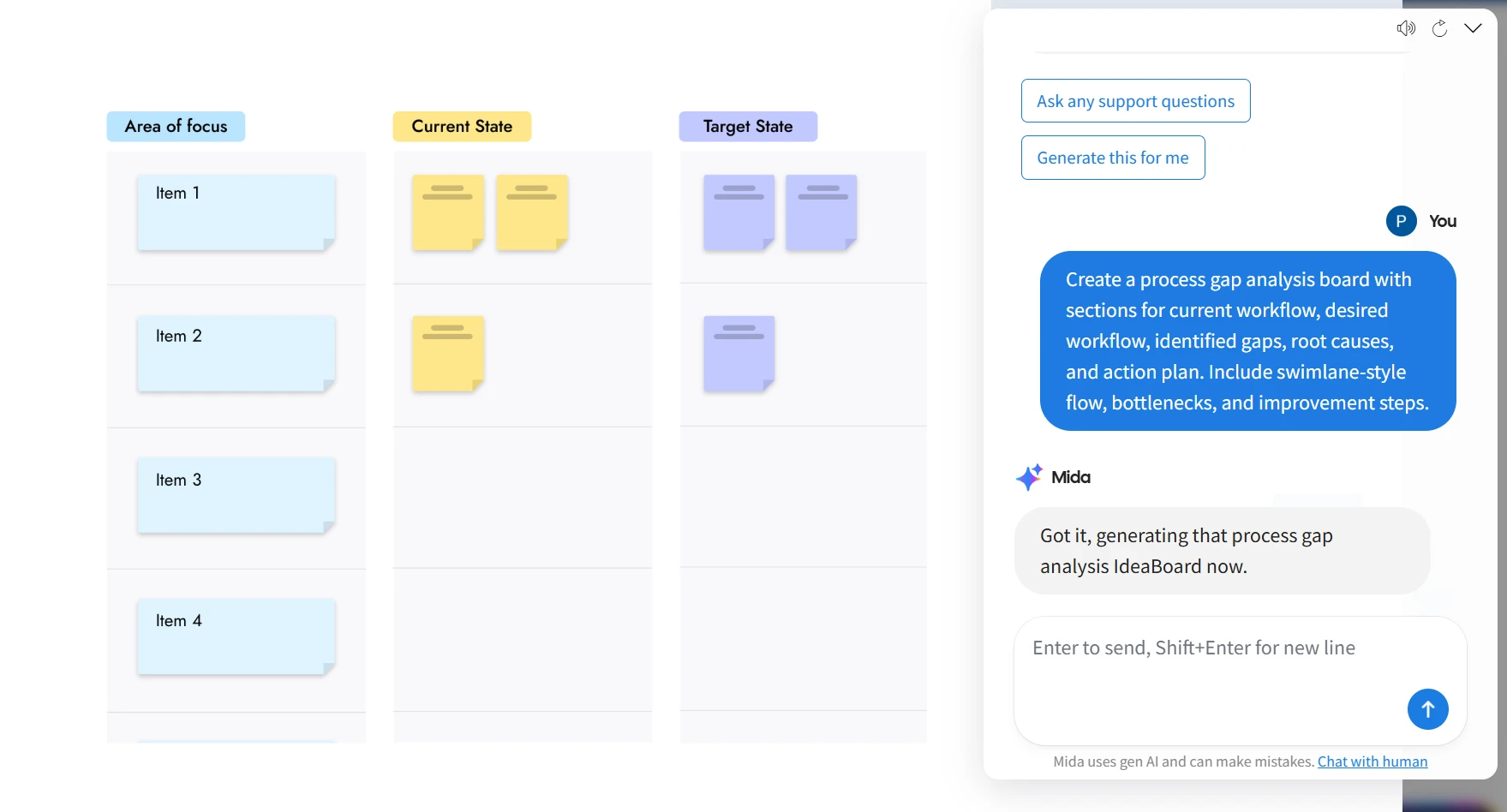
Generate and extend ideas with Mida AI
Once you start mapping your analysis visually, it becomes much easier to move from identifying gaps to actually closing them.
If you want to run a more structured and collaborative gap analysis, you can sign up for free and get started with IdeaBoard or try it instantly without signup.
FAQs about gap analysis example
1. What is meant by gap analysis?
A gap analysis is a structured way to compare your current state with your desired future state and identify what needs to change to get there. It moves the conversation from assumptions to clarity by grounding decisions in measurable differences.
2. What is a gap analysis example?
A gap analysis example shows how an organization compares its current state with a desired future state, identifies the gap between them, and defines actions to close it. It helps translate the concept into a practical, real-world scenario.
3. How to perform a gap analysis step-by-step?
Start by defining the current state using data, then set a clear desired future state. Compare both to identify gaps, analyze root causes, and convert insights into a structured action plan with owners and timelines.
4. What are the types of gap analysis?
Common types include business gap analysis, performance gap analysis, skills gap analysis, and strategic gap analysis. Each focuses on a different area, such as revenue, processes, capabilities, or long-term goals.
5. What is a skills gap analysis?
A skills gap analysis identifies the difference between the skills a team currently has and the skills required to meet business goals. It helps prioritize training, hiring, or capability-building initiatives.
6. What tools can be used for gap analysis?
Teams use spreadsheets, dashboards, and visual collaboration and brainstorming tools like MockFlow IdeaBoard to map current vs future states, organize gaps, and collaborate in real time for faster decision-making.

Asana Whiteboard: How to Add Visual Planning to Asana
Ever had a project that looked clear in Asana, but still felt hard to talk through as a team? That usually happens when the...
Rapid Ideation: How to Generate, Refine, and Act on Ideas Faster
Quick Answer: Rapid ideation is a structured brainstorming approach that helps generate a large volume of ideas quickly...

The UI Design Process: 9 Steps to Build Better Interfaces
Think back to your earliest experiences with a digital interface. Can you recall that pivotal moment when you first engaged with...
