Divergent vs Convergent Thinking: What Are Their Main Differences?
Quick glance: Divergent vs convergent thinking
Aspect | Divergent thinking | Convergent thinking |
Definition | Generates multiple possible answers or solutions to a problem | Evaluates alternatives to identify the most suitable answer or solution |
Thinking style | Creative, flexible, and exploratory | Logical, analytical, and selective |
Primary goal | Discover new possibilities and perspectives | Identify the most effective course of action |
Approach | Expands thinking beyond obvious or familiar solutions | Narrows possibilities using evidence and defined criteria |
Questions | Open-ended questions that encourage multiple responses | Focused questions that seek specific, well-supported answers |
Typical activities | Brainstorming, mind mapping, starbursting | Decision matrices, impact-effort analysis, idea prioritization |
Outcome | A diverse collection of ideas worth exploring | A well-supported decision or actionable solution |
Best suited for | Early problem exploration, creative ideation, discovering opportunities | Comparing alternatives, resolving constraints, finalizing decisions |
Introduction
Have you ever noticed how a brainstorming session can produce dozens of interesting ideas, yet the team still struggles to decide what to do next?
Sometimes, we start evaluating ideas too early and miss possibilities worth exploring. Other times, we keep generating options without getting any closer to a decision. Understanding when to expand our thinking and when to narrow it down helps us give each stage the attention it needs.
This balance is central to divergent vs convergent thinking, a distinction first explored in creativity research by psychologist J. P. Guilford.
Divergent thinking encourages us to question assumptions and consider alternative ways of solving a problem. Convergent thinking helps us compare those alternatives against what we know, what matters most, and what we can realistically achieve.
So, when should you explore more ideas, and when should you start narrowing them down? Let's look at the differences, practical examples, and techniques that can help you use both approaches effectively.
Divergent vs convergent thinking: Key differences
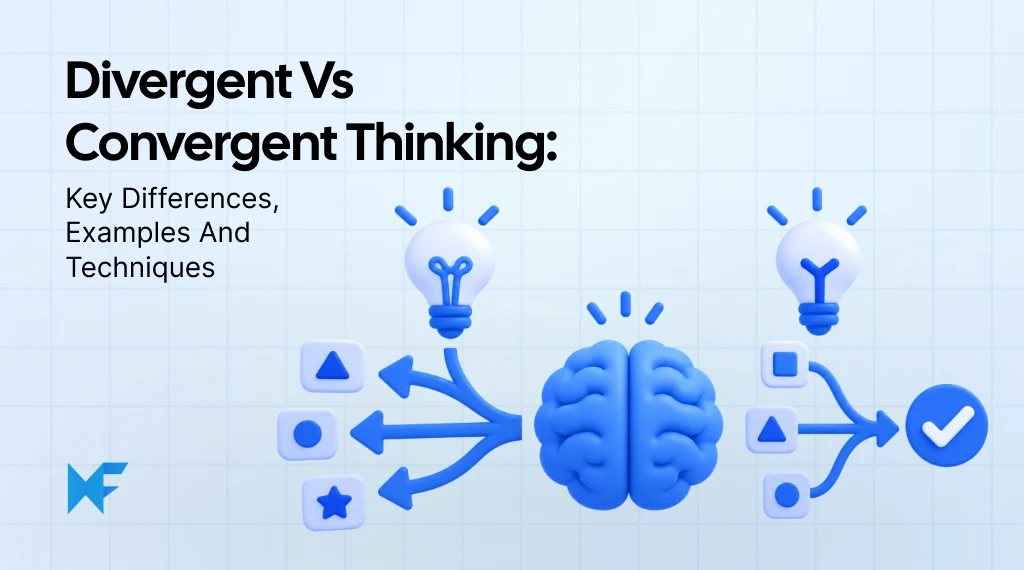
Divergent and convergent thinking are two complementary approaches to creative problem-solving. Divergent thinking helps us generate a wider range of ideas without judging them too early, while convergent thinking helps us evaluate those ideas and select solutions based on evidence and practical constraints.
Let's look at how each approach works and the role it plays in moving ideas forward.
What is divergent thinking?
Divergent thinking is a creative thinking process that involves generating multiple ideas, perspectives, or possible solutions to a problem. It encourages originality and flexible thinking by allowing us to explore different directions before deciding which ideas are worth pursuing.
By questioning our initial assumptions, we often uncover possibilities that would go unnoticed if we settled on the first reasonable solution.
For example, consider a product team trying to improve website conversions. Rather than assuming the signup form is the problem, they explore several possible improvements:
- Simplifying the signup process
- Redesigning website navigation
- Creating personalized landing pages
- Improving the clarity of website content
A divergent question might be:
"What are the different ways we could improve the user experience?"
Open-ended questions like this give brainstorming sessions more room for exploration. They encourage people to build on each other's suggestions and consider unconventional ideas before evaluating their feasibility.
A divergent thinker tends to explore alternative solutions with curiosity, although anyone can develop this approach through practice.
What is convergent thinking?
Convergent thinking is an analytical thinking process that uses logic, evidence, and defined criteria to identify the most suitable solution among available alternatives. It helps teams compare ideas objectively and make decisions based on their goals and constraints.
PMI's 2025 Pulse of the Profession report found that professionals with high business acumen reported meeting project business goals at a rate of 83%, compared with 78% among their peers. This reinforces the value of convergent thinking, which helps teams evaluate alternatives against business objectives, available resources, and practical constraints before making decisions.
For example, the product team now has four potential website improvements but limited resources to implement them. They evaluate each option by asking:
- What does existing user behavior data suggest?
- Which improvement is likely to increase conversions the most?
- How much development effort will each option require?
- Which solutions fit the available budget?
A convergent question might be:
"Which proposed improvement is most likely to increase conversions within our available budget?"
Unlike divergent questions that invite multiple possible answers, convergent questions focus attention on specific requirements. They help teams use critical thinking to eliminate less suitable options, prioritize promising ideas, and make informed decisions.
The key difference between divergent thinking and convergent is:
Divergent thinking expands the range of solutions we consider. Convergent thinking turns those possibilities into a clear direction for action.
When to use divergent and convergent thinking
Choosing between divergent and convergent thinking depends on what your team needs to accomplish at a particular stage of problem-solving. When you're still trying to understand a challenge or need fresh ideas, divergent thinking helps you explore possibilities without limiting the discussion too early.
Here's how to identify the right approach for different situations:
Situation | Thinking approach | Why it helps |
Exploring a new product concept | Divergent | Reveals different ways to address user needs before defining the product |
Investigating an unfamiliar problem | Divergent | Uncovers possible causes that need further investigation |
Brainstorming creative campaign ideas | Divergent | Encourages fresh concepts beyond familiar campaign formats |
Discovering customer needs | Divergent | Brings overlooked expectations and user perspectives into consideration |
Comparing product feature proposals | Convergent | Identifies which features best meet user needs and business goals |
Prioritizing a project backlog | Convergent | Helps allocate limited resources to the most valuable tasks |
Choosing a solution under a deadline | Convergent | Keeps decisions focused on essential requirements and available time |
Finalizing an implementation plan | Convergent | Clarifies priorities and turns selected solutions into actionable steps |
Knowing when to switch between the two approaches is just as important as knowing when to use them. A few practical considerations can help:
- Assess how well you understand the problem: If the underlying issue is still unclear, continue exploring before narrowing down solutions.
- Look at the quality of available options: When you have enough relevant ideas and supporting information, shift toward evaluating and prioritizing them.
- Recognize when the discussion needs direction: If brainstorming keeps producing similar suggestions without adding value, it's time to review what you've gathered and identify promising options.
Both approaches are useful in entrepreneurship as well. An entrepreneur exploring a new business idea uses divergent thinking to consider different market opportunities and business models. Convergent thinking then helps assess customer demand and financial feasibility before committing resources.
Divergent and convergent thinking techniques
Brainstorming, mind mapping, and SCAMPER are common divergent thinking techniques used to generate creative ideas. Affinity diagramming, decision matrices, and prioritization exercises are convergent thinking techniques that help teams organize findings and make informed choices.
Here are five practical techniques for each approach, with examples of how to apply them.
5 divergent thinking techniques and activities
These activities are particularly useful when familiar solutions aren't working or a team needs fresh perspectives.
Brainstorming encourages teams to generate ideas without immediate criticism. For example, a product team planning a new feature can first collect individual suggestions, then invite participants to expand on each other's ideas.
Gallup's May 2025 survey found that only 28% of U.S. employees strongly agreed their opinions count at work. Giving participants an independent idea-generation round helps create space for contributions before group discussion begins.
MockFlow provides a shared visual canvas where everyone can contribute sticky notes simultaneously, connect related suggestions, and leave comments for further discussion. The brainstorming session template is particularly useful for giving everyone five minutes to contribute independently before grouping similar suggestions. This prevents early opinions from dominating the discussion and keeps everyone's contributions visible.
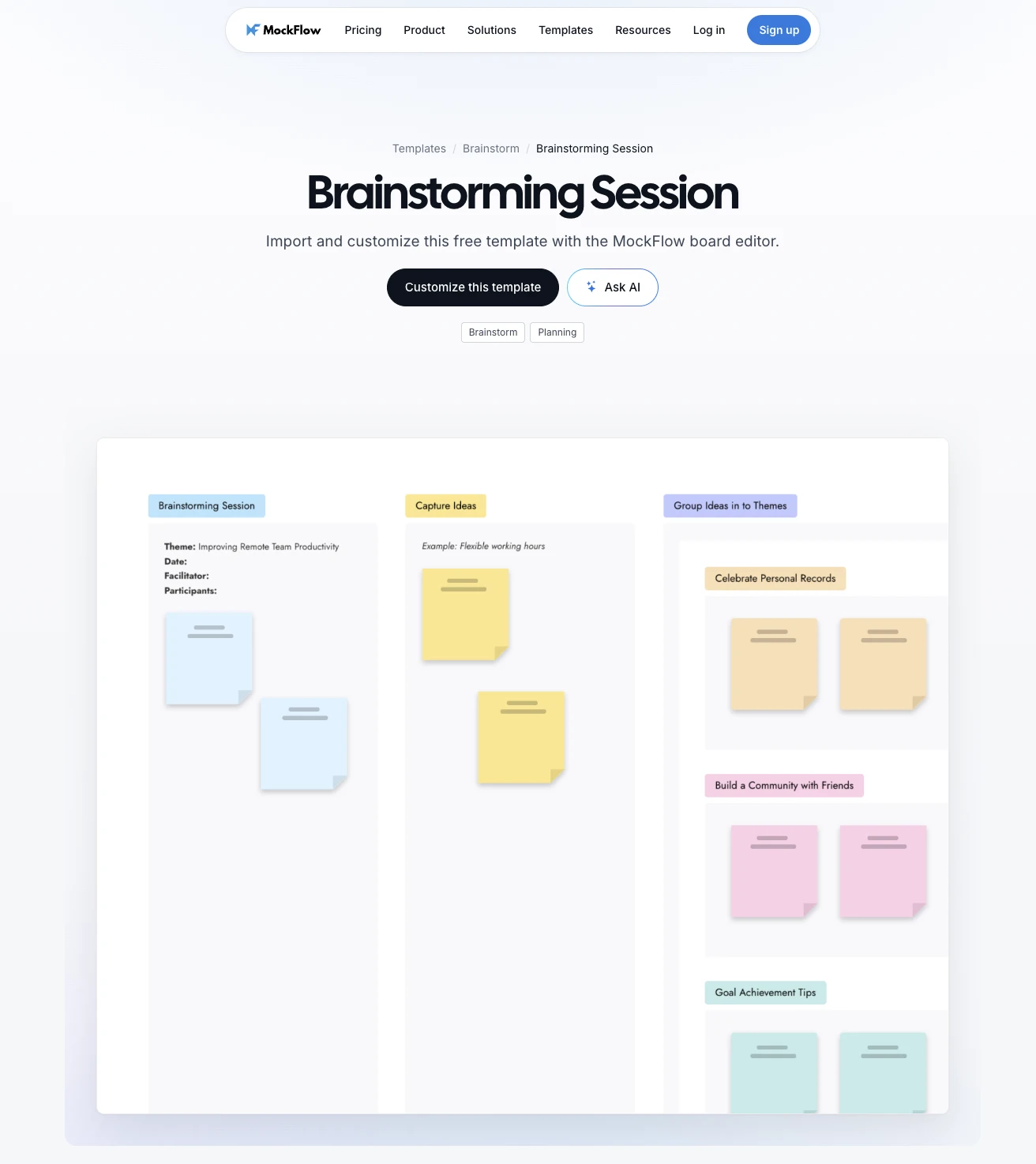
Click to customize this brainstorming session template
Mind mapping expands a central topic into related ideas, while concept mapping explores relationships between those ideas.
For example, when investigating customer retention, a team can begin with "Why do customers leave?" and branch into possible reasons. An AI mind map in MockFlow provides an initial structure that participants can expand or correct using actual customer insights. This helps them spend more time examining overlooked causes instead of arranging the diagram.
Concept mapping also supports convergent thinking when teams need to organize findings and understand how different factors influence one another.
Starbursting explores an idea through six question categories: who, what, when, where, why, and how.
For a proposed product feature, the starbursting brainstorming template provides a separate space for each category. Participants can contribute questions independently before discussing answers.
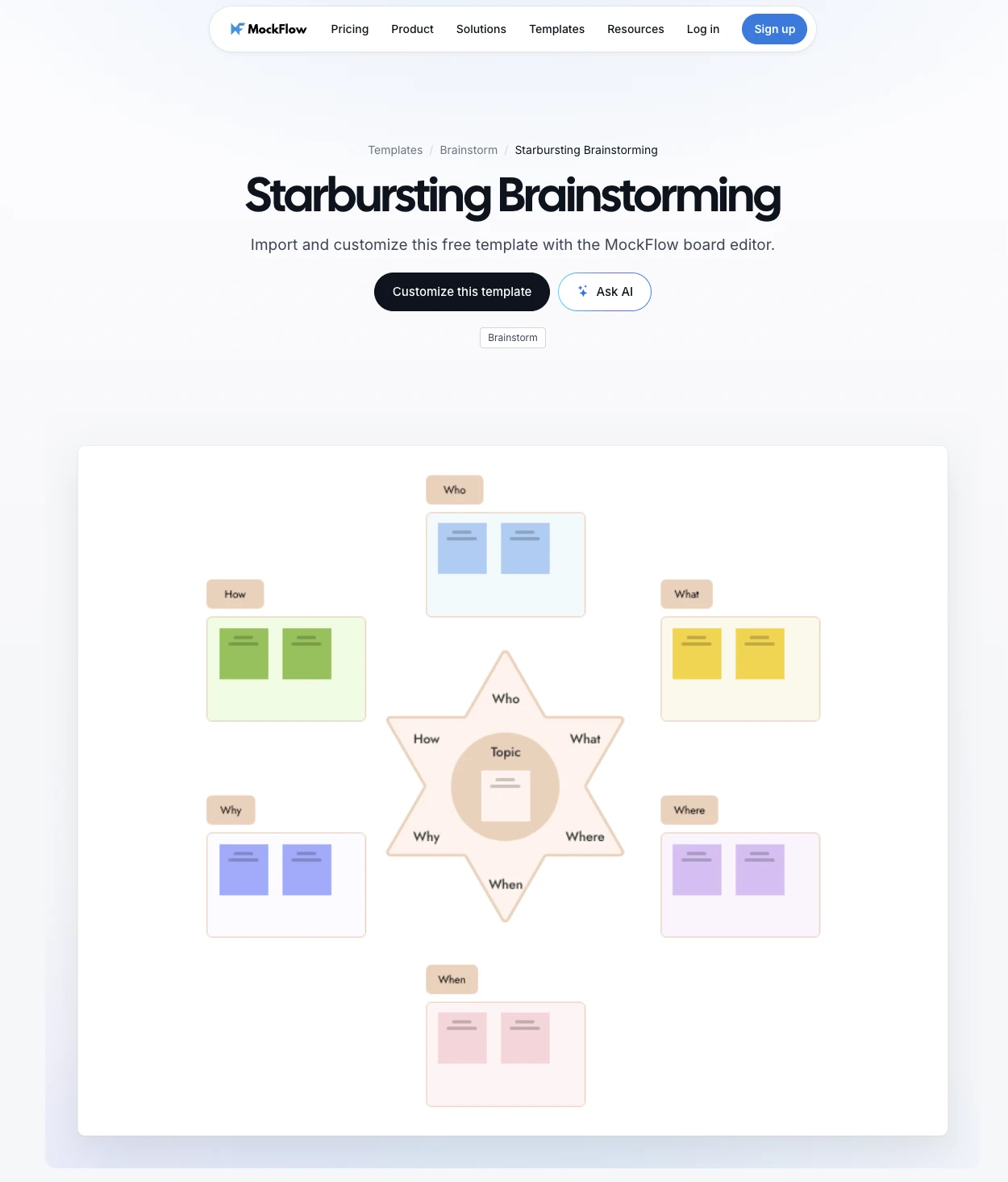
Click to customize this starbursting brainstorming template
The completed board reveals unanswered questions about user needs or implementation that deserve investigation before development.
SCAMPER uses seven prompts: Substitute, Combine, Adapt, Modify, Put to another use, Eliminate, and Reverse. Each encourages teams to rethink an existing product or process.
For example, when improving an app's search feature, the SCAMPER technique template helps teams examine the feature through each prompt. Under "Combine," they could consider integrating personalized recommendations into search results.
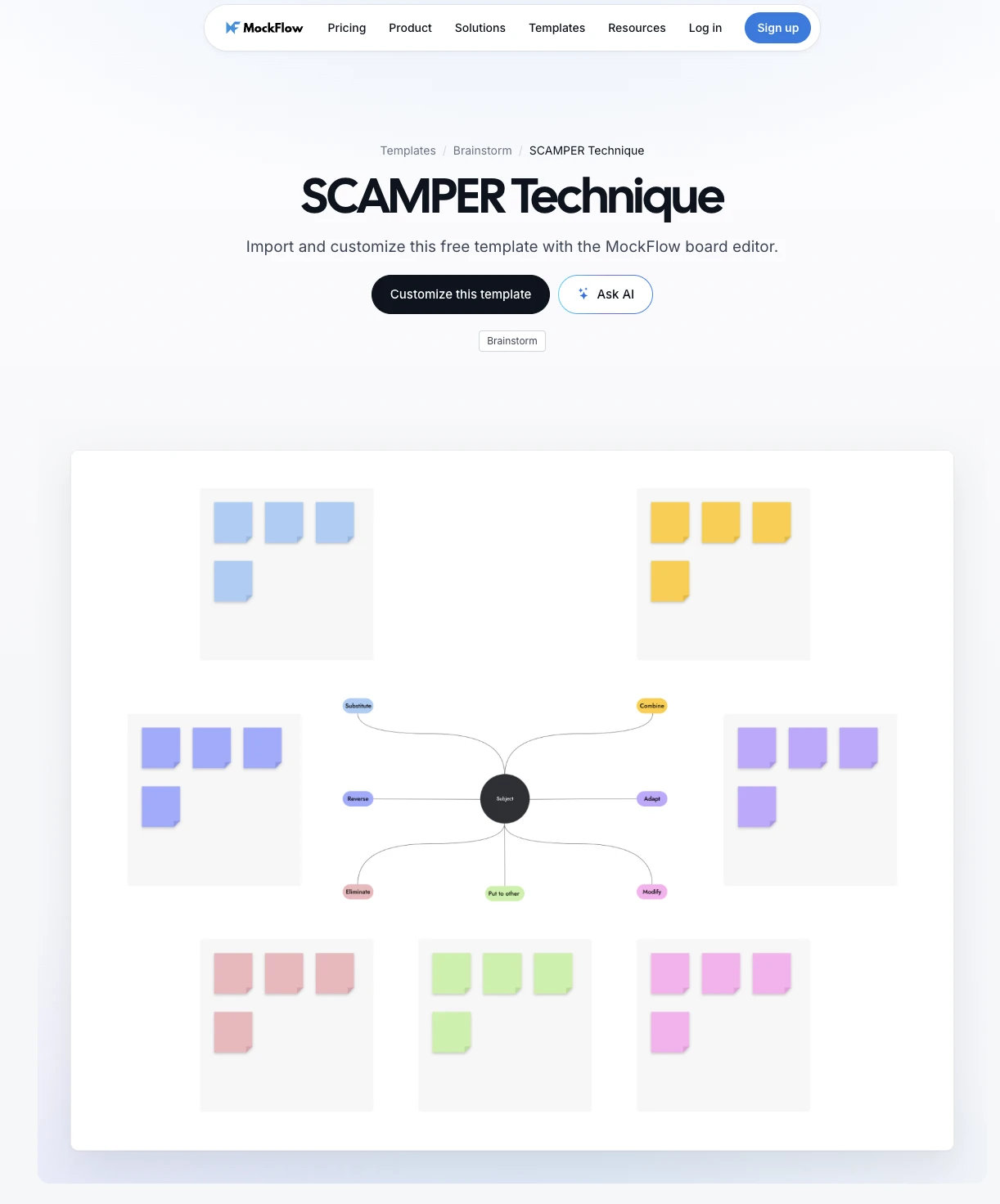
Click to customize this SCRAMPER technique template
Keeping suggestions separate encourages different improvement ideas instead of revisiting similar ones.
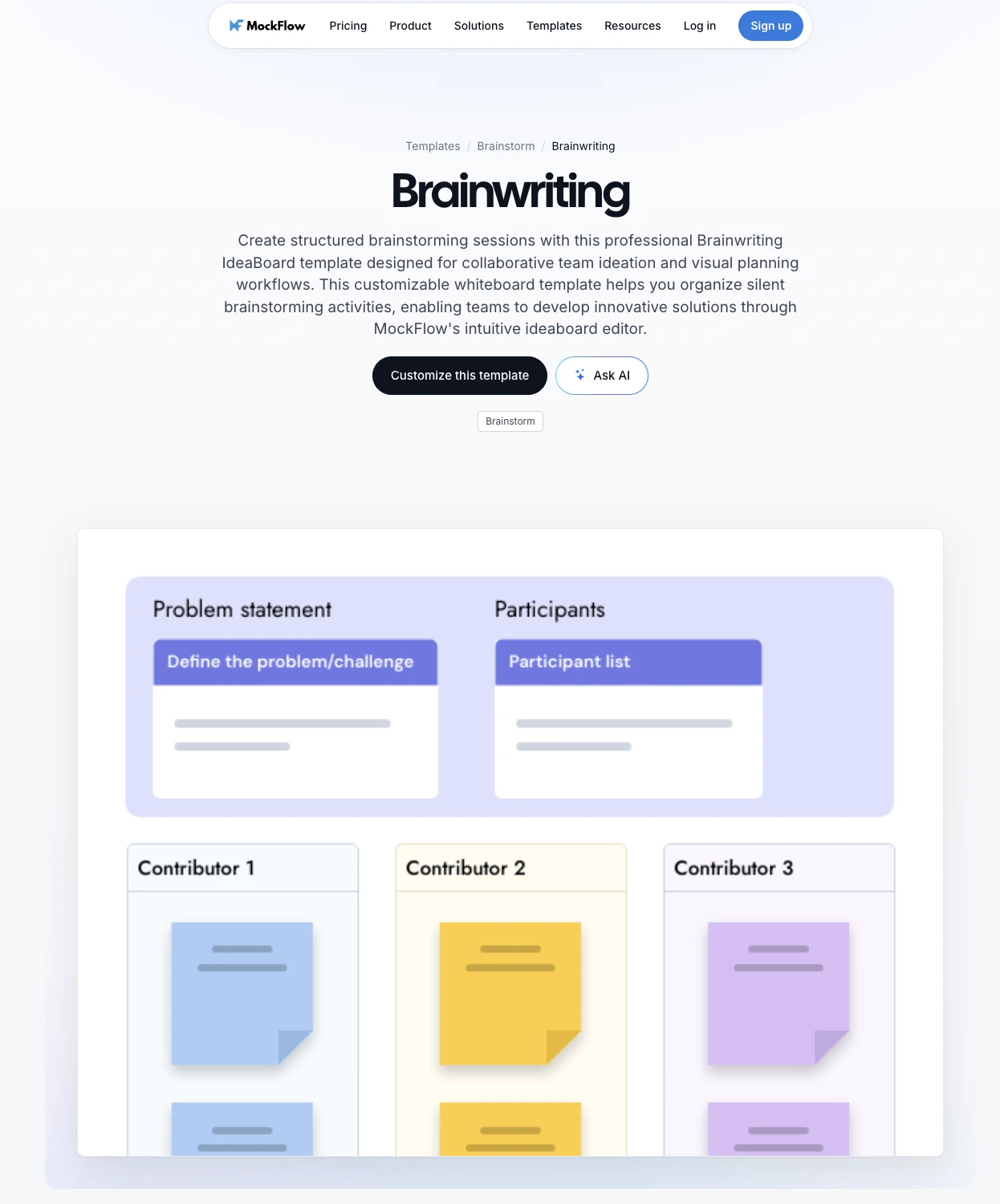
Rapid ideation encourages generating multiple ideas within a limited time. Brainwriting lets participants develop suggestions independently before discussing them.
For a team with mixed seniority, the brainwriting template offers everyone a dedicated space to contribute before others build on their suggestions. Participants get time to think without interruptions, and quieter voices receive equal attention.
For workshop preparation, Mida, MockFlow's AI agent, can create an initial brainstorming board from a prompt. A facilitator could request separate areas for individual ideas and group discussion, then adjust the layout to fit the session.
5 convergent thinking techniques and activities
These techniques are most useful when teams have gathered enough ideas and need a reliable way to determine what deserves attention.
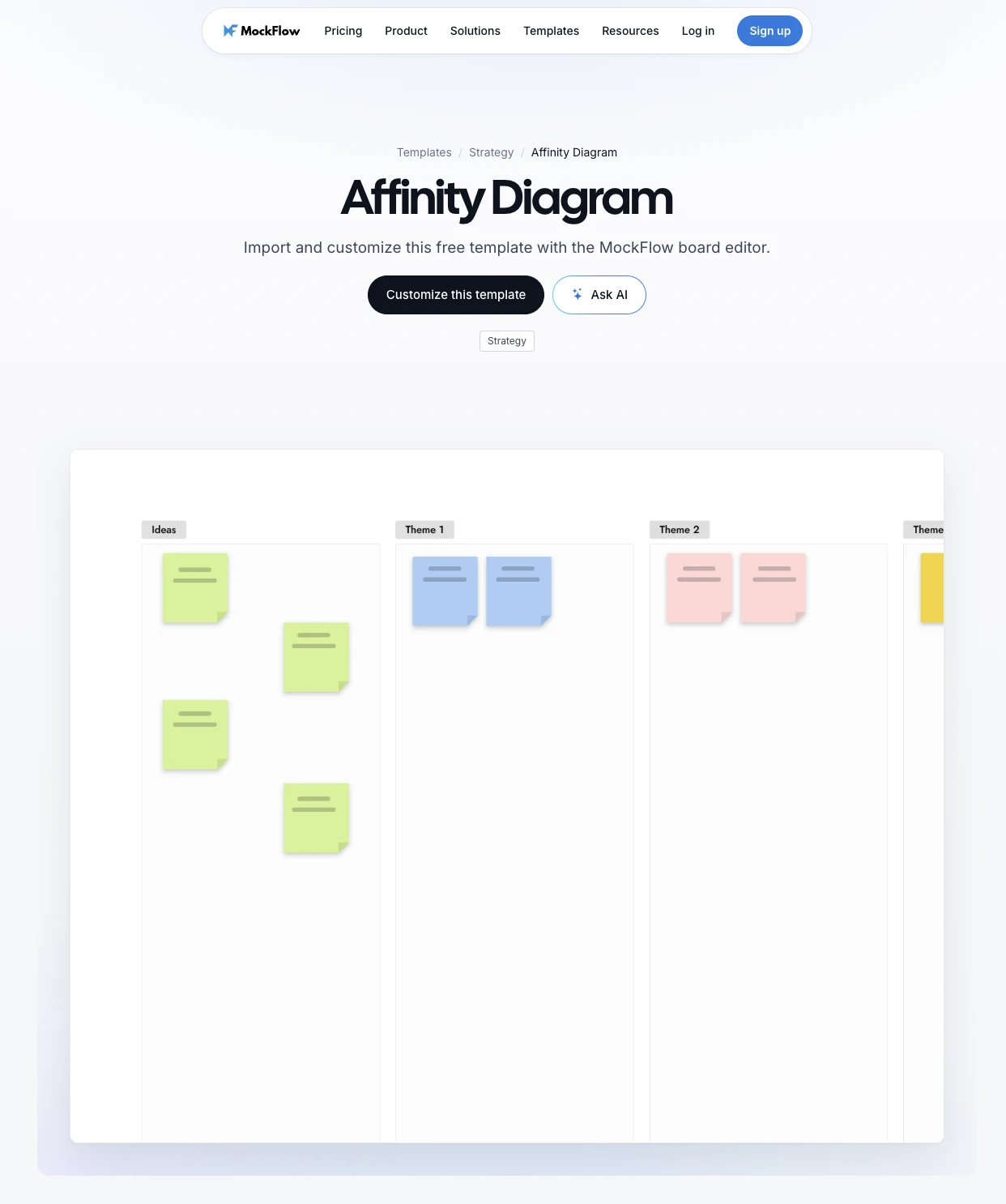
Affinity diagramming groups related observations into categories to reveal recurring patterns.
After gathering customer feedback, the affinity diagram template helps teams arrange individual comments into clusters. For instance, grouping repeated complaints about confusing navigation makes a recurring usability issue easier to recognize and investigate.
Click to customize this affinity diagram template
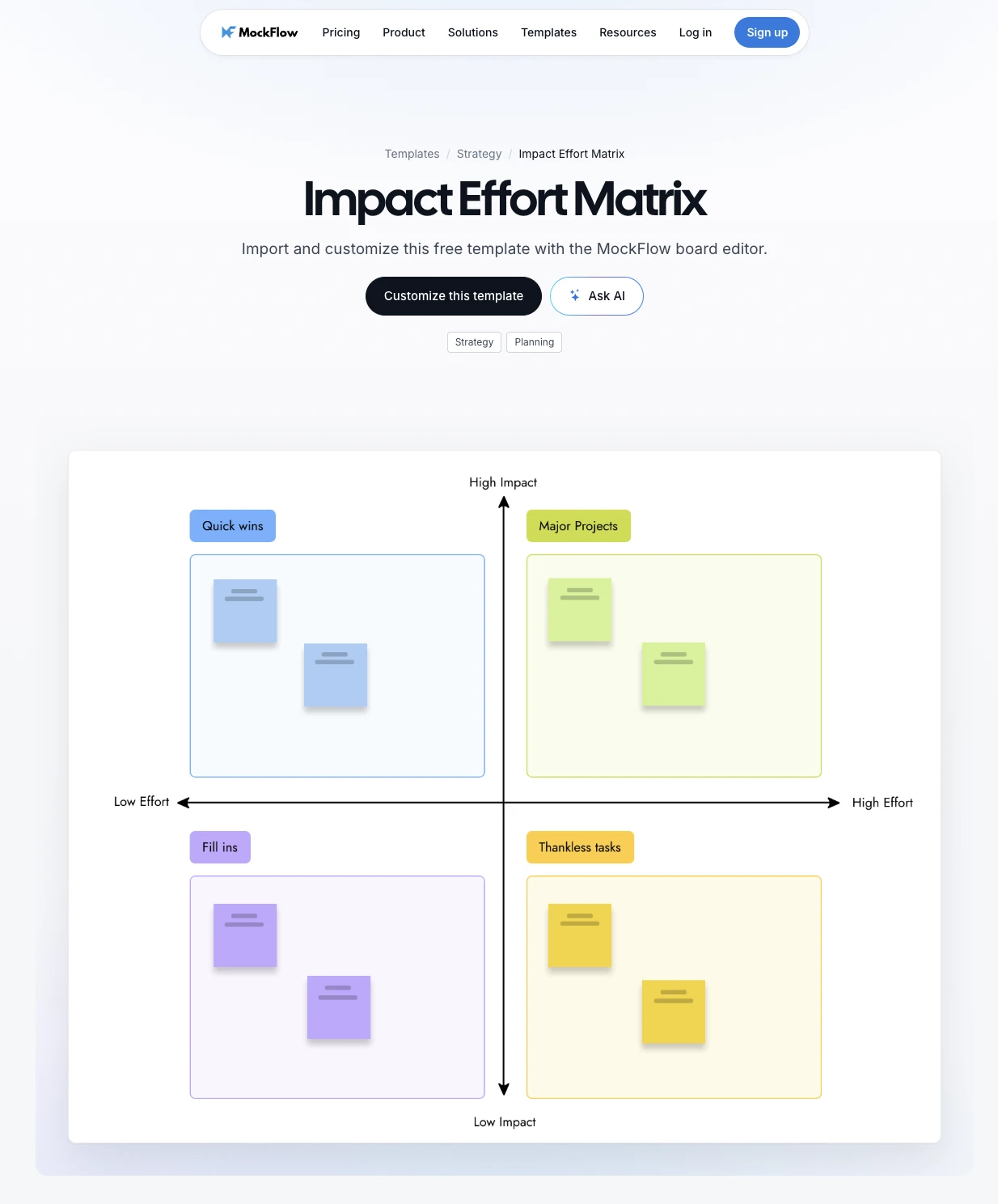
An impact-effort matrix compares ideas according to expected impact and implementation effort.
When prioritizing product improvements, the impact-effort matrix template lets teams position proposals in four quadrants. Discussing each placement helps them identify achievable improvements and recognize initiatives whose implementation costs outweigh their likely benefits.
Click to customize this impact effort matrix template
Prioritization becomes more reliable when teams identify the assumptions behind each proposal. Before selecting an idea, document what must be true for it to succeed, assess the uncertainty involved, and prioritize validating the riskiest assumptions rather than relying on impact and effort scores alone.
A decision matrix helps teams compare alternatives using consistent criteria, such as cost, feasibility, and user value. Each option receives a score, with greater weight assigned to factors that matter most to the decision.
For example, when choosing between software solutions, a team can score each option against its requirements and calculate the weighted totals. This makes trade-offs easier to understand and helps the team select a solution based on its priorities rather than personal preferences.
Dot voting helps teams narrow down a large collection of ideas by giving each participant a limited number of votes. It is particularly useful when several promising suggestions compete for attention and the group needs to agree on what to explore further.
For example, a product team preparing for a launch has proposed several activities, but the available budget and timeline won't accommodate all of them. The dot voting product launch priorities template helps bring these proposals into one shared space, where participants can compare options before voting.
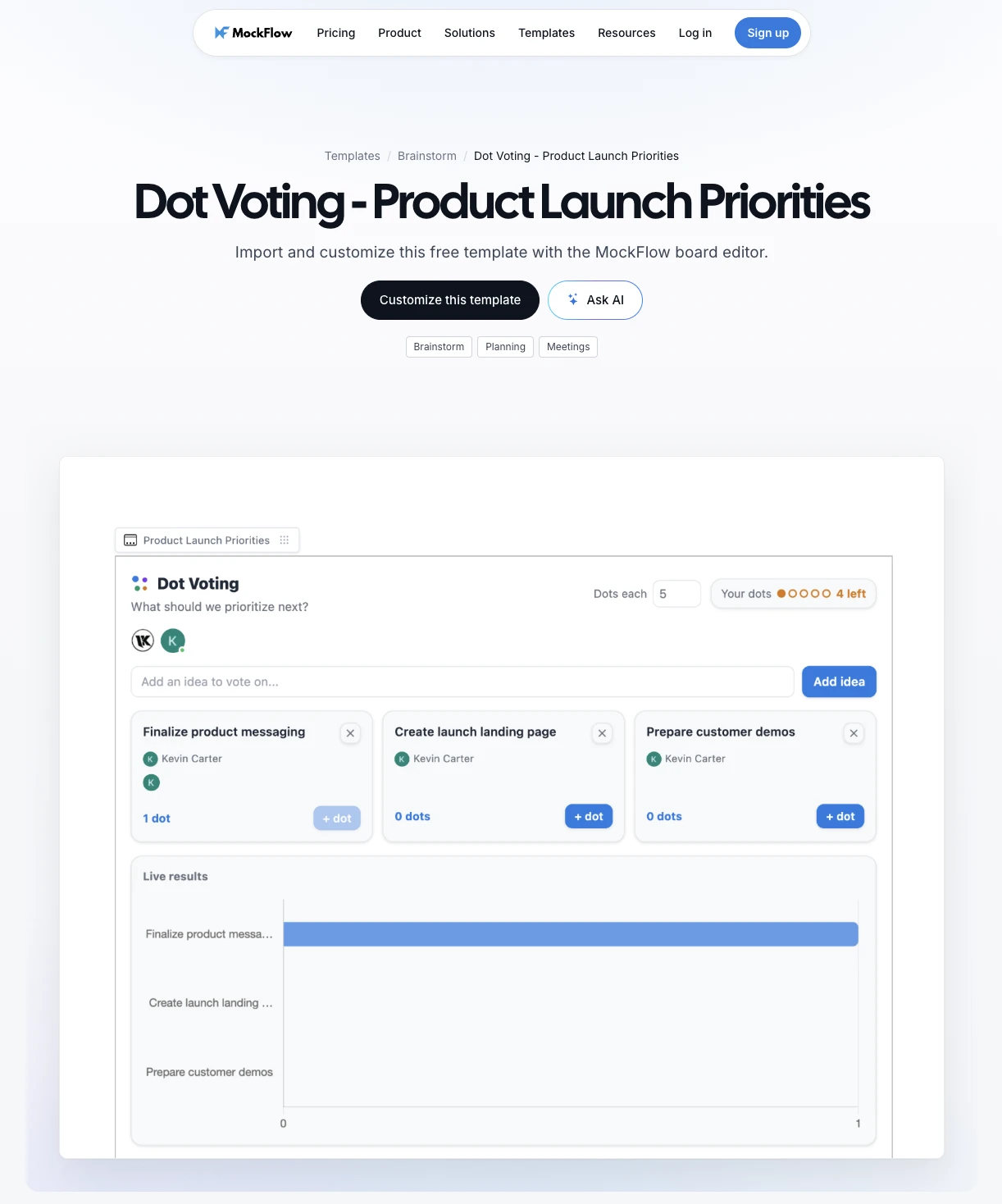
Click to customize this dot voting template
Participants can then use the interactive dot voting artifact to distribute their votes independently, reducing the influence of seniority or dominant voices on the initial shortlist.
When collecting suggestions from different departments, introduce a standardized idea submission process that captures the problem, affected users, expected business outcome, and consequences of inaction. Review submissions against these shared criteria before voting so decisions reflect their potential value rather than the influence of individual stakeholders.
SWOT analysis examines strengths, weaknesses, opportunities, and threats when evaluating a proposed strategy.
For a business considering market expansion, the brand SWOT analysis template provides four distinct areas for collecting evidence. Separating internal capabilities from external market conditions helps prevent unrelated observations from influencing the same decision.
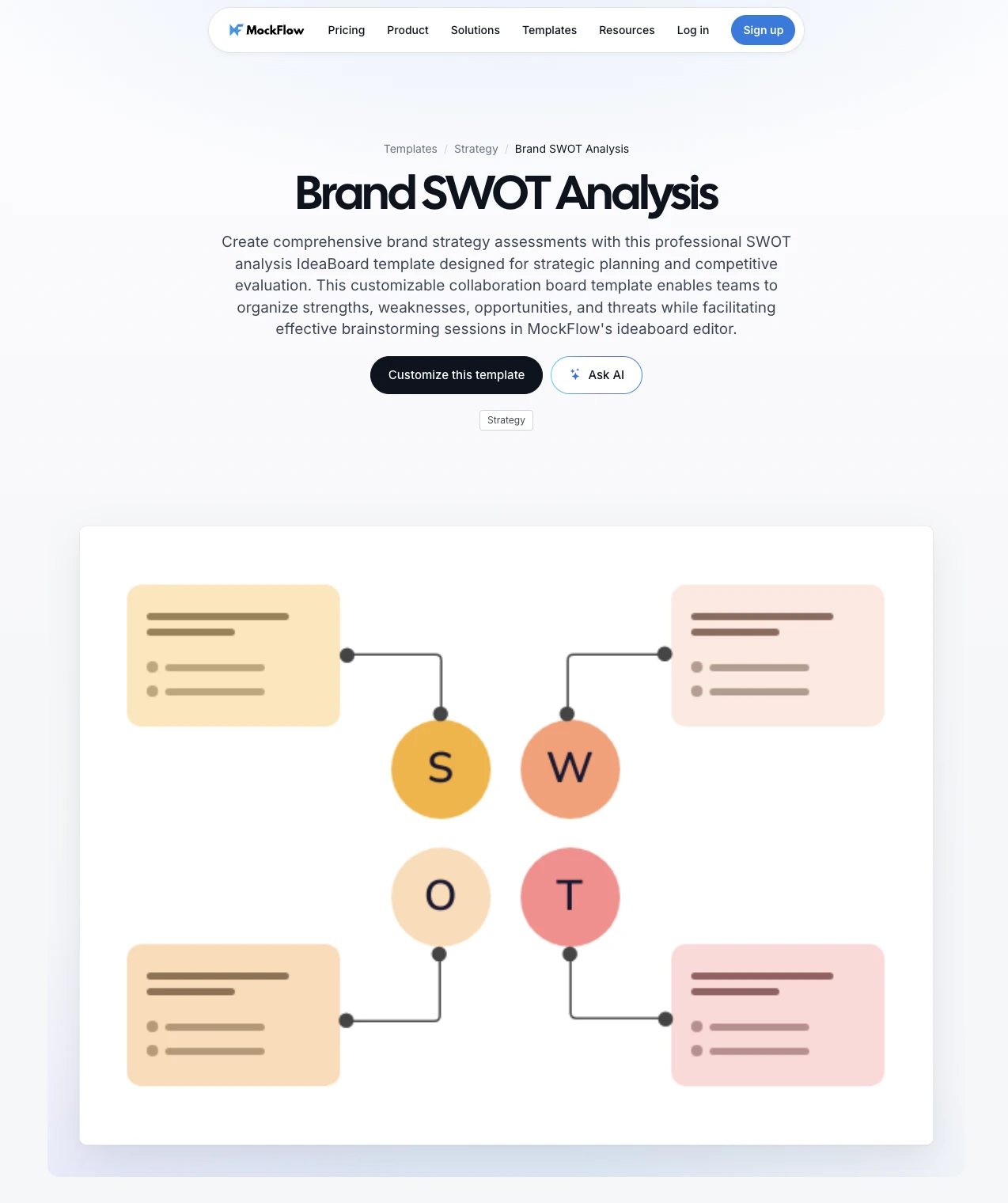
Click to customize this brand SWOT analysis template
When the team needs to examine its findings further, two resources are useful:
- SWOT Strategist: Helps teams develop a more structured assessment when they're struggling to identify relevant strategic factors or examine their implications.
- SWOT analysis mind map prompt: Helps organize SWOT findings visually so participants can examine connections, such as whether an existing strength gives the business an advantage in a new market.
Together, these activities help turn a broad strategic assessment into a more focused discussion about which opportunities deserve investment.
How to combine divergent and convergent thinking for creative problem-solving
The Double Diamond framework offers a practical way to combine divergent and convergent thinking during creative problem-solving. Commonly used in design thinking, it divides the process into two cycles of exploration and evaluation.
The first diamond focuses on understanding the problem through Discover and Define. The second focuses on developing and refining solutions through Develop and Deliver. Each diamond begins by expanding possibilities and then narrowing them based on what the team learns.
Here's how the four stages work together, using a mobile app's onboarding experience as an example.
Step 1: Discover and explore the problem through divergent thinking
The Discover stage begins with understanding what users are experiencing before deciding what's causing the problem.
Teams gather feedback and examine user behavior to explore different explanations. Open-ended questions such as "Where do users feel confused during onboarding?" help reveal issues that aren't immediately obvious.
Example: A product team notices that many users abandon onboarding halfway through. Instead of assuming the signup form is too long, they investigate several possibilities:
- Confusing instructions that leave users unsure what to do next
- Navigation issues that make important actions difficult to find
- An unclear explanation of the app's value
Gathering perspectives from users and internal stakeholders helps the team develop a fuller understanding of the problem.
Step 2: Define the problem through convergent thinking
During Define, the team organizes its research findings to identify which issues have the strongest supporting evidence. Related observations are grouped, recurring patterns are examined, and possible causes are compared against user feedback and usage data.
Example: The team discovers that users frequently abandon onboarding when instructions fail to explain the next action. Their findings lead to a specific problem statement: "New users struggle to complete onboarding because key instructions are unclear."
A clearly defined problem gives everyone a shared focus and prevents the team from spending time developing solutions for less significant issues.
When teams disagree on possible solutions, start by establishing a shared problem statement. Ask stakeholders to agree on the problem, who it affects, and the desired outcome before brainstorming solutions. This prevents teams from developing ideas around different interpretations of the same challenge.
Step 3: Develop potential solutions through divergent thinking
With the problem defined, the Develop stage encourages teams to explore different ways of addressing it. Designers, product managers, and engineers can contribute alternative experiences without immediately judging implementation difficulty.
For collaborative sessions, the MockFlow prompt library offers AI prompts that help create visual brainstorming structures. A team exploring onboarding improvements can start with a structured board to capture different proposals and develop them together.
Example: The team considers guided onboarding, interactive tutorials, contextual tooltips, simplified instructions, and a redesigned first-use experience. Seeing these alternatives together helps participants build on suggestions before deciding which deserve further evaluation.
Step 4: Evaluate, deliver, and refine solutions through convergent thinking
During Deliver, the team compares proposed solutions based on user impact, implementation effort, and available resources. The most promising options are then prototyped and tested to understand whether they address the identified problem.
Example: The team prioritizes contextual tooltips because they address confusing instructions without requiring a complete onboarding redesign. After testing, they examine whether more users complete onboarding successfully.
- If testing shows improvement: The team can refine the tooltips and prepare them for implementation.
- If users continue struggling: The team can revisit its findings, investigate remaining issues, and explore alternative solutions.
The Double Diamond allows teams to revisit earlier stages whenever new information challenges their assumptions. Switching between exploration and evaluation helps them make progress while remaining open to better solutions.
Benefits and limitations of divergent and convergent thinking
Neither divergent nor convergent thinking is better in every situation. Each brings a different strength to creative problem-solving, and understanding their limitations helps teams avoid getting stuck in endless brainstorming or committing to decisions before they've explored enough possibilities.
Aspect | Divergent thinking | Convergent thinking |
Creativity | Encourages original ideas and unexpected approaches | Refines creative ideas into solutions that meet practical requirements |
Problem exploration | Reveals different perspectives and overlooked possibilities | Identifies which findings are most relevant to the problem |
Collaboration | Gives participants room to contribute different viewpoints | Helps teams reach agreement on priorities and next steps |
Decision-making | Produces alternatives but doesn't establish which one to choose | Provides a basis for comparing options and making informed choices |
Main strength | Encourages innovation by challenging familiar approaches | Brings clarity by connecting decisions to evidence and objectives |
Main limitation | Too many ideas can make it difficult to establish priorities | Early evaluation can discourage unconventional ideas before they're fully explored |
Best balance | Set a clear point for reviewing and narrowing ideas | Allow sufficient exploration before applying selection criteria |
The challenge is knowing when to move between the two. Too much divergence makes prioritization difficult, while premature convergence can leave better ideas unexplored. Setting separate periods for exploration and evaluation helps teams stay creative while making well-informed decisions.
How MockFlow helps teams use divergent and convergent thinking
MockFlow is an AI-powered visual brainstorming and collaboration platform that helps teams turn ideas into actionable plans. With an infinite whiteboard, mind mapping, ready-made templates, real-time collaboration, and AI-assisted board creation, teams can explore possibilities and evaluate solutions in the same workspace. This makes it easier to switch between divergent and convergent thinking without losing ideas or the reasoning behind important decisions.
Here's how MockFlow supports each stage of the process:
- Explore ideas collaboratively: MockFlow's infinite canvas lets participants contribute sticky notes, build mind maps, and connect related ideas in real time. Ready-made brainstorming templates reduce preparation time and help facilitators focus on getting everyone involved.
- Get started faster with AI: Mida, MockFlow's AI agent, helps generate brainstorming structures from simple prompts. For example, asking it to "Create a brainstorming board for improving mobile app onboarding" gives teams a visual starting point they can expand and refine. MockFlow AI helps reduce the effort of setting up sessions.
- Keep recurring activities consistent: The AI prompt box and AI recipes help teams reuse prompts for activities such as exploring feature alternatives or reviewing workshop notes. This saves preparation time while maintaining a familiar structure across sessions.
- Make prioritization easier: Teams can organize brainstormed ideas using affinity diagrams, then compare shortlisted options with impact-effort matrices from MockFlow's template library. Interactive voting helps identify group preferences before evaluating the strongest proposals against practical requirements.
- Keep decisions open to refinement: Shared boards preserve earlier suggestions alongside current priorities. Team members can revisit alternatives, leave comments, and adjust their decisions as new feedback emerges, without having to reconstruct previous discussions.
Have a problem your team is trying to solve? Bring everyone together on MockFlow to brainstorm possibilities using sticky notes and mind maps, then use affinity diagrams and impact-effort matrices to identify which ideas are worth pursuing. Try MockFlow for free and put both thinking approaches into practice.
FAQs
1. Are people with ADHD divergent thinkers?
Some research has explored links between ADHD traits and divergent thinking, particularly the ability to generate original ideas and make unexpected connections. However, having ADHD doesn't automatically make someone more creative or a divergent thinker. Thinking styles vary among individuals, and creativity is influenced by many factors beyond attention-related traits.
2. What is the difference between divergent and convergent design thinking?
In design thinking, divergent thinking helps teams investigate user needs and explore different solutions. Convergent thinking helps them evaluate findings, define priorities, and select approaches worth developing.
The Double Diamond framework illustrates this relationship through two cycles: exploring and defining the problem, followed by developing and refining solutions.
3. What is an example of convergent thinking?
A product team has three feature proposals but enough resources to develop only one. They compare each feature's expected user impact, technical feasibility, and development effort.
Using an impact-effort matrix or a weighted decision matrix in MockFlow, the team can compare proposals visually, assess trade-offs, and identify which feature offers the greatest potential benefit within its available resources.
4. What is an example of divergent thinking?
A marketing team wants to increase engagement with an upcoming campaign. Instead of immediately choosing a familiar approach, they brainstorm several concepts, including interactive challenges, educational content, and community participation activities.
They explore these possibilities without judging them initially, allowing more creative directions to emerge before evaluation.
5. Is divergent thinking related to autism?
Divergent thinking is a cognitive process associated with generating different ideas, while autism is a neurodevelopmental condition.
Researchers have explored creativity and divergent thinking among autistic individuals, but findings do not establish a single thinking pattern shared by everyone with autism. Divergent thinking is neither a diagnostic characteristic of autism nor exclusive to autistic people.
6. Can we test divergent and convergent thinking with a quiz?
Yes, certain activities assess aspects of these thinking processes. The Alternative Uses Task examines divergent thinking by asking participants to suggest different uses for an everyday object. The Remote Associates Test assesses convergent problem-solving by asking participants to identify a word connecting three seemingly unrelated words.
Online quizzes can be useful for exploring how you approach problems, but they cannot definitively classify your thinking style or diagnose cognitive conditions.

How to Approach SaaS Product Design the Right Way
SaaS product design shapes how users experience your software from the first click to daily use. It goes beyond visual polish,...
Functional Decomposition Diagram: Step-by-Step Guide & Templates
Introduction A functional decomposition diagram helps you turn a system’s main purpose into a clear hierarchy of functions and...
Gap Analysis Example for Business, Projects, and Team Planning
Quick Answer: A gap analysis example shows how to compare a current state with a desired future state, identify performance or...
